Communication between people is often difficult. While worse when they do not speak the same language, it is even an issue for people who are personally close to one another, even spouses and partners. Often, one will think they have said something clearly but the other has not received the same message. In workplace and social situations. I don’t know whether being less close makes it worse (because the other person doesn’t share all your assumptions), or better (because you don’t assume that the other person does).
I do know that paying attention to this issue is generally helpful, particularly by not assuming that every person that you talk to is coming from the same place you are. There is an entire discipline of “Communication” dedicated to improving it. Communications professionals work with companies to “message” (or, probably better, “advertise”) effectively, in workplaces and interpersonal and familial and intimate relationships. They also help media, including health and medical media, even the old-fashioned written word or article, to be more clear and effective.
In healthcare, communication is crucial. You need to understand what your doctor or other health professional is telling you, not just the words (forget language differences!) but the meaning. Not just the literal meaning of the words, but the meaning that the speaker is attaching to it, and, presumably, hopes you understand. What condition do you have? Does it have a name? What is that in plain language? How sure are they?* What is the likely course of the condition? Will it get better or get worse? Are there treatments that can make it better? Cure it? Ameliorate it? Will they make the underlying condition better or relieve the symptoms? What happens if you don’t take the treatment? Are there alternatives? What would be the side effects of the treatment? Are there tests that can make the diagnosis more or less certain, or can help predict the likely course and outcome? And what is the cost – in actual money, for sure, but also in the possibility of a false positive or false negative result?**
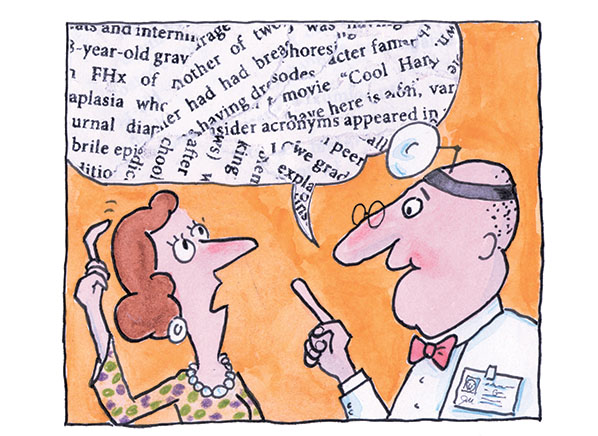
Effective communication takes work and time, and often healthcare providers do not have much time. There are things, however, that the provider can do to communicate more effectively, to make it more likely that the person that they are caring for (the patient) understands as much as possible.
1) Speak English (or whatever your shared language is) and not Medical. This is often difficult for medical people, because they have worked very hard to learn Medical, starting when they were students. Knowing the technical names for body parts and diseases, and especially acronyms, makes them feel that they are part of the team, shows their residents and attending physicians that they know what is going on. I am sure that a similar thing happens in many other professions, such as law and engineering. The problem, of course, is that regular people probably do not understand Medical very well, just as doctors don’t understand Legal or Engineering. They haven’t learned it. But you speak English, you used it before you were in medicine and still use it in other areas of your life. You can speak it. You can explain what is going on in English. You can translate the acronyms and eponyms and other -nyms. A little difference in a word can make a lot of difference in meaning – think of whether people hear the “not” or “usually”. Plus, Medical, like other languages, has a lot of words that sound kind of the same but mean very different things. “Orthopedist” vs “orthodontist”? Be clear.2) Remember that some words mean something different in Medical than in regular English. In Medical, a “negative” test is good; it means that whatever it was checking for (usually something bad) was not there. But in English, “negative” is, well, negative. Try using words that mean the same in both languages, like “the test came out good”.
3) Don’t obfuscate. When the medical professional is not sure what is going on, or when they are sure but are afraid you will be freaked out if you understand it, they may, like other people in similar situations, try to hedge and blur what they are saying. In this quest, the use of Medical can be very helpful -- except it is the wrong quest. Say what you mean, say it clearly. If it is bad news, you can say it as nicely as possible, you can try to make it easier to take, perhaps even “sugarcoat” it, but don’t lie and don’t hide behind the jargon.
4) Don’t go too fast. Don’t overwhelm people. Remember that some information takes time to digest. You know what you are going to say, but they don’t. After you say “you have cancer” (however tactfully you put it), it is likely that the person is not going to hear whatever you say next. Wait, repeat, check. Be compassionate, and take time. The worse that the news is for the person receiving it, the more time they deserve to have you take.
5) Check to see that the person understands. “Do you understand?” is not adequate. Ask them to tell you what they understand, in their own words.
There are also things that the other person, the patient, can do to help facilitate communication. While I think it is primarily the responsibility of the medical professional, since they are the one in possession of the information, and are not the sick-and-thus-vulnerable person, and generally have more power in the interaction, the patient can help themselves. Listen. Do not assume that you already know the answer (“it’s bad. It’s cancer”) but listen. Sometimes, you’re wrong. Sometimes, even if you’re right, your mind is moving so fast (“I’m going to die”, “I don’t want surgery”, “How will I tell my family?”, etc.) that you miss other important information. I have suggested that the doctor or other medical professional go slow here, but if they don’t, you can try to slow them down, ask for explanations, ask for repetition. After all, it’s your life. Having another person that you trust, such as a family member, can be helpful. It is two sets of ears. It is someone else who might be able to ask clarifying questions when you cannot. It is someone else who might hear things differently from you, and maybe, between what you both hear, you can come to a better understanding later
Some folks will say “I don’t care so much if my doctor is a great communicator, I just want them to be a good doctor.” Communication is part of being a good doctor. Even for a surgeon. I have had family members who had complications after surgery which were not communicated to them, but were the reason why some bad things happened. As with much else, poor communication is more common when people are not native English speakers, when they have less education, and when they generally feel less empowered to ask questions. It should be the doctor’s role to anticipate this and proactively address concerns and encourage questions and encourage the patient to restate the information in their own words.
But, if the medical professional isn’t going there, you, the patient, can help them along by trying to be open and effective in your own communication strategy.
*How sure is one example of probability, a part of statistics, and while the concept may seem abstruse and the idea of understanding statistics daunting to some, it is critical. If a doctor makes a diagnosis of your condition, do they think it is 100%? 90%? 50%? Shouldn’t knowing this make a difference to you?
**More statistics and epidemiology. But think about this: “tests” that can have false positive or negative results are not just done in radiology and the laboratory. If a doctor performs a physical exam, or asks you a question, it is a kind of test. If asked if you drink alcohol, say, your answer may be a false negative (you say you don’t, but you do). It happens.


No comments:
Post a Comment