Sunday, September 27, 2026

IMPROVED and Expanded Medicare for ALL. Now. The people want it!

I am in favor of the US having Medicare for All, specifically Improved Medicare for All, as defined in the two bills currently before the Congress: S 1506, sponsored by Sen. Sanders and 18 cosponsors, and HR 3069, sponsored by Rep. Jayapal with 117 co-sponsors. It is important to emphasize the “improved” part, because the deficiencies of current Traditional Medicare (TM), of which there are many, have been used by opponents of Medicare for All, to argue against it and to push various methods of privatizing Medicare, particularly Medicare Advantage and the WiSER program.

The deficiencies in the current TM program involve what is covered and cost. Some things are not covered by TM, including glasses, hearing aids, and nursing homes. This is ridiculous and is due to lobbying pressure by those industries, which want to ensure their profitability. Cost issues include, prominently, 3 things: Part B premiums (which are scaled to income, but start at $203 a month), Part D premiums (thanks to the GW Bush administration, Medicare now requires beneficiaries to have drug coverage, but also requires that it be purchased from a private insurer, and is not available from the federal government), and Medicare Supplement plans, which pay for the portion of covered services that Medicare does not. This is different from the services Medicare does not cover, like hearing aids or glasses, which the Supplement plans also do not. It is, most significantly, the 20% of a hospital’s Medicare-approved charge that Medicare doesn’t pay for. A hospital may normally charge, say, $40,000 for a stay including surgery and post-op care, but Medicare has an approved charge, say $10,000, and that’s all the hospital can bill the Medicare beneficiary. But then Medicare pays only 80%, so the patient is on the hook for $2,000. That’s largely what Medicare supplement plans cover.

So, the Part B and Part D premiums, and the need to buy a Medicare Supplement from an insurance company, can cost a good deal. This can make Medicare Advantage plans, which are basically HMO or PPO insurance products sold by the same companies that issue commercial insurance, and cover drugs as well as 100% of hospitalizations, look financially attractive. Plus, they also cover hearing aids, glasses, and sometimes dental. And even gym memberships! The potential disadvantage is that they are insurance company products and subject to the same limitations as most commercial HMO/PPO products. The most important are:

  •          Limited networks. Only some doctors and hospitals are in the network they pay for. Yours may not be. Or your hospital may be, and your doctor may be, but the ER doctors who care for you in the hospital are not. Or the anesthesiology group. Surprise charges! And most are geographically based, like most HMOs and PPOs, so it may be hard to get non-emergency care away from your home area. And some “destination” hospitals, such as Mayo and MD Anderson, do not accept MA. Virtually all doctors and hospitals accept TM.
  •  Denials. Most people who have commercial insurance have experienced denials of claims. Often it seems as if denial is the default (perhaps AI generated). These decisions can be appealed, but most people don’t appeal. And then it can be denied again, multiple times, for little or no reason. It is part of the business model of health insurance companies. For TM, a covered service is a covered service. It cannot be denied.

It’s not as if this will always happen with MA; as with other insurance products, the coverage varies. But it happens a lot, and unsurprisingly, happens most often to those with the lowest-cost products as it does with non-Medicare commercial insurance.

So, the Improved part of Medicare for All is crucial. It needs to cover all necessary health services, not just hearing aids and glasses, but nursing homes and rehabilitation and comprehensive mental health and dental health. All the things that have been cut out as sops to powerful lobbies. And it needs to cover 100%, not 80%, of approved charges. And let me not leave out the All part. That means everyone, birth to death, no exceptions, no carve-outs, no people or groups of people who are in a different plan, no Medicaid, no ACA. Just one program that covers all of us for everything. A single-payer, universal health insurance plan. Like every other wealthy, and most middle-income countries, have.

But Americans don’t support this, right? Well, actually, they do. Recent polling from GQR reveals 94% of Democrats support M4All! And yet Rep. Hakeem Jeffries, the House Democratic leader has recently joined other prominent “mainstream” “centrist” Democrats in announcing his opposition to it, instead favoring yet more inadequate piecemeal “reforms”. Rep. Jeffries: Get with the program! 94% is more than a lot. It is almost all! And it is not just Democrats: GQR also reports

 Massive support among base voters:

● 94 percent among Democrats;

● 94 percent among self-ascribed somewhat liberals;

● 73 percent support among Black voters;

● 76 percent support among women under age 50; and,

● 75 percent support among voters under age 30.


Impressive support among swing voters and notable support among Republicans:

● 60 percent among Independents;

● 67 percent among moderates;

● 60 percent among non-college women;

● 66 percent among college educated men; and,

● One in five (19 percent) Republicans and Trump voters support MFA.

Hmm. It is almost as if the Democratic leadership is not interested in welfare of the American people. It almost seems as if, rather, they are interested in appeasing their big donors.

Think about it. When you look at your own experiences with the healthcare system and health insurance companies, and those of your friends and family, it is scarcely a surprise that Americans hate the current system and are not particularly interested in partial solutions which cover some people for some things by method A, and others by method B, and still others by insurance so poor it covers little (method C), or others not at all (method D). The Commonwealth Fund reports that one-third of Americans 19-64 (pre-Medicare) are paying off medical debt, 46% of whom owe at least $2,000, and more than 1/3 used part or all of their savings to try to pay it off.

In addition, millions of Americans are experiencing “job lock”, a situation in which people feel that they have to stay in their current job to maintain their health insurance, rather than being able to find a better job or start a business. ValuePenguin reports that this amounts to 40% of US adults! Wendell Potter, in his “Health Care Un-Covered” correctly notes that the ACA does not solve this problem, nor does any hodgepodge approach. This concept is something that is completely absent from people in other countries -- because they have universal health insurance.

The American people are not interested in partial fixes anymore. They want to have freedom to work where they want and not have their lives ruined by medical debt so that health insurance companies can rack up even more profit (why would they?). They want the comprehensive, easy to understand, effective type of universal health insurance that has been proven to work, in many forms, in most other countries.

It is past time for Improved Medicare for All!

Thursday, September 17, 2026

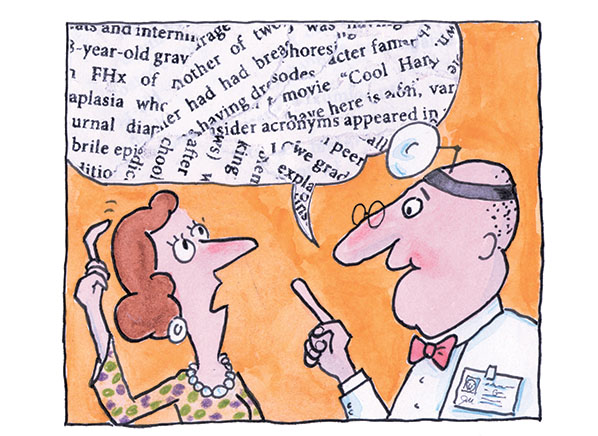
Communication between health care professionals and patients: Not always easy

Communication between people is often difficult. While it is worse when they do not speak the same language, it is even an issue for people who are personally close to one another, including spouses and partners. Often, one person thinks they have said something clearly but the other has not received the same message. It also happens inn workplace and social situations. I don’t know whether being less close makes it worse (because the other person doesn’t share all your assumptions), or better (because you don’t assume that the other person does).

I do know that it is generally helpful to pay attention to this, particularly by not assuming that every person that you talk to is coming from the same place you are. There is an entire discipline of “Communication” dedicated to improving it. Communications professionals work with companies to “message” (or, probably better, “advertise”) effectively, in workplaces and interpersonal and familial and intimate relationships. They also help media, including health and medical media, even the old-fashioned written word or article, to be more clear and effective.

In healthcare, communication is crucial. You need to understand what your doctor or other health professional is telling you, not just the words (forget language differences!) but the meaning. Not just the literal meaning of the words, but the meaning that the speaker is attaching to it, and, presumably, hopes you understand. What condition do you have? Does it have a name? What is that in plain language? How sure are they?*  What is the likely course of the condition? Will it get better or get worse? Are there treatments that can make it better? Cure it? Ameliorate it? Will they make the underlying condition better or relieve the symptoms? What happens if you don’t take the treatment? Are there alternatives? What would be the side effects of the treatment? Are there tests that can make the diagnosis more or less certain, or can help predict the likely course and outcome? And what is the cost – in actual money, for sure, but also in the possibility of a false positive or false negative result?**

Patient Communication - MHVI 

Effective communication takes work and time, and often healthcare providers do not have much time. There are things, however, that the provider can do to communicate more effectively, to make it more likely that the person that they are caring for (the patient) understands as much as possible.

1)    Speak English (or whatever your shared language is) and not Medical. This is often difficult for medical people, because they have worked very hard to learn Medical, starting when they were students. Knowing the technical names for body parts and diseases, and especially acronyms, makes them feel that they are part of the team, shows their residents and attending physicians that they know what is going on. I am sure that a similar thing happens in many other professions, such as law and engineering. The problem, of course, is that regular people probably do not understand Medical very well, just as doctors don’t understand Legal or Engineering. They haven’t learned it. But you speak English, you used it before you were in medicine and still use it in other areas of your life. You can speak it. You can explain what is going on in English. You can translate the acronyms and eponyms and other -nyms. A little difference in a word can make a lot of difference in meaning – think of whether people hear the “not” or “usually”. Plus, Medical, like other languages, has a lot of words that sound kind of the same but mean very different things. “Orthopedist” vs “orthodontist”? Be clear.
2)    Remember that some words mean something different in Medical than in regular English. In Medical, a “negative” test is good; it means that whatever it was checking for (usually something bad) was not there. But in English, “negative” is, well, negative. Try using words that mean the same in both languages, like “the test came out good”.
3)    Don’t obfuscate. When the medical professional is not sure what is going on, or when they are sure but are afraid you will be freaked out if you understand it, they may, like other people in similar situations, try to hedge and blur what they are saying. In this quest, the use of Medical can be very helpful -- except it is the wrong quest. Say what you mean, say it clearly. If it is bad news, you can say it as nicely as possible, you can try to make it easier to take, perhaps even “sugarcoat” it, but don’t lie and don’t hide behind the jargon.
4)    Don’t go too fast. Don’t overwhelm people. Remember that some information takes time to digest. You know what you are going to say, but they don’t. After you say “you have cancer” (however tactfully you put it), it is likely that the person is not going to hear whatever you say next. Wait, repeat, check. Be compassionate, and take time. The worse that the news is for the person receiving it, the more time they deserve to have you take.
5)    Check to see that the person understands. “Do you understand?” is not adequate. Ask them to tell you what they understand, in their own words.

There are also things that the other person, the patient, can do to help facilitate communication. While I think it is primarily the responsibility of the medical professional, since they are the one in possession of the information, and are not the sick-and-thus-vulnerable person, and generally have more power in the interaction, the patient can help themselves. Listen. Do not assume that you already know the answer (“it’s bad. It’s cancer”) but listen. Sometimes, you’re wrong. Sometimes, even if you’re right, your mind is moving so fast (“I’m going to die”, “I don’t want surgery”, “How will I tell my family?”, etc.) that you miss other important information. I have suggested that the doctor or other medical professional go slow here, but if they don’t, you can try to slow them down, ask for explanations, ask for repetition. After all, it’s your life. Having another person that you trust, such as a family member, can be helpful. It is two sets of ears. It is someone else who might be able to ask clarifying questions when you cannot. It is someone else who might hear things differently from you, and maybe, between what you both hear, you can come to a better understanding later 

Some folks will say “I don’t care so much if my doctor is a great communicator, I just want them to be a good doctor.” Communication is part of being a good doctor. Even for a surgeon. I have had family members who had complications after surgery which were not communicated to them, but were the reason why some bad things happened. As with much else, poor communication is more common when people are not native English speakers, when they have less education, and when they generally feel less empowered to ask questions. It should be the doctor’s role to anticipate this and proactively address concerns and encourage questions and encourage the patient to restate the information in their own words.

But, if the medical professional isn’t going there, you, the patient, can help them along by trying to be open and effective in your own communication strategy.


*How sure is one example of probability, a part of statistics, and while the concept may seem abstruse and the idea of understanding statistics daunting to some, it is critical. If a doctor makes a diagnosis of your condition, do they think it is 100%? 90%? 50%? Shouldn’t knowing this make a difference to you?

**More statistics and epidemiology. But think about this: “tests” that can have false positive or negative results are not just done in radiology and the laboratory. If a doctor performs a physical exam, or asks you a question, it is a kind of test. If asked if you drink alcohol, say, your answer may be a false negative (you say you don’t, but you do). It happens.


Monday, September 7, 2026

Lies and cowardice screwing almost everybody's health care coverage

There is usually more than one way to look at a situation. Often referred to as “point of view”, it is good to consider this, particularly in personal relationships, as the way you see things might not be the way the other person does. In the Trump years most of us have become more aware of a different basis for disagreement, not based on different interpretation of the facts but upon different facts. This is not just a difference in emphasis-- you and I both believe X and Y are true, but I think X is more important than Y and you think Y is more important than X.

We are in a situation in which a large portion of the population believes lies are facts, believes that things that are not true are true. Of course, this has always been the case, like when most folks thought that the Earth was flat, or that the sun and stars revolved around the Earth. These were definitively disproved, we know the truth, and yet there are other just as ridiculously incorrect beliefs (and, here, I except, for brevity, religion) that many people still cleave to. Heck, there are still flat earthers! I doubt that most of the leaders of the Republican Party or members of the administration in Washington – or even Fox News commentators -- actually believe most of these falsehoods (except Donald Trump, who seems too demented or stupid or isolated or all three to know), but they find them convenient ways of keeping the public’s attention focused away from what they are doing to benefit themselves and their buddies. This could be called the “Wizard of Oz” technique, and misdirection is a core part of most magic acts, but it is also a core component of fascist tyrannies.

These outright lies in the Era of Trump are incredible, both in number and the real impact on people. In the area of health, the focus of this blog, they have been amazing in terms of their scope and impact. Vaccines, among the few actual preventive things that medicine can do, have been attacked and criticized and completely wrongly said to cause worse problems than they solve. Not to put too fine a point on it, this is pure evil coming from RFK, Jr. and his team of loons. Yes, there are individual people who should not get one or more individual vaccines, because of a serious prior allergic reaction, or even worse a rare effect like Guillain-Barre, but for the vast, vast majority of children and adults vaccines are all good. They basically eliminated smallpox from the world, and essentially eliminated terrible killers like measles in this country – until a new movement endorsed by the Secretary of HHS brought them back. Your measles as a kid wasn’t too bad? Neither was mine. But lots of kids got sick. A bunch died. You never had measles because you’re too young? Because even your parents are too young? And you all had vaccinations? Sadly, maybe you’ll see it in your children. Mumps made people deaf and infertile, meningococcus dead or brain damaged, H influenza the same. Polio made people dead or paralyzed, in wheelchairs or in iron lungs. When I was a medical resident, we saw H influenza meningitis and epiglottitis, meningococcal disease, even some measles and polio. All eliminated by vaccines. Until we stop using them.

Smallpox Epidemic, 1924–1925 | MNopedia  Measles - Wikipedia  Life in the Lung” photo exhibit – Melnick Medical Museum

Smallpox                                Measles               Polio (in iron lung)

There are many, many other health disasters promulgated (it seems on purpose) by this administration. Eliminating or cutting back infectious disease surveillance – cyclospora, E. coli, salmonella -- anyone? Enjoying that? How about animal diseases? And funding for medical research – being heavily cut back especially for researchers that the administration doesn’t like.

But one HUGE area is health insurance, financial coverage for our medical care. I have written about the terrible US health care non-system which is designed to make money for private corporations (insurance companies, big hospitals and health systems, Pharma) instead of being designed to deliver the best actual health care for our people, and how it needs to be replaced by a system of covering everyone, as in every other wealthy country – improved Medicare for All. People need financial coverage because all those big corporations are owned by investors who demand ever-increasing profits, so the costs of the overall system (highest in the world by far), and to individuals, keeps going up.

Under the current administration, the opposite is happening. In a recent editorial in the NY Times, the cuts to coverage are enumerated and documented. The most dramatic of these are cuts to the Medicaid program and the subsidies for purchasing individual insurance on the marketplace created by the Affordable Care Act (ACA, “Obamacare”). The Medicaid cuts target the most vulnerable and needy, the poor and disabled, and the cuts to the ACA subsidies means that the poor-but-not-quite-poor-enough-to-qualify-for-Medicaid population that was finally insured through ACA will lose it. (If you want to know how poor you must be to qualify for Medicaid, you can look it up by state, but it is always very poor. When you look it up, remember that while many states tie eligibility to about 135% of the Federal poverty level, many others have much lower qualifying incomes.) This is really bad because it is going to kill people, is going to strain many physicians and hospital systems – especially those that cannot afford it, like rural hospitals – and create a lot of misery.

There are several other bad things related to health coverage that the Times does not even address. One of these is the aggressive promotion of Medicare Advantage (MA) plans for Medicare eligible people. These plans are not actually Medicare, a federal government run program, but private insurance products that use Medicare money (and gets paid more per patient than traditional Medicare, TM). On the one hand, if you get a good, comprehensive MA plan it can save you money (with TM you probably need to pay for a Medicare supplement and Part D plan as well as the Part B premium taken from your Social Security payment). But it can also have bad results because the insurance companies that run it can, and often do, deny payment for your care, just as they do for regular insurance.

Another health insurance problem the Times does not address is the fact that even in the best situations (in those states that chose to expand Medicaid and before Trump), the ACA did not cover everyone. Both this and Medicare Advantage are also areas not addressed by those making policy for the Democratic Party. It is not coincidental that the Times and that portion of the Democratic Party called (depending on where you stand) “centrist”, “moderate”, “Wall St.” or “right-wing” are similar, because both share a similar ethos. This is to be better than the GOP on a lot of social issues affecting individuals but to not threaten the basic status quo: corporate America making a lot of profit, and enriching its investors, at the expense of the rest of us, particularly but not only the poor, who get screwed out of medical care and/or bankrupted by the bills. Oh, and, by the way, if you one of the majority of people who have employer-sponsored health insurance, you’re still not safe. Costs for insurance to employers (with much or all of the increase passed on to employees) is expected to go up 11% in 2027!

The “centrist” branch of the Democratic Party does not support eliminating or strictly regulating Medicare Advantage, not to mention Improved (covering everything) and Expanded (covering everybody) Medicare for All. The same tired and inadequate reasons are given: “we can’t afford it” --- ridiculous given that every other wealthy or middle-income country does -- when what they mean is “we don’t want to alienate the billionaires who continue to support us”. They say that they need to “be moderate” because they don’t want to turn off independent voters, which results in policies that do not significantly help most regular people. Like Improved and Expanded Medicare for All (see the Jayapal House, HR 3069, and Sanders Senate, S 1506, bills) would.

We should be terrified of what the Trump Administration and GOP are doing, especially trying to disenfranchise voters before the election, and the huge cuts to our health care. But voters are not going to be excited by “Republican lite”; they need to hear about bold programs that will change their lives for the better.

Total Pageviews