Showing posts with label Bodenheimer. Show all posts

Sunday, May 24, 2015

Health, Medicine and Justice published: available on Amazon


NOW
Available from Amazon, Barnes and Noble, and independent booksellers.
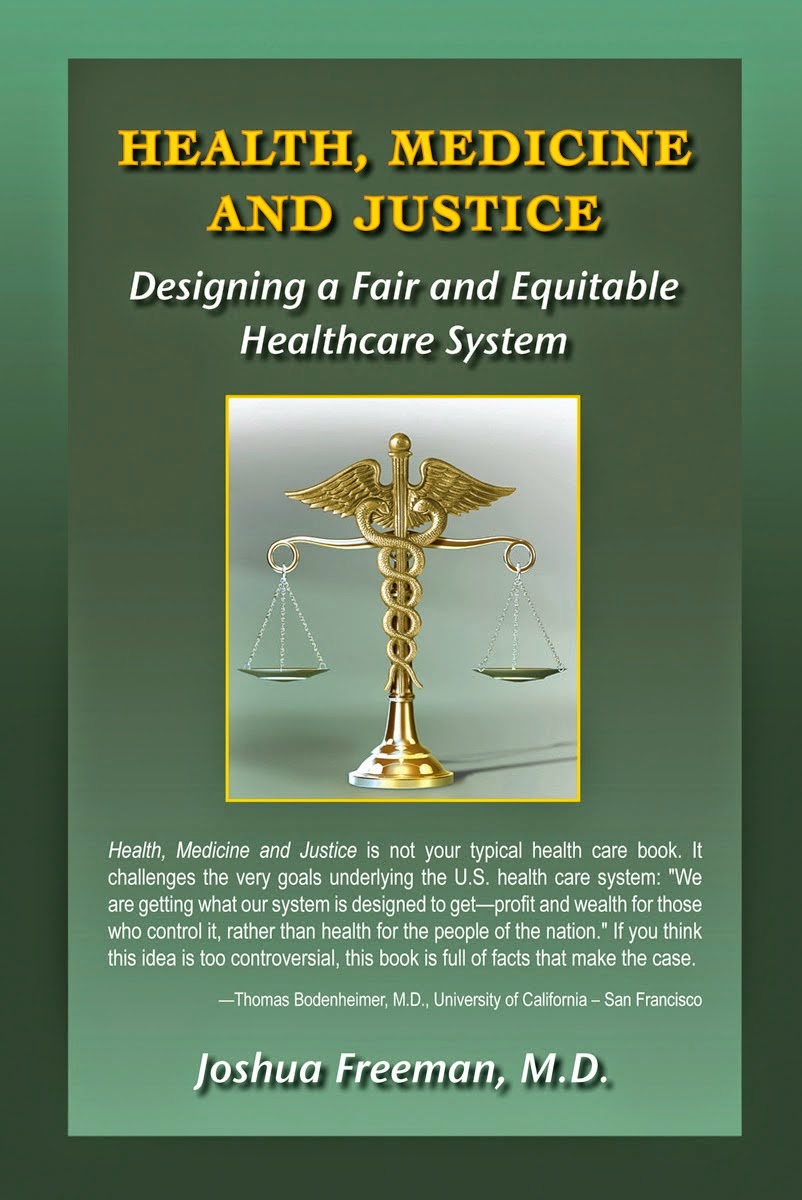


Health care delivery in the U.S. is a mess. We lead the world by far
in spending, but trail other developed countries in most health outcomes.
Our health care is disjointed, not coordinated, and seems
to be designed to maximize profits for insurers and health care
providers. These two groups usually seem to be in conflict about
which should get most of the money. While individual patients may
receive outstanding care, especially when it can be delivered profitably,
the population as a whole does not. Is the system not working,
or is it working too well to do the wrong thing? After all, “every
system is perfectly designed to get the results that it gets”.
In this book, Dr. Freeman argues that the problem is that our
healthcare system is not designed primarily to improve health. He
presents extensive evidence about the design of our health care
system and the results that it gets. He examines the imbalance
of high-tech care with primary care, the way our doctors are educated,
how new discoveries are presented to the public, and the
role of profit in distorting the design of U.S. healthcare. He suggests
how a new system could be designed based on the values
of achieving the best health for all of our people.

-----------------------------
“Health, Medicine and Justice is not your typical health care book. It challenges the very goals underlying the U.S. health care system: “We are getting what our system is designed to get—profit and wealth for those who control it, rather than health for the people of the nation.” If you think this idea is too controversial, this book is full of facts that make the case.” —Thomas Bodenheimer, M.D., University of California – San Francisco 


Uncommon sense on health care - a book review, The Kansas City Star, March 29, 2015
“Joshua Freeman is chief of family medicine at the University of Kansas Hospital and an inveterate blogger. He started his “Medicine and Social Justice” blog in 2008 calling for universal health care coverage and has returned repeatedly to the subject. That’s because even though the Affordable Care Act makes coverage available to many people, Freeman doesn’t think it goes far enough. And while politicians dare not speak its name, Freeman isn’t shy about what he thinks we need: A single-payer, Canadian-style system covering everyone.

Freeman recently gave me an advance copy of his new book, “Health, Medicine and Justice: Designing a Fair and Equitable Healthcare System,” laying out his arguments. It’s a fine primer on the tangled web of special interests and ultimately futile regulation that passes for a health care system in this country. (Truth in punditry: Freeman cites my reporting in his chapter on the role of profit in health care.)

Freeman provides telling anecdotes: His experience treating uninsured patients whose chronic illnesses were out of control because they couldn’t afford care. His discovery in New Orleans of a safety-net clinic sponsored by Qatar — which means America, the richest nation on Earth, accepts foreign aid to care for its poor. He’s also good at taking points often made by others and making connections. Yes, we know we spend more on health care than other wealthy
nations and despite that, our people aren’t particularly healthy. But the U.S. also spends less on social services, he observes, the kinds of things
that elevate people from the poverty that degraded their health in the first place.

But the poor don’t have political clout. Health care providers and insurers do. So that’s where the money goes. “We have a health care system that is designed to make profit rather than health,” Freeman says.

According to Freeman, a single-payer system — basically, Medicare for all — would go a long way toward putting the focus back on patients. It would eliminate the crazy quilt of insurance plans that drive up administrative costs. And it would set more equal and rational payments for medical
services. Providers could still compete, Freeman says, but it would be on the basis of quality or personal style.

Perhaps Freeman’s most compelling argument is that a system covering everyone would unite us all, rich and poor. We would all have an equal
stake in making sure providers were adequately paid and delivered high-quality care, and that everyone had access to that care.

But Freeman sees health care as a basic human right. That’s still a subject for debate in the United States.” — by Alan Bavley


“The US health care system is broken,” Joshua Freemen tells us in the opening line of his powerful critique, Health, Medicine and Justice: Designing a Fair and Equitable Healthcare System. He spends the next 300 pages masterfully and persuasively documenting this charge. His voice is disappointed more than it is angry or shrill. Freeman is a practicing family physician and the chairman of the Department of Family Medicine at the University of Kansas School of Medicine. It is his system and he wants to see it perform as it should, to work in a more equitable fashion, and to produce results that the country is paying for but not getting. His command of fact is impressive and his tone caring and therapeutic. He tells us about everything from comparative health systems in Europe to profit motives in the Board Room. Dr. Freeman concludes that a single
payer health system is the solution to better and more equitable healthcare in America. It is “political will,” he tells us, “that will fix the broken system.”
—Fitzhugh Mullan, M.D., Murdock Head Professor of Medicine and Health Policy, Professor of Pediatrics The George Washington University


“In his book, Health, Medicine and Justice, Joshua Freeman not only explains the unique features of the U.S. health care system that result in significantly higher costs but only mediocrity in performance, he also discusses the issues against a background of health care justice. This leads to the compelling conclusion that, being all in this together, we can apply principles of health care justice to ensure higher quality health care for everyone, at a level of spending that the nation can afford.”
—Don McCanne, M.D., Senior Health Policy Fellow, Physicians For a National Health Program (PNHP)


“This is an informative and entertaining overview of the current status and deficiencies of the US healthcare system. It will serve as a useful text for anyone just beginning their inquiry into how the system works, or for someone wanting a refresher course on the influences of social policy and values on the outcomes of the unique approaches to providing healthcare prevalent in the  US.”
—Robert Graham, M.D., former CEO, American Academy of Family Physicians


“Whether simplifying the arcane methods of financing graduate medical education, or clarifying the inaccuracies and conflicts of interest in the way that medical schools report their production of primary care doctors, Dr Freeman provides insight into the bases for our out-of-balance health care workforce. In an engaging and understandable style, he not only identifies the underlying issues but also points to some opportunities for righting the health care system’s deficiencies; and makes a strong argument for why we should do so. If you don’t care about social justice and don’t want to risk caring more, don’t read this book.”
—Christine C. Matson M.D., Glenn Mitchell Chair in Generalist Medicine Chair, Department of Family and Community Medicine, Eastern Virginia Medical School

------------------
Contact: Joshua Freeman, M.D.
Cell Phone:
Email: jfreeman3@gmail.com
Health, Medicine and Justice
Designing a Fair and Equitable Healthcare System
By Joshua Freeman, M.D.
Published in 2015 by Copernicus Healthcare • 315
pages • ISBN PB: 978-0-9887996-8-4 • $18.95

Saturday, February 16, 2013

Creating team based care: are non-physician providers more effectively used in primary or subspecialty care?


The shortage of primary care physicians in the US, which I have often discussed (most recently in “When is the doctor not needed? And who should take their place?, January 5, 2013), has become a national theme. The Robert Graham Center of the American Academy of Family Physicians (AAFP) has done much of the work in documenting this shortage, such as in the article “Projecting US Primary Care Physician Workforce Need” by Petteson, et al., discussed in my post “Health reform, ACA, and Primary Care: Is there still a conundrum?”, December 24, 2012. Essentially the problem is we have too few primary care doctors for the current population, the demand for them will continue to grow, and the rate of production (medical students entering primary care specialties) is below that even needed to replace those who retire. The growth in demand is a result of (in order of impact): population growth, aging of the population, and a more-or-less-one-time blip from increasing coverage under ACA (although for the latter, the people with a need for care were already there; it is just that with having insurance they will be able to seek it more easily).

 In a recent issue of Health Affairs, Green and colleagues argue that “Primary Care Physician Shortages Could Be Eliminated Through Use Of Teams, Nonphysicians, And Electronic Communication “.[1] This is not a new concept; it is a central component of what is known as the “Patient Centered Medical Home”. The article suggests that many functions now carried out by physicians can be done by others, ranging from nurse practitioners and physician’s assistants, to nurses, to others on the health care “team”. It also suggests that many problems that now require face-to-face communication (trips to the doctor’s office) could be done by phone or “virtually”, such as by structured email or web-based visits. Thomas Bodenheimer and his colleagues in San Francisco have done much of the work in this area, most recently published in Annals of Family MedicineEstimating a Reasonable Patient Panel Size for Primary Care Physicians With Team-Based Task Delegation”.[2]

Green, et al., use computer simulation models to estimate the “panel size” (number of patients that can be cared for per doctor) by the employment of such techniques; they add calculations for “pooling” of physicians, that is, sharing of patients among a group of doctors. This allows greater efficiency by “smoothing out the bumps” that may occur when one physicians has more or fewer patients coming in for same-day care or not showing up for their appointments by allocating them among the group. Using these statistical models they estimate that the ability of patients to access care (get in to be seen) would be dramatically increased by the implementation of such policies.

The work done by both the Green and Bodenheimer groups is convincing, and provides a model for more efficient primary care practice that would help to address the problems our country faces from having too few primary care doctors. Indeed, these approaches utilize the “crisis” as a way to actually improve both access to and quality of patient care. There are, however, challenges to implementation of this model. One is payment; while health systems in many parts of the nation have demonstrated that it is possible to restructure their practices to achieve these advantages, this is most effective in settings in which the provider is also the insurer (notably Kaiser). In those parts of the country where this model of care is less prevalent, where most payment to medical providers is “fee for service” for face-to-face visits to doctors, there is not only no incentive to change, there is a large negative financial incentive since any non-face-to-face care is, essentially given out free.

A second challenge is that such models only work where there is a large enough concentration of patients and providers to achieve the benefits of scale; as with most such analyses, it leaves out the needs of rural populations. Some large systems, such as Geisinger in Pennsylvania, have been successful in creating such efficiencies in their clinics in rural areas, but Geisinger is atypical; there are not many like it. In addition, it is a financially integrated system (like Kaiser) – that is, it is also the payer -- and it works in a relatively-densely populated rural area of northeastern Pennsylvania, not like the vast empty frontier counties of the West.

It is interesting to me that so much of this emphasis on efficiencies, and particularly the use of professionals other than physicians to provide care, has been on primary care. This, I am sure, is due in part to the need for primary care in all settings, while much specialty care can be centralized in larger cities. It is also because there is not a shortage of many non-primary-care specialists for the needs of the population (although there are for some, such as general surgery, especially in non-urban areas). The reason usually given for this non-shortage is largely that these specialists make so much more money than primary care doctors, so medical students are attracted to them. To the extent that some specialties also have more regular work hours and a limited scope of work, it may also increase their attractiveness.

The limited scope of work (although not, necessarily, less difficult work, especially when considering surgical interventions) also makes them, in many ways, more appropriate fields to use non-physician professionals than primary care. This is the reverse of the usual assumptions that sub-specialists are seeing difficult problems, while primary care providers see mostly colds and blood pressure checks. In fact, primary care is complex, as it sees both undifferentiated patients and those with multiple chronic diseases. Most specialty care is more routine, seeing a much more limited set of diagnoses with a more limited set of interventions; for the typical subspecialist, less than a half dozen diagnoses may account for 80% of visits, while for a family doctor the top 20 are probably 30%. Thus, the breadth of knowledge and skills in making complex decisions and appropriately prioritizing problems, require a level of sophistication and training not taught or developed in most other health professionals (family nurse practitioners are one other provider group where there is at least an effort to have this breadth of training). It is, then unsurprising that most of the tasks suggested for nurses and others to increase the efficiency of primary care practices have limited scope: maintaining disease registries, calling for recommended preventive care, screening a small set of diagnoses.

This type of narrow, in-depth scope of work is much more characteristic of subspecialty care, and it is one of the reasons why expanded-scope nurses and physician’s assistants have found so much use in these practices. They follow people with congestive heart failure for cardiologists or diabetes for endocrinologists, they manage chemotherapy recipients for oncologists, they use algorithms to care for people in intensive care units, they do pre- and post-operative care for orthopedists and other surgeons. And they do not go outside of the set of diagnoses and treatment options with which they are familiar; following the model of the physicians with whom they work, when a patient’s problem is not in their narrow area, it is referred.

The targeted but limited expertise of such nurse specialists have explains why they function so well clinically in subspecialties. What explains why it works financially is that the doctors (or hospitals, or health systems) that employ them are reimbursed at subspecialist physician rates (already very high) for work that is done by others; thus they can afford to pay such “physician extenders” relatively well compared to folks working in primary care. Reimbursement for “teams” follows the model of reimbursement for physicians: care for a limited set of diagnoses in a detailed way, especially when it involves procedures, is paid much better than management of complex sets of interactive diagnoses.

Unfortunately, the problem with such practice is challenging because the same person often has multiple conditions, and interventions that help one may make another worse. While efforts to build teams, and have each professional work at the “top of their license”, is important, so is payment. As long as primary care is reimbursed at lower rates it will continue to face challenges in recruitment of physicians, nurses, and other team members. 

We need to develop and implement great strategies for team-based care. We also need to dramatically decrease the ratio of income for subspecialists and their subspecialist teams relative to those working in primary care.


[1] Green LV, Savin S, Lu Y, “Primary Care Physician Shortages Could Be Eliminated Through Use Of Teams, Nonphysicians, And Electronic Communication”, Health Affairs, 32, no.1 (2013):11-19
doi: 10.1377/hlthaff.2012.1086
[2] Altschuler J, Margolius D, Bodenheimer T, Grumbach K, “Estimating a Reasonable Patient Panel Size for Primary Care Physicians With Team-Based Task Delegation” , September/October 2012 vol. 10 no. 5396-400 doi:10.1370/afm.1400

Sunday, September 23, 2012

Social determinants key to the future of Primary Care


A "Perspective" in the September 6 issue of the New England Journal of Medicine, "Becoming a physician: the developing vision of primary care"[1] by Kathleen A. Barnes, Jason C. Kroening-Roche, and Branden W. Comfort*, addresses the change in the practice of primary care enabled by changes in payment and structure and how this is more attractive to medical students. All three are medical students (although Kroening-Roche already has both his MD and MPH) from schools in different parts of the country (Harvard, Oregon, and Kansas); they met at the Harvard School of Public Health, and all of whom seem to be interested in being primary care physicians. They describe a model – or, more accurately, as they say, a vision – of primary care practice in which they see themselves in the future, and about which they are enthusiastic. By extension, one would hope that this is also true of many other medical students.

The practice that they describe is quite detailed in many ways:
 "…a day in a primary care office would begin with a team huddle….The team would discuss the day's patients and their concerns. They would review quality metrics, emphasize their quality-improvement cycle for the week, and celebrate the team's progress in caring for its community of patients…The RN would manage his or her own panel of patients with stable chronic disease, calling them with personal reminders and using physician-directed protocols…The social worker, nutritionist, and behavioral therapist would work with the physician to address the layers of complexity involved in keeping patients healthy. Clinic visits would ideally be nearly twice as long as they are now…"

It sounds great. As the authors note, there are practices that are working toward, and in some cases have begun to achieve this "new model" of care; these 3 did not originate these ideas. Practitioners and thinkers such as Tom Bodenheimer, Joe Scherger, Bob Phillips, and Kevin Grumbach have written about this, and many practices, particularly integrated groups such as Kaiser Permanente, Inter-Mountain Health Care, and Geisinger Clinic have implemented many of these characteristics. But will it be the future of all health care? Will, importantly, these changes – or ones like them – both provide the functionality that the health system needs from primary care and the physicians entering into this practice?

In many articles, including Transforming primary care: from past practice to the practice of the future [2], Bodenheimer has emphasized the need for teams from a practical standpoint – there are more people needing care and not enough primary care physicians to provide it. Phillips ("O Brother Where Art Thou: An Odyssey for Generalism", presented at the Society of Teachers of Family Medicine Annual Conference in May, 2011) shows data indicating that even including "mid-level providers" such as advanced practice nurses and physician's assistants there are way too few primary care providers, and the trajectory of production is in the wrong direction. Our own data[3] show the marked decrease in the number of medical students entering family medicine (and other primary care specialties) in the last dozen years. So it is profoundly to be hoped that the model of care described by these authors develops, that they are able to develop it, and that it will attract more future physicians.

While practice change is hard, and culture change is harder, there are issues that these authors talk about but do not seem to overly worry them. They note the importance of the Affordable Care Act, and how it "…emphasizes population health and primary care services, and establishes accountable care organizations that require strong primary care foundations," but do not, in my opinion, adequately address two key challenges to implementation that will present profound obstacles to the achievement of their vision.

The first is payment, reimbursement, allocation of health care dollars. They assume that, "…thanks to a restructured reimbursement system," medical assistants will "…have protected time to provide health coaching for behavior change and to ensure that the patients on their panel were current with their preventive care." Because reimbursement would be "…through global payments linking hospitals to primary care practices, the physician, too, would have a financial incentive to keep patients healthy…."  It is a great model, and one that I agree with, but it hasn't happened in most places. Because it is more costly and requires significant investment in prevention and primary care, and since there are unlikely to be additional dollars in the health system, it will mean lower reimbursement for hospitalizations, for procedures, and for the specialists who are the currently the most highly paid. This, I would argue, would not be a bad thing, but it will not happen easily. Those who are doing well under the current system are going to fight to hold on to it, and the reimbursement structure is not changing quickly enough to push such change outside of integrated health systems – and even within many of them.

The second is what can be summarized as the "social determinants of health". Good public health students, they observe that "…the health care system must strive to affect more than the 10% of premature mortality that is influenced by medical treatment," and note correctly that "Primary care cannot be primary without the recognition that it is communities that experience health and sickness. Providing better health care is imperative but insufficient." 

This is true, but there is more to it. Health care, in itself, even well-organized with adequate numbers of primary care practices working in teams, and collaborating with public health workers, and going out into the community, and employing culturally-competent health navigators/guides/case managers/promotoras, is not going to do it alone. The social determinants of health have to be addressed by the entire society.

Poverty, unstable housing, food insecurity, cold, and the social threats that often accompany the communities in which they are prevalent (violence, drug use, abuse, etc.) will continue to create situations in which people are not healthy and need medical care. Even in the larger society, in the part where people are not living at the edge, there are many anti-health forces; stress (including the stress of working harder and at more jobs to keep away from the edge), the ubiquity and ease of access of poor quality, high-calorie food, and the shredding of the social safety net that is almost gone for at the bottom and fraying at the sides (Social Security, Medicare), are not harbingers of a happier, healthier society.

I am thrilled about the enthusiasm of these young physicians and physicians-to-be, and their commitment to primary care and a new kind of practice. They begin by observing, echoing Bob Dylan from 50 years ago, and more important the movement that was growing then, that "times are changing", but I fear we are not yet clear what that change will be; there is tremendous energy – and even more money – behind a change that will be for the worse for everyone except the most privileged.

They end by saying that "We are here to engage in and advance the movement." They are talking about transforming primary care, but I hope that they and their colleagues recognize that it will not be enough unless they are willing to engage in and advance the movement to transform society.


*In full disclosure, one of the authors, Branden Comfort, is a student at the KU School of Medicine. Although he has spent his clinical years at our Wichita campus, I know him well because we worked together in the student run free clinic (and he was my advisee) in his first two years here in Kansas City.


[1] Barnes KA, Kroening-Roche JC, Comfort BW, "The developing vision of primary care", NEJM Sept 6, 2012;367(10):891-4.
[2] Margolius D, Bodenheimer T, Transforming primary care: from past practice to the practice of the future, Health Aff (Millwood). 2010 May;29(5):779-84.
[3] Freeman J, Delzell J, ""Medical School Graduates Entering Family Medicine: Increasing The Overall Number", Family Medicine, October 2012, in press.

Total Pageviews