Showing posts with label Amazon. Show all posts

Tuesday, June 26, 2018

Bezos, Buffett, Dimon and Gawande: Better quality in health maybe; a solution, no


A big item of health news in recent weeks is the planned establishment of some sort of health delivery operation by three major corporations personified by their CEOs: Warren Buffett of Berkshire-Hathaway, Jeff Bezos of Amazon, and Jamie Dimon of JP Morgan. We have no details about what it will actually look like, but we are assured that it will be high-quality, efficient, and cost-effective, utilizing the most modern methods of achieving those goals, which our creaky, antiquated, and resistant-to-change health system does not. It will also be non-profit, important given that none of these companies are, but this is the most common model for health care in the US and in itself says very little. As the first concrete step toward its creation, and clue to what it may be, they have appointed Dr. Atul Gawande as its CEO. Presumably he will be instrumental in creating this new venture, and his views on quality and efficiency may provide guidance on what might characterize it.

Dr. Gawande, a Harvard surgeon and senior writer for the New Yorker, has provided us a prolific body of writing in that magazine and in several books, (including the best-seller about issues occurring at the end of life, “Being Mortal”), to help inform us of his views. He has a wide scope of interest in health care and a demonstrated willingness to learn from other industries. Perhaps his most famous article is “The Cost Conundrum”, which appeared in June 2009 and highlighted the wide variation on expenditures by Medicare for similar populations, focusing on the highest cost region, McAllen, TX, and comparing it to a similar population in El Paso, TX, where costs were much lower. Later, in January 2011 “The Hot Spotters” highlighted the work of Dr. Jeff Brenner in Camden, NJ, and others, to use modern geo-mapping techniques to identify the areas with the highest levels of emergency (911) utilization (unshockingly, in Camden, the two highest were a low-income senior citizens housing unit and a long-term care facility) and try to develop methods for addressing their health needs before they became emergencies. In “Big Med”, August 2012, he discusses application of some of the principles that work in restaurants such as the Cheesecake Factory to health care. The principles include enough variety to meet everyone’s needs without expensive unnecessary redundancy; he shows how this applies in orthopedic surgery and how quality is improved and costs saved when every surgeon in a hospital doesn’t use his (or, more rarely among orthopedists, her) favorite implant device and there is some standardization (commented on in this blog on August 24, 2012, Quality and price for everyone: Bigger may be better in some ways, but not all). A very good review of Gawande’s work and probable priorities has been done by the outstanding Dr. Don McCanne in his “Quote of the Day” on June 22, 2018 “Don’t wait for Atul Gawande”, and I will not repeat it here.

Of course, the employees of Berkshire-Hathaway, JP Morgan, and Amazon already have health insurance, so that this new scheme will not reduce the rate of uninsurance. It is possible that it – whatever “it” turns out to be – will allow enrollment from other employers, or possibly even individuals who are currently insured by another mechanism, whether through Medicare, the ACA-sponsored exchanges, or even Medicaid. This will depend in part on what “it” is – mostly an insurance plan, mostly a care delivery system, or a combination of both like many HMOs.

It is possible that this new operation may indeed succeed in achieving, or at least significantly moving toward, the “Triple Aim” of higher quality, greater patient satisfaction, and lower cost. Certainly the third of these is a major focus of businesses that provide health insurance to their workers, and we will grant these people the benefit of the doubt that they also wish to achieve the first two. Some HMOs have had significant success in doing so already, most notably Kaiser Permanente. Other HMOs that were once “consumer cooperatives” (eliminate the middleman and pay less for the same care or the same for more and better care) have almost all been bought by insurance companies, and it is obvious that the “save money” (or really “make more money”) leg of the #TripleAim is of far greater importance to their business model than patient satisfaction or quality. The bar, as has been demonstrated ad infinitum, including in the work of Dr. Gawande as well as other policy analysts from
academia, the foundation world, and journalism, is so low that large improvements in quality can come from things that it is we already know how to do. The major obstacle to this has always been how providers are paid, and this is where the behemoth strength of this new triumvirate may have significant impact.

Unfortunately, though, there is no suggestion that this new operation would do anything to help those currently either frozen out of the system (including poor people in states that have not expanded Medicaid, undocumented people, and those who cannot afford insurance premiums even with ACA support). The average salaries at JP Morgan and Berkshire-Hathaway are high since so many of the employees are high-level finance types, raising the mean and median. However, Amazon is a different story. Jeff Bezos may be the richest person in the world, he did not get there by paying his employees a living wage; the median income for an Amazon employee is $28,446. While they may have health insurance, it would not be surprising if many of Mr. Bezos’ employees qualify for food stamps, and have difficulty making their copays; that median salary is about the poverty level for a family of four, and if it is the median, many workers make less.

It could be argued that is unfair of me to criticize a program – especially one still in the planning stage -- for not achieving what it does not set out to achieve. However, there is nothing wrong – and indeed it is quite correct – to note that it is far from being a health care panacea. By not setting out to ensure access for everyone, it will not solve the basic problem in achieving the Triple Aim. I mean, it’s good to be focusing on quality, cost and patient satisfaction but without a plan to assure that everyone has access to care it can ring a little hollow.

As was observed by Schiff, Bindman, and Brennan more than 20 years ago, and quoted by me before (Medical errors: to err may be human, but we need systems to decrease them, August 10. 2012), denial of care – or lack of access to care for financial, geographic or other reasons -- is the “gravest of all quality defects”.

Sunday, May 24, 2015

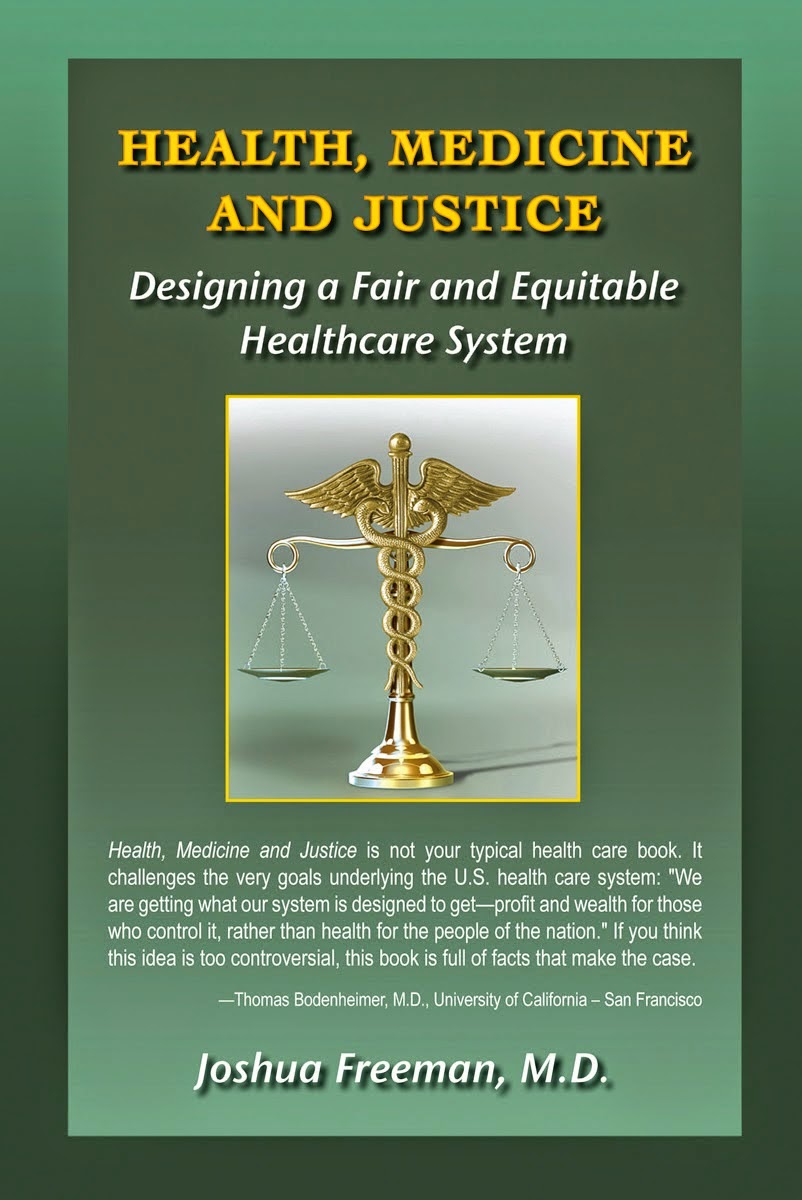
Health, Medicine and Justice published: available on Amazon


NOW
Available from Amazon, Barnes and Noble, and independent booksellers.


Health care delivery in the U.S. is a mess. We lead the world by far
in spending, but trail other developed countries in most health outcomes.
Our health care is disjointed, not coordinated, and seems
to be designed to maximize profits for insurers and health care
providers. These two groups usually seem to be in conflict about
which should get most of the money. While individual patients may
receive outstanding care, especially when it can be delivered profitably,
the population as a whole does not. Is the system not working,
or is it working too well to do the wrong thing? After all, “every
system is perfectly designed to get the results that it gets”.
In this book, Dr. Freeman argues that the problem is that our
healthcare system is not designed primarily to improve health. He
presents extensive evidence about the design of our health care
system and the results that it gets. He examines the imbalance
of high-tech care with primary care, the way our doctors are educated,
how new discoveries are presented to the public, and the
role of profit in distorting the design of U.S. healthcare. He suggests
how a new system could be designed based on the values
of achieving the best health for all of our people.

-----------------------------
“Health, Medicine and Justice is not your typical health care book. It challenges the very goals underlying the U.S. health care system: “We are getting what our system is designed to get—profit and wealth for those who control it, rather than health for the people of the nation.” If you think this idea is too controversial, this book is full of facts that make the case.” —Thomas Bodenheimer, M.D., University of California – San Francisco 


Uncommon sense on health care - a book review, The Kansas City Star, March 29, 2015
“Joshua Freeman is chief of family medicine at the University of Kansas Hospital and an inveterate blogger. He started his “Medicine and Social Justice” blog in 2008 calling for universal health care coverage and has returned repeatedly to the subject. That’s because even though the Affordable Care Act makes coverage available to many people, Freeman doesn’t think it goes far enough. And while politicians dare not speak its name, Freeman isn’t shy about what he thinks we need: A single-payer, Canadian-style system covering everyone.

Freeman recently gave me an advance copy of his new book, “Health, Medicine and Justice: Designing a Fair and Equitable Healthcare System,” laying out his arguments. It’s a fine primer on the tangled web of special interests and ultimately futile regulation that passes for a health care system in this country. (Truth in punditry: Freeman cites my reporting in his chapter on the role of profit in health care.)

Freeman provides telling anecdotes: His experience treating uninsured patients whose chronic illnesses were out of control because they couldn’t afford care. His discovery in New Orleans of a safety-net clinic sponsored by Qatar — which means America, the richest nation on Earth, accepts foreign aid to care for its poor. He’s also good at taking points often made by others and making connections. Yes, we know we spend more on health care than other wealthy
nations and despite that, our people aren’t particularly healthy. But the U.S. also spends less on social services, he observes, the kinds of things
that elevate people from the poverty that degraded their health in the first place.

But the poor don’t have political clout. Health care providers and insurers do. So that’s where the money goes. “We have a health care system that is designed to make profit rather than health,” Freeman says.

According to Freeman, a single-payer system — basically, Medicare for all — would go a long way toward putting the focus back on patients. It would eliminate the crazy quilt of insurance plans that drive up administrative costs. And it would set more equal and rational payments for medical
services. Providers could still compete, Freeman says, but it would be on the basis of quality or personal style.

Perhaps Freeman’s most compelling argument is that a system covering everyone would unite us all, rich and poor. We would all have an equal
stake in making sure providers were adequately paid and delivered high-quality care, and that everyone had access to that care.

But Freeman sees health care as a basic human right. That’s still a subject for debate in the United States.” — by Alan Bavley


“The US health care system is broken,” Joshua Freemen tells us in the opening line of his powerful critique, Health, Medicine and Justice: Designing a Fair and Equitable Healthcare System. He spends the next 300 pages masterfully and persuasively documenting this charge. His voice is disappointed more than it is angry or shrill. Freeman is a practicing family physician and the chairman of the Department of Family Medicine at the University of Kansas School of Medicine. It is his system and he wants to see it perform as it should, to work in a more equitable fashion, and to produce results that the country is paying for but not getting. His command of fact is impressive and his tone caring and therapeutic. He tells us about everything from comparative health systems in Europe to profit motives in the Board Room. Dr. Freeman concludes that a single
payer health system is the solution to better and more equitable healthcare in America. It is “political will,” he tells us, “that will fix the broken system.”
—Fitzhugh Mullan, M.D., Murdock Head Professor of Medicine and Health Policy, Professor of Pediatrics The George Washington University


“In his book, Health, Medicine and Justice, Joshua Freeman not only explains the unique features of the U.S. health care system that result in significantly higher costs but only mediocrity in performance, he also discusses the issues against a background of health care justice. This leads to the compelling conclusion that, being all in this together, we can apply principles of health care justice to ensure higher quality health care for everyone, at a level of spending that the nation can afford.”
—Don McCanne, M.D., Senior Health Policy Fellow, Physicians For a National Health Program (PNHP)


“This is an informative and entertaining overview of the current status and deficiencies of the US healthcare system. It will serve as a useful text for anyone just beginning their inquiry into how the system works, or for someone wanting a refresher course on the influences of social policy and values on the outcomes of the unique approaches to providing healthcare prevalent in the  US.”
—Robert Graham, M.D., former CEO, American Academy of Family Physicians


“Whether simplifying the arcane methods of financing graduate medical education, or clarifying the inaccuracies and conflicts of interest in the way that medical schools report their production of primary care doctors, Dr Freeman provides insight into the bases for our out-of-balance health care workforce. In an engaging and understandable style, he not only identifies the underlying issues but also points to some opportunities for righting the health care system’s deficiencies; and makes a strong argument for why we should do so. If you don’t care about social justice and don’t want to risk caring more, don’t read this book.”
—Christine C. Matson M.D., Glenn Mitchell Chair in Generalist Medicine Chair, Department of Family and Community Medicine, Eastern Virginia Medical School

------------------
Contact: Joshua Freeman, M.D.
Cell Phone:
Email: jfreeman3@gmail.com
Health, Medicine and Justice
Designing a Fair and Equitable Healthcare System
By Joshua Freeman, M.D.
Published in 2015 by Copernicus Healthcare • 315
pages • ISBN PB: 978-0-9887996-8-4 • $18.95

Total Pageviews