Showing posts with label travel. Show all posts

Saturday, June 4, 2022

Where has all the caution gone? COVID infection is still common!

Most infections diseases in people get passed from one person to another, although sometimes animals and insects are the vectors. More rarely (as in the case of COVID-19) an ‘enzootic’ infection (one that resides in animals) can ‘make the jump’ to people, although after that the transmission continues to be primarily person-to-person. If there is an outbreak of an infection it can spread rapidly among ‘susceptibles’ (people who do not have immunity through either prior exposure to the infection or from vaccination against it), particularly in crowded conditions.

Many of us are aware of this from our children. In winter, young children in school and day-care bring home infections that can make them sick and often infect other members of the family. Luckily, most of these are minor and transient (the ‘common cold’), but in the past included many serious and potentially fatal diseases such as polio, measles, mumps, whooping cough, rubella, diphtheria, Hemophilus influenza, chickenpox, and others. The frequency of these diseases has gone down dramatically as a result of vaccines that have been incredibly effective. Outbreaks still occur in places and populations where an insufficient percent of the children have been vaccinated to result in ‘herd immunity’. In the US, this is, sadly, most common not in communities which do not have access to vaccinations, but in which large numbers of people have, for whatever their reasons, chosen to forego vaccination for their children.


Dave Caverly, Speedbumps


The way that outbreaks of any infectious disease, from colds to influenza to chickenpox to sexually-acquired infections to COVID-19, occurs depends upon the route through which that organism is transmitted – sometimes by respiratory droplets (cold, COVID, pneumonic plague, polio), sometimes through fecal-oral contamination (think young children), sometimes through sexual contact involving exposure to blood or other body fluids, sometimes by more than one of these. Respiratory transmission is particularly great in crowded indoor environments, such as schools, concerts, restaurants, clubs, and family gatherings. And gyms, where people working out are breathing heavily. And singing (such as the karaoke sessions enjoyed by the NY State judges before many came down with COVID). Sexual transmission is, of course, less likely to be incidental and requires close and often prolonged contact.

But there is a similarity. This is that we are at risk for exposure not only from symptomatic individuals with whom we have contact, but often from those who are not, or not yet, symptomatic but who have been infected by someone else. In the case of sexually acquired infections, the idea that when you have sex with someone you are not only having sex with them, but potentially anyone else they have had sex with, or the people those people had sex with. Monogamy, is of course, protective, provided, of course, that it is actually practiced. It does not necessarily take many outside episodes to introduce an infectious disease.

In the case of COVID, we are not talking about sex, but about high-risk exposures. And also about what we assume should have been low-risk exposures but were to people who themselves may have taken greater risks. You may be pretty careful, not go out much, wear your mask if you are indoors with groups of people that you do not know, but be less careful if you are with close family members, especially those in your home. But just as a child can bring home a cold from daycare, or a sexual partner can bring home an STI from a relationship that you did not know they had, a family member can bring home COVID from a concert, club, restaurant, airport, social gathering, or other event in which others, who you (and maybe they) do not know were infected, unvaccinated, unmasked. If you happen to be more vulnerable: older, sicker, immunocompromised, and especially (because this is usually fixable) unvaccinated, the outcome can be not just infection but hospitalization and even death.

Minority communities have higher rates of all of these problems – infection, hospitalization, and death. Some of this can be tied to greater prevalence of chronic disease, some could possibly be lower rates of vaccination, and much may be related to having a higher rate of low-income and jobs that require actual presence and cannot be done from home by ‘Zooming it in’. It can also be true that poorer families may be more likely to have multiple generations living in the home, with various sources of infection (school, work, social activities) increasing the likelihood of COVID being brought into the home and infecting family members who are more at-risk.

Most of us want to see and interact with our family members. But if those family members have contracted infection, whether by “choice” (adopting higher-risk behaviors, not wearing masks, especially not being vaccinated) or by bad luck despite taking precautions, seeing them puts us at greater risk. Some of that risk may be unavoidable, but some can definitely be mitigated. COVID is NOT gone, but people are taking more and more risks, including me. I returned from a trip to Europe a few days ago, and while I wore an N-95 mask on the plane and in the airports, it was risky (the line for passport check in the Madrid airport crowded despite ironic signs on the floor asking people to maintain a 2-meter distance, between which were many people, was surely a potential super-spreader event). But I seem to be one of the few people worried about it. In the gym, no one else is wearing a mask, even as they huff and puff on machines which definitely increases the likelihood of spread, and I take no reassurance from their carefully wiping them down, since this is not really how COVID is spread. The front desk has even taken down the plastic barrier that has long been in place.

If all this were occurring because the rate of infections, and thus hospitalization and death, were down, this could be a good sign. Unfortunately, it is not. A recent headline in my local paper, the Arizona Star, on June 3, 2022 is “AZ COVID numbers continue to rise”, and daily published an update on number of cases. Yes, vaccination has definitely reduced the rate of hospitalization and death among those who have been infected, but the greater the number of infections the greater the risk of those really bad outcomes.

Death is now less likely, at least among the vaccinated. Be vaccinated. But COVID is still there, and in many places cases are increasing. Continue to exercise caution, and try to not take unnecessary risks.


Sunday, May 22, 2022

The Fourth Surge? The Fifth? Guess what: It’s still not safe out there!

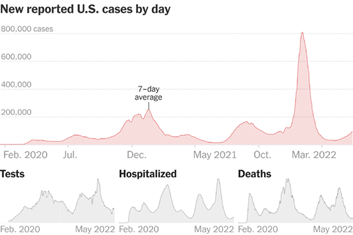
The US recently passed a million deaths from COVID-19. There have been a lot of articles marking this dubious milestone, notably in the NY Times as in this Briefing by Jonathan Wolfe, and this Daily podcast.  The Wolfe piece includes two important graphics, one showing the number of new cases by day. It also contains shows hospitalizations and deaths, and makes the several “waves” very clear. And that this Spring’s wave is huge. The second graphic shows deaths, by time and by race/ethnicity in the key non-child, not old, age range of 25-54. A lot of deaths, and while the particular minority group that is most affected varies among the different surges, Blacks and Latinos are disproportionately dying.

A million people is a lot of deaths. It is, as Wolfe points out, more Americans than have died in all the wars in our nation’s history. It is more people than have died in any other country. It remains about 20% of the world’s deaths. I have often written about how the US healthcare system is far inferior to that of many other countries, particularly the wealthy ones that are our appropriate comparison group. It is unfortunate that this area, where we are but certainly should not want to be #1, demonstrates our lack of an effective public health system and the inadequate coverage for healthcare of so much of our population.


It demonstrates more than that, as anyone can tell you, regardless of the group that their political position demands be blamed. People are getting out more, mingling more, interacting more, going to physical workplaces more – and getting infected more. Not a day has gone by recently where I have not heard from a friend or relative about something that they did for the first time in a long time – go to a concert, or to an indoor restaurant, or get together with a group of people in someone’s home. And every single one of these stories has ended with someone, the friend or relative or one of the people that they interacted with, getting sick and testing positive (and possibly, likely, others to follow). I have learned more than I ever expected to about the unreliability of home test kits, which have sometimes been falsely negative two or three times in a sick person before the result of a more definitive test came back a couple of days later. The amount of virus (“antigen” if you want to be cool) that you need to make you sick is less than that required to generate sufficient antibody (what your body makes to fight the virus) to turn these tests positive.

It is tempting to say people are behaving badly or stupidly, but what is true is that people’s behaviors – tentative or full-throttle efforts to move back to a “normal” pre-pandemic life – have increased the number of infections. And that the increase in the number of infections leads to an increase in the number of hospitalizations and deaths. These are sometimes, but not always, in the people adopting the “risky” behavior. Sometimes they are in the people (often older, sicker, more vulnerable) that they live with.

Both my wife and I have traveled abroad recently, and it makes us nervous. She went to India, and we both are now in Europe. We tried to be as safe as we could on an airplane where the pilot and staff announce regularly that “you are not required to wear a mask, but please respect the decision of other people to mask or not mask”. I guess that means that there have been at least arguments, and likely fights, on planes over this issue. A federal judge in the US, in the middle of this current surge in infections, ruled that the government could not require people to wear masks on planes, and the administration did not appeal it. Thus, in traveling from India, through Dubai, everyone was masked until my wife got off at O’Hare – and most people were not. There are legal scholars who disagree with this judge’s ruling, but the key point, whether you agree with it or not, is that she ruled that the Constitution does not give the federal government the right to require people to wear masks on planes. She did not rule (and of course, could not rule!) that not wearing a mask was safe. This distinction seems to be lost on many people.

Including judges, of course. We just learned that 70 New York State judges went to a retreat in Montauk, NY, and that (as of May 19) 20 of them have tested positive for COVID, and many are sick. And there will likely be more. The fun of that retreat included a big karaoke party, a really effective way to spread the droplets that cause the infection. And these are the people who issue the rulings about what is allowed and what is not. Makes me feel really secure; how about you?

On a more chilling note, a close relative just told me about a longtime friend who has not been vaccinated,  won’t do it, and refuses to wear a mask. But he does not refuse to travel or to go out and interact with others, even in settings where evidence of vaccination is required. He lies and says he is vaccinated. “Luckily” for him (and, of course, unluckily for the rest of us!) he shares his father’s name, so he uses his father’s evidence of vaccination to access these venues. Think about that. Think about how reassured you are when you are with a group of acquaintances and “everyone” is vaccinated or tested negative. Or are on a plane where “everyone” has had to present proof of vaccination. Do you feel secure? You should, actually, at least feel more secure. The odds are very much lower in these settings. And in private groups, of course you trust your friends and relatives. On the other hand, it might not be everyone. One of them might be this guy. Or one of the thousands, probably millions, like him.

Recently, a ruling by a federal judge has blocked the federal government from ending Title 42, a public health regulation invoked by Trump to keep migrants coming from Mexico out of the US  based upon the possibility of their bringing in COVID, which has been continued until now. But it is not migrants who are spreading COVID; it is infected Americans who have not been vaccinated, will not wear masks, and openly mingle in public (and private) places.

In small villages in India everyone is wearing a mask. At O’Hare, or your local restaurant, or even on an airplane or in a convocation of judges, people are not. Luckily they are vaccinated. Unless, of course, they’re not. Since people’s desire to “open up more” began, early in the pandemic, I have been saying “opening = death”. Vaccines have helped a lot, and there area lot fewer deaths and hospitalizations when folks are vaccinated even when they are infected.

Sadly, there are too many people who are doing their best to try to make it worse.

Total Pageviews