Showing posts with label PBMs. Show all posts

Thursday, March 21, 2024

PBMs, pharmacies, and insurance companies: Three legs of a many-legged stool. Or cabal.

PBMs. What are they? Pharmacy benefit managers. Oh, thanks. That clears up a lot!

Well, they are big and important in the health care industry, which should give you a clue: they are somewhere between “not about helping you” and “evil”. Unfortunately, this describes almost every big corporation (pharmacies, insurers, pharmaceutical and device manufacturers, and large health care “provider” corporations) that is involved in health care, or more realistically, sucking money out of the public (directly from you or your government) that was intended to provide health care.

But, back to PBMs. They are, as the name suggests, “managers”, in this and many other cases another word for “middlemen”, set up to be intermediaries between the pharmaceutical companies and pharmacies and insurance companies and you, the consumer (remember that last, “you the consumer”, the one entity in this calculus that has very little weight?). Much of what PBMs do, and a lot of the things that they do that make them more money (and thus could be called “abuses”, since they are not about the only important thing, maximizing the health of the people) are described in this piece from American Progress, “5 things to know about pharmacy benefit managers”. In addition to receiving payments for their services from insurance companies (presumably a legitimate fee, although perhaps for a service that benefits the insurers and not you, and as we shall see below, another scam as many of them are owned by insurance companies!), they also have other little “tricks”. Pharmaceutical companies (another huge pig at the trough of health care dollars) frequently offer discounts in the form of rebates on the cost of expensive drugs – and often, to be fair, negotiated by the PBM – intended to help the consumer. But the PBMs often keep a portion of that rebate. More insidious is that this rebate is a percentage of the price, so the higher the price, the more the PBM gets to pocket. This may (and often does) lead to their “preferred drug lists” having the most expensive drugs as preferred. While this does not cost the patient more (because it puts it in a lower tier), it does make more money for the PBM.

PBMs also engage in “spread pricing” where the amount they receive from the insurer for a drug is more than they pay the pharmacies. And they keep it. And the cost of your insurance and your co-pays can go up to “repay” the insurer for the payments that they make to the PBM. Most of us are familiar with paying for things at a discount, only to discover that the discount is from an inflated “list price”, which already includes a sizeable profit for the vendor. Nowhere is this as common as in drugs; if you have a drug plan (say, Medicare Part D) you are likely to discover that what you pay for your drugs (your co-pay) doesn’t count to your annual deductible, since the insurance company and PBM (now often one and the same) have decided you are already getting a good deal from the discounts that they have received, even when they are pocketing the spread. In 2018, Ohio discovered its Medicaid program was paying $220 million more to PBMs than the latter were paying to the pharmacies for them! Entrepreneurship? Criminal theft?

In a recent piece on his substack, Health Care Un-Covered, health insurance industry whistleblower Wendell Potter describes how ‘The PBM-insurer mafia comes for community pharmacies’. The first important item is contained in the title – “PBM-insurer mafia” – now these two entities are not in competition but in collaboration as two of the “Big 3” PBMs are now owned by insurance companies (OptumRx by United Health and ExpressScripts by Cigna), and the third (Caremark) by a pharmaceutical chain, CVS. This follow the pattern prevalent in all industries, but particularly in “health care” of increasing consolidation, vertical integration, and monopoly power. As Potter describes, one victim of this has been independent community pharmacies. Why such independents are good and of value is eloquently described by one such pharmacist quoted in his piece, so I  won’t re-quote it here; suffice it to say it is what you can imagine is lacking in corporate chains – personal service to people. The benefit to the PBMs of putting independent pharmacies out of business and shunting prescription business to the chains is obvious for CVS/Caremark, but also true for ExpressScripts since it has a deal with Walgreens. And, of course, for all in insurance companies to their owned mail-order pharmacies (which you may get regular emails urging you to use). As is always the case, the lowest income people (who often have the worst insurance coverage, or have Medicaid) are the worst hit, but increasingly insurers and their PBMs have found ways to screw all of us.

There has been increasing political pushback, finally. ‘Last year, Republican Ohio Attorney General Dave Yost said that “PBMs are modern gangsters.”’ This year, Senate Finance Committee Chairman Ron Wyden (D-Ore.) and Ranking Member Mike Crapo (R-Idaho) tried to get new legislation passed; ‘“The time for PBM reform was yesterday,” Wyden said. “It’s past time to crack down on the shady practices of these pharma middlemen that result in higher drug prices for consumers and threaten pharmacies across Oregon and nationwide. I’ll be working around the clock to get this done as soon as possible.”’ But it hasn’t yet passed; it is hard to get consensus on anything in Congress these days, and the insurance companies and PBMs have very powerful (and generous!) lobbies. ‘In recent months, an independent pharmacy, Osterhaus Pharmacy, in Iowa, sued the major PBMs over DIR* fees. In its lawsuit against UnitedHealth, it stated, “This vertical consolidation has served OptumRx well. It now controls not just the pricing of drugs, not just the selection of the drugs covered by Part D Plans, and not just the selection of pharmacy services providers in each Part D network; OptumRx also controls access to almost a quarter of the Medicare beneficiaries enrolled in PBM‐affiliated Plans.”’

Yup. If you are convinced that such consolidation (monopolization) of our health care system is a good thing for efficiency and effectiveness, you should have a UnitedHealth poster on your wall. They are the largest “health” insurance company, control the largest share of Medicare “Advantage” clients, own the doctors’ network Optum, and, as above, control OptumRx. The last two are very big moneymakers for them, and account for much of their growth and profit. But the others are just as bad and would like to be as big.

On the other hand, perhaps you are not so convinced. In which case you should be calling your senators and representatives and letting them know that they should be supporting legislation to rein in the PBMs. And, while they’re at it, the insurance companies. And all the big profit-making corporations jacking up the cost of health care while limiting the care.

They have the dollars. But we have our voices, and our votes!


*DIR: Direct and Indirect Remuneration fees, which are charged to pharmacies by PBMs. A much more detailed description of them is in Potter’s piece, but in brief they are another method for the PBMs to scam more money, and to do so without any meaningful transparency.

Thursday, March 7, 2024

"Health care" Corporations are Evil. Most of the people who work for them are not. Fight back!

Usually, when I write a blog post, I start with something that has happened or is happening, try to develop it and point out the relationships between it and other things that are happening. Toward the end I make an effort to form a conclusion, and, perhaps even make suggestions as to how the problem(s) might be addressed. However, today I think I’ll lead with the conclusion, so folks do not have to read too far:

All of the US healthcare industry (not system) is run by corporations that are effectively evil.* They function for only one purpose: to suck as much money, in the form of profits, stock price, and executive salaries (the executives, who are people, are of course evil) from our economy under the false flag of providing health care. They care not one whit about the health of people, society, or community, nor about decency. They include insurance companies, large hospital systems and provider groups (often owned by insurance companies and -- the exemplar of morality-free rapacious profit -- private equity), pharmaceutical companies and device companies, the large pharmacy chains (e.g., Walgreen’s, CVS) and the PBMs (pharmacy benefits managers) that control drug distribution.

*[I do not believe that corporations are people, despite the scandalous Citizens United decision that decided that they were and that money is speech, so are without human characteristics.]

I could end it there, and say “if you have any questions, read my previous blogs, and the references I cite”, but I will go to talk about a few recent events and actions that bolster this case. First, however, I want to talk about people, the people who work in health care, the people who the other people (called “patients”) seeking health care actually run into. Almost uniformly, they are not the problem. From the higher-paid physicians and other clinicians, including nurses, who provide clinical care, to the pharmacists and pharmacy assistants who dispense medications, to those who answer the phones, schedule appointments, take questions to be transmitted to the clinicians, and even collect money, these are overwhelmingly hard-working people trying to do a good job of serving you. They are almost all employed, however; even about 75% of physicians (and growing) are employed by corporations. If your doctors seem rushed and not to have enough time for you, if they are focused on computer screens, if they don’t quickly call you back, this is not their choice, it is the mandate of the corporation that employs them. It is essentially the same as the traditional “speed up” for assembly line workers: to be “more efficient”, a euphemism for “making more money for the corporation”. The same is true for the clerks who may take a lot of time to answer the phone, or who are “unwilling” to cut you some slack on your bill (when really they do not have the power to), or the pharmacist who takes “too long” to fill a prescription or provide you with the information that you need. These are, by and large, good people trapped in a heartless system.

And, yet, because these are the people –physicians, nurses, pharmacists, clerks – whom we, as patients, see and interact with, they are the ones on whom we take out our frustrations when we feel we are not being treated as we should be. When we are denied care when we are late because the bus was delayed, or because we had to get our children off to school but the early appointment was the only one available, or because we don’t get off work until 4:15 but the 3:30 appointment was the last available. Yes, like the rest of us, all these people in healthcare want to work reasonable hours and get home on time, but the rules that they are required to enforce are not made by them. They are made by the corporate executives, those who have sold their souls, the CPAs and MBAs (and occasionally MDs and RNs, but usually those also have MBAs) whose expertise is in making money for the corporation, not in serving you, and who are handsomely rewarded for it. They are the people who are responsible and to whom your anger should be directed, but good luck getting to them. Maybe you can reach the CEO of a small rural hospital (who will almost never be the real CEO, since it is probably owned by a large hospital corporation) but not the heads of the insurance companies and pharmaceutical companies and massive health systems and private equity owners of all of these. More than the highest Mafia dons, they are protected by layers and layers of others who keep them from having to interact with you. But they ARE the evil people (even if, like those Mafia dons, they are nice to their children), creating, maintaining, and expanding an industry designed to extract as much money as possible from the economy and mis-label it “health care”.

The idea that this skates close to the edge of what is legal is disingenuous. It is often illegal; a huge part of the industry regularly acts illegally. We want there to be laws against such abuse, but even when there are they are irregularly, even rarely, enforced largely due to inadequate funding for the regulators. This is on purpose; those huge corporations have the money to buy – I mean donate to – congresspeople and also offer high-paid jobs to former regulators who “behaved” in the revolving door system. And when the rules are enforced, the fines are relatively low, and are just written off as a “cost of doing business”

Examples?

How about “Whistleblower Accuses Aledade, Largest US Independent Primary Care Network, of Medicare Fraud”, KFF Health News (March 5, 2024)? Using a practice known as “upcoding”, the company employs large numbers of people to add additional diagnoses to the one for which the person is being treated, increasing the reimbursement. This practice results in greater fee-for-service payment, but is even better (for the company) in increasing the “capitated payment” that they get for a particular “covered life”, both in general managed care and in Medicare Advantage programs. In this case, and in many hospitals, it is the provider who is fiddling the data to get more money from the insurer (which, in the case of Medicare Advantage, as well as Medicaid and some other programs, is the government – that is, you, the taxpayer).

But let’s not cry for the poor insurance companies, although they would like you to think it is the doctors and hospitals who are at fault for milking them. Even when something very bad happens, like the recent cyberattack at the largest health insurer, UnitedHealth, in which they may have paid a $22M ransom, it is the providers who are not getting paid. UnitedHealth is doing just fine, thank you. Not only is $22M not that much for them, but as pointed out by former insurance executive and current whistleblower Wendell Potter in his substack

Keep in mind that while the company is unable to pay thousands of the country’s doctors and hospitals for who knows how long because of the hack, UnitedHealth will be able to hold on to billions of dollars in premium income longer, and that will boost its investment income, which is considerable on any day of the week.

They have the system covered from all angles. UnitedHealth has moved into owning practices directly, through Optum, a very large provider and the source of a big percent of their profit. Along with their Medicare Advantage products.

Indeed, as providers and insurers point the finger at each other, and as pharmacies buy up the PBMs that control utilization, increasing vertical integration, and as private equity companies buy up all of these, there is one thing that you can be sure of: the benefit to the customer, consumer, patient, person, society is the one thing not being considered. We are the collateral damage in the fights among these amoral (at least, really immoral) behemoths.

What can we do? It often seems like there is not much. Our feeble cries are drowned out by the corporate contributions to our congresspeople. But we can let our elected representatives know that we are on to the abuses by those companies, and that we hold them responsible for holding (or not holding) the corporations responsible. We can, for example, demand something specific, that they sign on to the Patients over Profits pledge (initiated by National Nurses United, NNU, and now sponsored by many patient and community groups):

I pledge to put patients over profits and not take contributions over $200 from the executives, lobbyists, and PACs affiliated with the corporate health care industry, including private insurers, pharma corporations, and private hospitals who are organizing to take over our health care system.

They won’t if just a few of us ask. But if LOTS of us do, they just might.

And that’s a start.

Tuesday, August 22, 2023

Older adults cannot afford healthcare even if they are insured: Time for a new system!

Are health insurance companies the real enemy of Americans’ health? A strong argument can, and has been, made by myself and others that they are. More broadly, however, the enemy is all the companies that pursue making money as their primary goal, with providing healthcare a sideline (albeit a costly one). So many corporations are involved and responsible that it is hard to be sure that insurance companies are the main ones at fault. “Even” actual health care providers – mainly hospitals and “health systems” – try to squeeze out the poor and poorly insured and greatly prefer to deliver only the most high-profit-margin care. And, certainly, one cannot leave out the drug companies, making gigantic profits at the cost of our health (they remain #1 in profits, every year), or the less-well-known but also very dangerous “PBMs”, pharmacy benefit managers, who bundle our drug plans, and act as middlemen between the insurers and the drug companies and the providers. (You notice I didn’t say “consumer” or “patient”; they are no more than grist for the profit mill!)

But one can still make a strong case for insurance companies being at least a major cornerstone of the evil empire, sucking money out of government coffers, employer contributions, and, yes, your pockets, for the privilege of denying you care and padding their bottom lines. Long noted for their unwillingness to cover everyone, the insurance industry is moving the needle by providing poor coverage even to those it does insure. Two recent studies have looked at the financial burden on older adults provided by health care, one at those with private insurance and the other at those with Medicare.

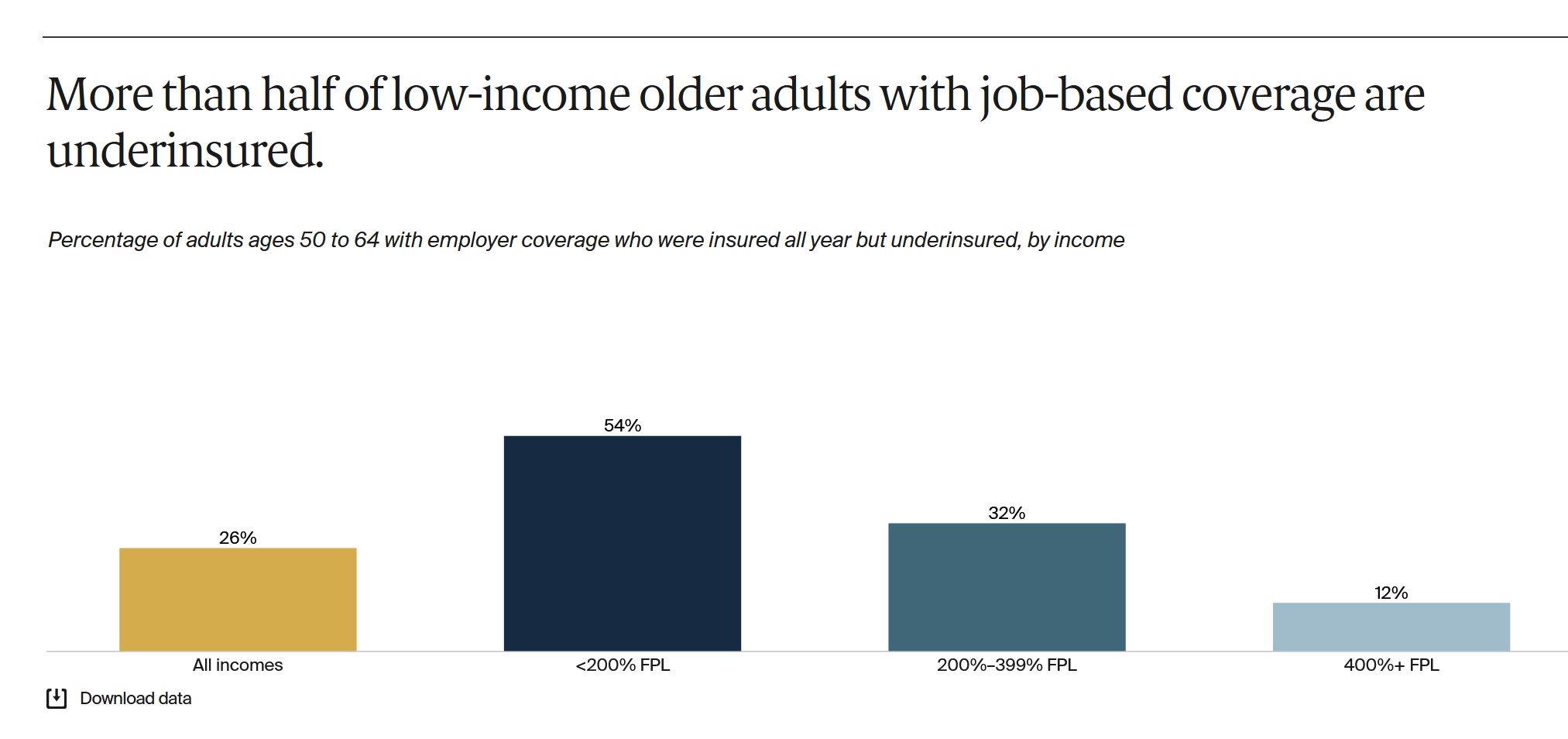
The Commonwealth Fund looked at the coverage and costs for older-but-not-yet-Medicare adults 50-64 in ‘Can Older Adults with Employer Coverage Afford Their Health Care?’ by Lauren A. Hayes and Sara R. Collins (August 10, 2023). A majority of these folks have private insurance through their employers (55%) with higher income (>400% of the Federal Poverty Level, FPL) at 82% and low income (<200% FPL) at 22%. It wasn’t enough. More than half of low-income and more than 1/3 of middle income (200-400% FPL) people had difficulty paying their premiums and didn’t get adequate medical care because of the cost. Unsurprisingly, those worst affected were not only low-income but sick; the issue of paying for health care is greatest when one has health problems.


The Kaiser Family Foundation study, ‘Medicare Households Spend More on Health Care Than Other Households’, by Nancy Ochieng, Juliette Cubanski, & Anthony Damico (July 19, 2023) examined adults over 65, those on Medicare. They found – well, what the title says. Again, not surprising; older people are sicker, and sicker people use more healthcare (duh!) and it costs them more. While Medicare is a federal government program, there are still out-of-pocket costs associated with it. For hospital care (Medicare Part A, funded by your paycheck deduction), traditional Medicare (TM) pays only 80% of approved charges, which means sick Medicare recipients have to come up with the other 20% (which can be a huge amount of money) or have a Medicare-supplement policy to cover it, which of course costs additional premiums. Medicare recipients also have to pay a monthly fee for Medicare “Part B” (the “outpatient” portion) which usually is deducted from their Social Security payments. At least this is tiered, so higher income people pay more and lower income less (or sometimes nothing). Also they have to pay for a drug plan (Part D). 


About half of Medicare recipients are now in “Medicare Advantage” (MA) plans, which are essentially HMOs. I have written about them previously, but because they are not actually Medicare (although paid for with Medicare dollars) but private insurance, they have the ability to deny coverage altogether. They have good perks if you don’t need expensive care (often no co-pays, no 20% coinsurance, drug coverage so no need for a separate Part D plan, coverage for some things TM doesn’t cover like glasses and hearing aids) which make them attractive to healthier seniors. But while TM covers (if only at 80%) the things it says it covers, and doesn’t deny individuals, MA can and does. So while Medicare Advantage can be advantageous for some seniors, its greatest advantage is to the insurance companies.

Indeed, that some people are better off with one type of plan and others with a different one is both understandable and OK. But that the difference is whether you are sick or not is dangerous, since the non-sick can quickly become sick, especially if they are elderly. That we try to segment public opinion by pitting the sick against the not-yet-sick (“I’m doing ok, and can afford my premiums and healthcare, for now”) is what is truly sick, and intolerable. It is a marker of a reprehensibly designed system.

The authors of the Commonwealth Fund report have a number of suggestions for addressing the problems that they identify, all of which are tweaks to our current system, and, in the unlikely event that they were implemented, would immediately be “gamed” by the power players – the insurance companies and the health systems – to ensure that there would still be lots of people left out, lots of people suffering. Their suggestions do not entail scrapping the entire for-profit insurance system that strangles the health of our people in favor of an adequately-funded single payer system, but rather the creation of new programs, and new rules to try to limit the damage caused to the health of older Americans by a system that simply should not exist

Seniors can be attracted to MA plans because of the costs TM doesn’t cover, especially the 20% of hospital bills. Those in MA plans, as well as those “younger” – still employed – older people in employer-based insurance plans can be financially screwed because those plans are operating with the goal of making money for the companies, not ensuring health care. The fact is that both problems could be addressed together – by getting rid of the profits and costs of insurance companies, enough money could be saved to cover 100% of all health care needs for Medicare recipients. One could say this is “ironic”, if it weren’t for the fact that irony implies lack of intentionality, and this criminally flawed and abusive system is clearly intentionally structured.

Dr. Don McCanne, who reported on this in his recent “Health Justice Monitor”, writes

Should that be the primary mission of our health care administrators? Of course not! Their primary mission should be to move health care to the people, the patients, all of the patients, and they need to use our health care dollars to do that. Our current system has demonstrated beyond any doubt whatsoever that private administrators have been and always will be on the wrong mission, and we need to replace them with public administrators who will always pursue a mission for the public good.”

Yes. Stop trying to make deals with the devil. Those companies, including insurance companies, taking money intended to provide healthcare as salaries and profit are evil, and it is hard to think of the legislators and executive-branch functionaries who facilitate and enable this as anything else.

Our government should use its (ie, our) money to fund our promises for healthcare to our seniors, not insurance companies who pay them back with graft.

Monday, February 24, 2020

Drug corporations from manufacturers to retailers are rotten down the line


Drugs, drugs, drugs. We hear a lot about drugs. Especially about the Opioid Crisis, which is a very serious problem in the US. But the other drug problem we hear about is also very serious: the cost of drugs and the inability of people to access the drugs that they need, not to mention to save their lives, because of the cost.

One such drug is insulin, needed by people with Type 1 diabetes to survive. Stories of people dying from, or almost dying from, lack of access to insulin, or having to go to Canada or Mexico to buy it, are both sad and galling.  It is particularly so in the case of insulin because its discoverers wanted it to be free. In 1923, Frederick Banting and his colleagues Charles Best and James Collip sold the patent to the University of Toronto for $1 each, worried that if they did not patent it drug companies would patent an inferior version of insulin (imagine that!) and people would die. The University of Toronto gave the patent royalty-free to drug companies, specifically Eli Lilly.

Unsurprisingly, that marked the end of being motivated by the public interest. As early as 1941, Lilly and two other companies were indicted for price fixing of insulin, and it has gone on from there. In 1982, Lilly was able to synthesize human insulin (previously insulin was made from beef or pork pancreas, which had a lot of reactions, although pork was closer to human and thus preferred). Of course, the price took off. With the complicity of the government, worse in administrations that believed corporate profit (especially for big donors) was more important than human lives, the price continued to rise. This has led us to story after story about people with diabetes, like Josh Wilkerson, dying because they could not afford $1,200 co-pays. Banting and Best are turning in their graves.

Yes, pharmaceutical manufacturers are greedy and evil, whether they make insulin or Epi-Pen or colchicine, or other drugs (like pyrimethamine – see Martin Shrkeli) and deserve every bit of anger, hatred, and scorn that has been visited on them. They are continually the #1 (or, sometimes, #1!) profitable industry in the US, making lots of money because, well, people need their products to live. But they are not the only part of the drug industry that is responsible for bleeding us for profit. They are complicit with insurance companies, who agree to pay the outrageous prices that they demand (because, after all, they just raise their premiums), and with our bought-and-paid-for Congress. For example, when Congress passed the Medicare Part D Drug Act in 2003 it contained a prohibition against Medicare, the nation’s largest insurer, negotiating drug prices, thus ensuring that American pay far more for drugs than people in other countries (there is a reason uninsured folks go to Canada or Mexico)! As I noted recently, the idea is often put forward that without drug company profit, innovation in pharmaceutical discovery would grind to a halt, but in fact nearly 2/3 of discoveries are made outside the US and most of those in the US are discovered through research funded by the National Institutes of Health.

But beyond the usual villains, pharmaceutical and insurance companies, we have the wholesalers, retailers, and “bundlers” of drugs also making out like bandits (they are bandits, even if, thanks to that bought-and-paid-for Congress, their schemes are often legal) from our health needs. The “bundlers”, called Pharmacy Benefit Managers (PBMs) are contracted by large insurers to negotiate for the “best prices” with pharmacy retailers. For a positive spin on what they do, see this piece from “The Balance”. However, they are also responsible for a lot of the high cost of drugs, especially for those with worse, or no, insurance. In addition, they have a lot of practices that enhance their profit at your expense, many explained in this piece from the Commonwealth Fund, such as jacking up the price charged to insurers and pocketing the difference (“spread pricing”) and pocketing rebates from manufacturers. The entire role of PBMs is complex and bewildering, but they play a critical role in the important process of profiting off of your illness.

More recently, we have seen exposure of the nefarious practices of the final link in the chain of getting you your needed medicines, the retail pharmacies themselves. Of course, the old mom-and-pop drugstore on the corner is almost a thing of the past, having been replaced by mega-chain pharmacies such as CVS, Walgreens, Rite Aid and Duane Reed. (Of course, in many big cities they are still on every corner, not just competing with each other but with themselves; in places like New York City they are more ubiquitous than Starbucks!) These chains drove out the small drugstores by underpricing them, but having been successful in that, they have adopted practices that are frequently unethical, sometimes illegal, and always guaranteed to make them more profit. Indeed, two of the largest PBMs are now owned by these chains (Caremark by CVS and Envision by Walgreens), enhancing the vertical integration of the industry.

A New York Times exposé of January 31, 2020 by Ellen Gabler tells how retail pharmacies overwork their employees, sometimes with resultant errors such as patients getting the wrong medicines and often having adverse effects. It was titled “How Chaos at Chain Pharmacies is Putting Patients at Risk”, but this headline, while accurate, does not explain the real reason for the chaos, which is that these pharmacies are using an old and dishonorable technique made famous by Henry Ford in the early days of assembly lines called “speed up”. Speed-up, increasing the expectations for “production” (in this case, number of prescriptions filled per hour) has been a target of union contracts since the 1930s, but as the influence of unions has waned (with the collaboration of pro-corporate legislatures) these practices have increased. Pharmacists may be “professionals” (like nurses and doctors) but whatever your education and training, if you work for a large corporation who sets the rules and standard and has control, you are a worker, and need the protections that all workers should have. The most conscientious of these professionals have protested, often to the state boards that regulate them, as cited in the Gabler article:

In letters to state regulatory boards and in interviews with The New York Times, many pharmacists at companies like CVS, Rite Aid and Walgreens described understaffed and chaotic workplaces where they said it had become difficult to perform their jobs safely, putting the public at risk of medication errors.

They struggle to fill prescriptions, give flu shots, tend the drive-through, answer phones, work the register, counsel patients and call doctors and insurance companies, they said — all the while racing to meet corporate performance metrics that they characterized as unreasonable and unsafe in an industry squeezed to do more with less.

“I am a danger to the public working for CVS,” one pharmacist wrote in an anonymous letter to the Texas State Board of Pharmacy in April.

“The amount of busywork we must do while verifying prescriptions is absolutely dangerous,” another wrote to the Pennsylvania board in February. “Mistakes are going to be made and the patients are going to be the ones suffering.


So is the problem being addressed? You can be sure that it is, by the corporations that run these pharmacies. How? The complaints of the pharmacists are being taken care of in the way that big corporations often do, that is, ignoring them and deleting mention of them from their reports. In a follow up on February 21, 2020, “At Walgreens, complaints of medication errors go missing”, Ms. Gabler writes:

Pharmacy employees at Walgreens told consultants late last year that high levels of stress and “unreasonable” expectations had led them to make mistakes while filling prescriptions and to ignore some safety procedures.

But when the consultants presented their findings at Walgreens’s corporate offices this month, there was no reference to the errors and little mention of other concerns the employees had raised.

That’s because senior leaders at Walgreens had directed the consultants to remove some damaging findings after seeing a draft of their presentation, a review of internal emails, chat logs and two versions of the report shows.

In one instance, Amy Bixler, the director of pharmacy and retail operations at Walgreens, told them to delete a bullet point last month that mentioned how employees “sometimes skirted or completely ignored” proper procedures to meet corporate metrics, according to the chat logs and the draft report.

Good for you, Ms. Bixler! Took care of that problem! You should get a nice bonus this year!

If these practice are of concern to you, they should be. So should the price gouging up and down the line in the pharmaceutical industry, the drive to profit for manufacturers, PBMs, insurance companies, and retail pharmacies to make lots of money off you, or you die. “Your money or your life!” is an old cliché attributed to highwaymen. It should be the mantra of the pharmaceutical industry in this age of unfettered capitalism.

But no highwayman ever had the reach or power or ownership of politicians that these folks do. 

Monday, February 4, 2019

Venezuela and Medicare for All: Don't forget who benefits!


The mainstream media is not an evil, liberal-to-radical behemoth by any means. It is, however, often a willing, and sometimes self-deluded, ally and shill for the interests of the well-to-do in society, as well as for many questionable government policies. The latter is particularly important in the drumbeat buildups to wars, and is recently apparent in the coverage of Venezuela in journals such as the NY Times. The US government is making the case not only that Venezuelan president Nicholas Maduro is illegitimate because it has decided his election was “unfair” and “tainted”, as well as an evil and violent dictator, but that it will recognize unelected self-declared Juan Guaido as president. The Times has gone so far as to publish a self-congratulatory op-ed by Guaido, and it news coverage is typified by ‘Venezuelans Opposed to Maduro Pour Into Streets for Day of Protests’ and a Sunday Review piece by a Guaido supporter called ‘Venezuela’s Very Normal Revolution’.

I do not doubt that thousands marched against Maduro or that millions oppose him (or probably that millions support him). I certainly am not saying Maduro and his government is good, or that there is not justifiable opposition to his violent repression of opponents. I am not saying that revolutions are bad. I am saying that this one is funded and supported by the US government not because Maduro is bad -- the US has supported and continues to support dozens of brutal dictators around the world. It is because he is not our dictator, not one who supports US policy, and this is critical because Venezuela is the country with the largest oil reserves in the world. As for the NY Times -- as with most leftist governments, the support for the one in Venezuela comes more from the poorest people, while those with access to the NY Times are among the most privileged.
And this is the connection to domestic health policy, and in particular coverage of the Democratic candidates for president’s positions on Medicare for All. The NY Times (and all mainstream media) is of course owned by the very wealthy, and as individuals they see the world as members of the class of which they are part. But, possibly more important, the editors and reporters are middle and often upper-middle class, and they see the world from this perspective, from that of their families, and friends, and neighbors who are – amazingly – also privileged! The people who have access to these editors and reporters are very skewed away from the most needy, or indeed most people (who are not the same as most people in an upper middle class suburb).
In specific, we get essentially uncritical coverage of the statements of billionaires like Michael Bloomberg and Howard Schultz that “Medicare for All” is unaffordable, despite the clear fact that it is the current system that is unaffordable, and that a universal health system is going to cost less. One key part of this lower cost is the elimination of private health insurance companies’ profit, and their incentive to increase it by decreasing the availability of care. Yet the Times article covering Elizabeth Warren’s increasing iffiness on the issue contains phrases like ‘would people lose the choices offered by private insurance?’ That is, your ability to choose (maybe, depending upon what their employer offers) which overpriced-to-unaffordable policy, offered by which rapacious, obscenely-profit-making insurance company, to cover you so that, even after paying the premiums and co-pays and deductibles, you find out that, whoops, it doesn’t really cover what you thought it would or should, and you’re out of luck, and either have to pay out even more money you cannot afford or go without the health care you need. Wasn’t that what the insurance you bought supposed to get you?
Nope, not necessarily, and often not at all. The first goal of private insurance companies is to make a profit. That profit has to be maintained and expanded. The two major ways of doing so are 1) by raising the prices people (and their employers, if they are lucky enough to have employers who pay offer health insurance) pay, in premiums, deductibles, and co-pays, and 2) by denying coverage for care, or paying less for it, which often results in providers not, well, providing it to you. The insurers hire “pharmacy benefit managers” to get them the ‘best’ prices on drugs, often requiring your doctor to keep writing a different brand-name drug-of-the-month (again, see Danielle Ofri, “The Insulin Wars”), with the cost to you always going up.
What would Medicare for All offer? Or, more explicitly, Improved and Expanded Medicare for All, as in the House Bill that was H676 and will get a new number this year? First, everyone would be in the same program. No more shopping around for the least bad deal among the universe of bad insurance. Everyone would get the same benefits. The benefits would include all medically necessary health care: inpatient, outpatient, nursing home, home care, drugs, mental health, dental, eye care. Even hearing aids. Nothing excluded, except perhaps truly cosmetic surgery. Providers could not refuse to accept this insurance because they would have no business. Oh, maybe some doctors and hospitals could make a living caring for Howard Schultz and Michael Bloomberg and Saudi sheikhs who pay in cash, but there aren't very many of them, and so even the supplemental insurance we now buy would be unnecessary. There would be, you see, no deductibles or co-pays. Everything would be 100% covered. It sounds good. It would be good.
And it is not unaffordable. Currently, the government funds over half of health care (Medicare, Medicaid, government employees and retirees at all levels, military), and it is about 60% if you also count the revenue lost because employer contributions to health care premiums (unlike salary) are tax-deductible. The majority of the sickest and most needy (elderly, blind, and disabled) are already in Medicare. Most vulnerable children are in Medicaid or S-CHIP. To make up the additional cost, employers and individuals would continue to pay, but in taxes rather than premiums, co-pays, and deductibles, and for most (maybe not for Schultz and Bloomberg!) it would cost them a lot less. Most estimates of the excess costs in the US health care non-system are in the 30-35% range, for profits and administrative costs in the private sector (Medicare’s are in the 1-3% range). Administrative costs include insurance companies hiring armies of workers to deny claims, while providers have other armies to fight them, and demand more. This is money spent for no health benefit for the population, but it would be a mistake to minimize the extent to which those – insurers and providers and drug and device manufacturers – who are pocketing it would go to keep it coming.
Thus the role of the mainstream media, and the mainstream Democrats – to appeal to the needs (not desires, real needs!) of most of the people for health care and at the same time not threaten the wealthy and profitable sectors that can fund campaigns for or against them. Thus the concerns of “don’t people want to have their private insurance?” and even more ludicrous their choice of insurance company (“I’ve always been an Aetna man! So what if it costs a little more and I get just as little? I’m worth it!”). Thus the nonsensical pieces on how much a single payer Medicare for All program will cost, which ignore the cost of our current arrangement. And, somehow, manage to not address the fact that this current arrangement leaves concern for people’s health to last, and so doesn’t deliver it.
I understand that people are worried about change. But the cost, in dollars and health, of the current system has moved the majority of the population to want something different, something that meets their needs and costs less.  It is available, if we seek to do it, if we can resist the pressures from the industries and billionaires who profit from the current way of doing things.
When we read about the need to overthrow foreign dictators, or hang on to private insurance companies, we always must remember to ask: cui bono?

Total Pageviews