Showing posts with label Kaiser Family Foundation. Show all posts

Thursday, August 1, 2024

Racism and lack of social services: The status of women's health care in the US

A recent publication from the Commonwealth Fund is the 2024 State Scorecard on Women’s Health and Reproductive Care in which they rank all the states (plus DC) for how well that care is provided and the health status of women that results. The map below gives an overall sense (darker is worse), and the entire ranked list can be found in an interactive table in the document. 


The first thing that we see is that there are no real surprises. Massachusetts is at the top and Mississippi is at the bottom. The other top and bottom states are the usual suspects for almost anything that is beneficial to people, with the Northeast doing best and the old Confederacy doing the worst. There are always some minor shifts within those groups, and in this ranking we see that Louisiana* and South Carolina are only “worse than average” not in the “bottom performing states”, while disappointing to me, Arizona and New Mexico are in the lowest group. The reasons are a little different in different states; the Arizona legislature is (narrowly; we hope to flip it this year) controlled by Republicans who are as mean and nasty as those in the deep south. New Mexico is controlled by Democrats, but it is very poor. Poor is a big component of health status, and its fingerprints are all over this data on women’s health.  ‘Despite a small rebound in women’s life expectancy in 2022, it remains at its lowest since 2006,’ says the report.

Abortion care – access to it and the quality of it – has dominated the national political discussion. I don’t want to minimize it; it is incredibly important that women can have abortions, it is a privacy issue, and it will hopefully have major negative repercussions for the party whose agenda is to limit it. That the greatest restrictions on abortion are in the same states that have the worst women’s health status is neither a coincidence nor a surprise; the people who control these states and are anti-abortion are also racists and are unwilling to provide funds to improve the health standards of people who are women, minority, or poor – and especially all three. But it goes far beyond abortion:

For health outcomes, we measured all-cause mortality, maternal and infant mortality, preterm birth rates, syphilis among women of reproductive age, infants born with congenital syphilis, self-reported health status, postpartum depression, breast and cervical cancer deaths, poor mental health, and intimate partner violence.

Abortion is not the major component of poor reproductive health status. Maternal mortality rates are shockingly high in the southeast, and worst in the Mississippi Delta. The US overall does not do very well in this area, especially as it is the richest country in the world. Data from the CIA (!) shows that in 2020, the US maternal mortality rate overall was 21/100,000, tied with Lebanon, Grenada, and Malaysia and just slightly worse than the West Bank or (pre-war) Gaza Strip. This was (and remains) much higher than Canada (11), UK (10), and most of Europe, including eastern Europe at 5 or less! (Note, showing the same dramatic racist differences as in the US, Israel is at 3). Of course, this overall rate in the US is driven by the states with the highest rates, with the worst states having a range of 34.1-51.7! While this is largely the result of excessively high rates in minority women, it is worth noting that the maternal mortality rate for white women in the US is over 19!


This is a good time to discuss the segmentation of results for maternal mortality (and all-cause mortality, and really most things) by race or ethnicity. In the bizarre, perverted, and of course racist excuse provided by many (racists) for why the US’ maternal mortality is so high compared to civilized countries, it is often said “it’s the minorities that drive the rate up”. In addition to ignoring the excessively high rate for US whites (19) it is scarcely an excuse; indeed, it is an indictment. It is not only that the US, unlike civilized countries, does not provide health care for everyone, essentially free of charge at the time of service (that is, paid for by tax revenues, as well as costing a lot less because of the elimination of the incredible profits extracted by middlemen such as insurance companies in the US). It also provides lousy social services of all kinds, not ensuring, as civilized countries do, housing, food, and education for everyone. These (the “social determinants of health”) are even more important than medical care in creating improved health status. And, while other countries do spend much more money than we do on providing them, the total cost per capita is probably less than what the US spends on health care alone! Of course, much of the spending (particularly on social services and health care for the poor, like Medicaid) is on a state basis; that is why there are such differences between the Massachusetts’ and Mississippi’s in this Commonwealth Fund study. And what are the practices that work? Again, no surprise:

In our scorecard, states with the lowest rates of maternal mortality had:

·       more maternity care providers (Vermont #2, Connecticut #3)

·       fewer women with no prenatal care (Vermont #1, California #3, Connecticut #5)

·       fewer women with no postpartum checkups (Vermont #1)

·       fewer uninsured women ages 19–64 (Vermont #3)


It cannot be stated too strongly that public funds should support a public social safety net, not bloat the profits of private companies as they do here in the US! This is most well-documented for the piggish pharmaceutical industry and the entirely unnecessary (indeed, far worse than unnecessary, destructive and evil) for-profit health insurance industry, which I have discussed many times. But it is also the other parts of the health care industry, particularly delivery systems (e.g., hospitals). Yes, the for-profits, hospitals and nursing homes and other facilities, especially those run by corporations. But it is also the ostensible “non-profits”, which do their best to emulate for-profits by doing everything possible to exclude patients without insurance or with Medicaid, pay their CEOs (and other C-suite executives) exorbitant salaries, and channel huge earnings into subsidiaries that actually own or invest in for-profit enterprises! This is documented in Why many nonprofit (wink, wink) hospitals are rolling in money by Elisabeth Rosenthal (Washington Post, July 29, 2024) and discussed by Don McCanne in Health Justice MonitorNot-for-profit care begets profits’. Dr. McCanne cites a study by KFF showing even a program providing “street medicine”, healthcare for the homeless, in California is making money by getting huge amounts of Medicaid funds. Providing health care to homeless people is a good thing, something we need more of. If I had my druthers, I would rather see them making money than huge “non-profit” hospital systems (or of course straight for-profits, although those at least pay taxes), but they shouldn’t be either.

In health care, and in all social service, all the public money should go to providing direct care (OK, maybe with a 2% overhead, like Medicare – but NOT Medicare (Dis)Advantage – has). Zero dollars should go to profits (or “excess” income that can be invested for profit), bloated salaries, and the like.

We have too many people, women and others, dying because of the lack of such care.


*Louisiana just put the two drugs used for medication abortion, mifepristone and misoprostol, on its state’s controlled dangerous substances list, like narcotics. So look for LA’s ranking to drop!

Thursday, June 27, 2024

Not enough primary physicians OR Nurse Practitioners: It's the money, stupid!

Like doctors, more nurse practitioners are heading into specialty care”, a recent article in the Washington Post (June 17, 2024) by Michelle Andrews, a contributing writer for KFF News, and McKenzie Beard, makes the point that

Nurse practitioners have long been a reliable backstop for the primary-care-physician shortfall, which is estimated at nearly 21,000 doctors this year and projected to get worse. But easy access to NPs could be tested in coming years. Even though nearly 90 percent of nurse practitioners are certified to work in primary care, only about a third choose the field, according to a recent study.

That study, called ‘No One Can See You Now: Five Reasons Why Access to Primary Care Is Getting Worse (and What Needs to Change)’ was published by the Millbank Memorial Fund, and goes on at length to explain those reasons, and what needs to change.

Spoiler Alert: Like physicians, primary care nurse practitioners make less money, often for more work, and far less restricted scope of practice. Or, borrowing from an old political mantra, “It’s the money, stupid!” Or, as the WaPo article quotes Candice Chen, an associate professor of health policy and management at George Washington University, “We get what we pay for.”

It is, of course, more than just the raw amount of money. It is also how much NPs – and physicians – are paid for the amount of work that they do. This work is undervalued for primary care, based upon the notion that, somehow, being expert in a narrow specialty and knowing a lot about a little, is worth more than having a broad knowledge and being able to help a lot of people, most people, a great deal. Thus, subspecialists dramatically limit their practices to what they feel most expert at and expect the primary care clinician to do everything else. This often includes preparing people for a procedure and following them up after, which are both completely the responsibility of the person doing the procedure. Subspecialists particularly like to send paperwork back to primary care. “Your primary care doctor (or NP) will have to take care of this.” Implication: ‘Unlike primary care clinicians, I do important things.’

I would argue that managing people’s health is doing important things. Which is what the primary care clinician (family physician, general internist, general pediatrician, or the NPs that work in these fields) does. Managing the actual person, you, not just one of your diseases, or one aspect of one of your diseases; being knowledgeable about you, your life, and the interactions of all your conditions and the impact that they have on the rest of your life.

How might this manifest? Let’s say you have knee pain. You go to your family physician, who examines it, and decides that you need an x-ray. They review the x-ray and the report, and decide that you might benefit from seeing an orthopedist. They fill out the referral. Then, after the consultation and recommendation from the orthopedist, they review it, and decide how to implement the treatment. That is a lot of work. The orthopedist was done in a few minutes. Guess who gets paid, altogether, more?

Like the physicians that employ them, NPs are often very expert in their limited area (say, heart failure management), but often do not know how to manage that problem in the context of a person whose other diseases or medications may complicate that. This is where the (underpaid) primary care clinician, physician or NP, has to come in. It is a lot of responsibility, a lot of work, and often a lot of extra hours. One NP profiled in the WaPo article is taking training to become a dermatological NP. This is one of the medical fields with the highest pay/work ratios. Most of its work is not emergent and can conveniently be scheduled during the day during the week, and is less likely than many other specialties’ work to interfere with treatment for other conditions. And it is very highly reimbursed.

Should people be paid based upon the amount and difficulty of their work? If we did, people doing the most difficult work that everyone agrees needs to be done but that most people do not want to do (e.g., picking up the garbage, doing farm work in the hot sun) would be paid more than those who get fancy offices and lots of perks and boss folks around (e.g., CEOs). But difficult can have other definitions; this is really a separate discussion. In health care, for physicians (and now NPs) it should be how they contribute to the system. Currently the usual measure is money, that is, how much a given practitioner brings into the practice, or more commonly now, to their employer (often a health system), which is based on how much payors (insurers) pay for different things. That amount is not God-given, but a matter of policies that could be changed. Two mechanisms through which the amount of reimbursement is set are the RUC and the facility fee. The RUC is a group of non-governmental physicians appointed by the AMA that makes recommendations on how Medicare money should be divided up between specialists – like “one gallbladder removal is worth 6 complete examinations”, or whatever. Medicare is not required to accept their recommendations, but they usually do. And – surprise – the RUC is mostly made up of subspecialists, not primary care clinicians!

The facility fee is an amount that Medicare (and other insurers, see below) tack on to the physician fee if the practice is owned by a health system rather than a physician, and is often several times the fee for the procedure. To be clear, this means that if I receive a procedure today from a physician in their office and you get the same procedure in the same office by the same physician next week, but in the interim that practice has been acquired by a health system, the charge will be MUCH more. Medicare or your insurance may pay it, or most of it, but your co-pay will be much higher, and all of our premiums go up. This practice is hardly ever made apparent or explained in advance to patients (“Hi, thanks for calling. Just to let you know, Dr. Smith’s practice was just acquired by the MuchProfit Health System, so you will be charged three times as much for your procedure as you would have been last week.”) This is so insidious (not to say evil, but it is evil) that even doctors are often surprised, as revealed in the essay by Dr. Danielle Ofri in the New York Times (June 17, 2024) Even Doctors Like Me Are Falling Into This Medical Bill Trap’ and the follow-up letters and comments from other physicians.

The fact that facility fees and the RUC are about Medicare does not mean that they do not affect the fees, cost, and reimbursement from other insurers. Almost all insurers payment rates are set as multiples of Medicare. That is, if Medicare pays $100 for something, they may pay $150 or $200 (and, more recently, those multiples are lower, with patient responsibility higher). Changing these two factors, facility fees and RUC allocations, for Medicare will affect all insurers and make a real difference in income (which is why most subspecialists and hospitals oppose them).

Should primary care clinicians be paid more, or subspecialists less, or somewhere in between? Whichever, by decreasing the difference more clinicians are likely to enter primary care specialties. And, whichever, the raking off of facility fees to increase the wealth of hospitals, not to mention the pocketing of huge profits by insurers, has to stop.

Sunday, September 3, 2023

The problems with our US 'Healthcare' system are well documented. We need to start with the solution!

Many sources of news have provided information that should be shocking on the abuses of the US “healthcare” industry. They include newspapers like the New York Times, Washington Post and the Guardian, non-profit policy organizations like the Commonwealth Fund and the Kaiser Family Foundation (KFF), and many smaller podcasts, substacks, and blogs (well, like this one). The rapacious profit-taking by corporations from dollars ostensibly allocated to provide our healthcare by the federal and state governments (through Medicare and Medicaid), our employers and, not least, ourselves, is regularly siphoned off for profits and administrative costs (like multi-million dollar C-suite salaries).

That this continues to happen and is built into the way our “system” (or better “non-system”) works seems to completely mystify our government and policy wonks. Their response is a hodge-podge of regulations that seek to try in some way to limit the negative health effects of our system, and to limit the number of people who are unable to access care because they have little money, no insurance, poor quality insurance, or have been excluded for reasons such as prior disease. The obvious solution – one single-payer health insurance system that automatically includes every single person of every age – has been anathema to them, despite the overwhelming evidence of it being pretty successful in every other developed country. And, even when far from perfect, always better than the US in terms of health access, health outcomes, and cost. We presume the reason is, essentially, corruption – that, as a result of getting fat and wealthy at the public (and our private) trough, these corporations give lots of money to politicians.

Just a few recent examples of what is wrong with not having single payer:

·        The NY Times reports on a “glitch” in many states incorrectly disenrolling children from Medicaid. Whoops.


·        The Healthcare Un-Covered substack takes a good long look a the practices of health insurance companies.

In the “good old days”–let’s call that period pre-2008–the majority of commercial insurance was full-risk: increases came out of payor profitability rather than employers’ and consumers’ pockets, and patients were protected from high out-of-network/out-of-pocket costs. In 15-20 years, everything has changed.  A lot.

Sure has. Its “poster child”, United Health Group, makes lots of money on its insurance business per se, denying people (whether on “regular” insurance or on Medicare-substitute plans like Medicare Advantage). Even more, it is making its most money on its owned physician practice subsidiary, Optum, as well as their pharmacy benefit mangers, using what is called “intercompany eliminations” to have one of its subsidiaries pay more to another of its subsidiaries than to competitors. Plus the Optum practice groups do not have the caps and regulations affecting the insurance group.

Practically, this means UnitedHealth Networks can pay its own physicians, UCCs, ASCs and the care delivery sites it owns above market rates–through something called intercompany elimination–then starve other providers with low rates. This accomplishes two things: it makes the starving providers more likely to sell their practices to Optum, and it allows UnitedHealth to post amazing profitability and stay under federal MLR caps. This is what we call “a good problem” in business.

Good problem for United Health. Big, bad problem for everyone else, including the providers in other groups and mostly the people (that is the English word for “patients”) who seek care.

·        The administration announces the first 10 incredibly-overpriced drugs that Medicare will negotiate the prices of.  Allowing Medicare to negotiate drug prices is one of the most popular issues in the US, across party lines; KFF found ‘in a survey late last year, 89 percent of Democrats and 77 percent of Republicans said they favored the plank of the Inflation Reduction Act that authorizes negotiations.’ Pharmaceutical companies of course push back, with completely bullshit claims that it will limit the number of new drugs. What it will, of course, threaten, is not whether they make a profit, but only the incredibly amount of money these companies are raking out of the economy in grossly excess profit. One good example of the vicious, avaricious abuses is found in The Lever, “Big Pharma’s American Con”, documenting how they rip us off while charging much less in the regulated environments in other countries.

·        The new administration regulations on nursing home staffing have angered both the operators (whose costs will go up, and also have trouble finding staff – at the salaries they pay) and the patient-advocacy groups who point out that they are far too little (patients have to be seen by someone 33 min a day??).

·        And on and on.

What do all these issues – and many more -- have in common? Well, of course, they are manifestations of insatiable and unregulated greed by corporations, and the willingness of our government to allow money that is supposed to be for our health go into corporate pockets. But they also have in common the fact that they can only exist in the absence of a single, rational, health insurance system for the American people. What can we do? We can – and I have, in this post and in many others – document and decry the absolute ripoff of the American people. For example, Medicare Advantage, which is great if you are pretty healthy and doing well, but not so much if you are sick and they deny you care, that are funded (even overfunded, paid more per recipient than is given to traditional Medicare) with the dollars that you have contributed over your working life to the Medicare trust fund. Of course, it is facilitated by the revolving door with government functionaries who are supposed to be regulating them but don’t, and facilitate their greed, and are rewarded by leaving the government and going to work for them for beaucoup bucks. One example is Billy Tauzin, the former Louisiana congressmen who chaired the committee that passed Medicare Part D and included a prohibition on Medicare negotiating drug prices, who became CEO of PhRMA. Or Tom Scully, the Center for Medicare and Medicaid Service director who oversaw  the development of privatized Medicare, who went on to join a major health private-equity firm and made out like the bandits he and they are, as detailed in American Prospect. The list of what is wrong seems endless.

So, I think, it is time to stop leading with all the skullduggery, rapacious, thievery, failure of public trust, and outright killing of people, and start with the solution. A single-payer health system. Everybody in, nobody out. Birth to death. No one is excluded, and no one can be “thrown out”. It covers the same things for everyone, regardless of income. If it is something people need for their health, it is covered; if it is unneeded, frivolous, or harmful it is not. Glasses, hearing aids, mental health, dental, long-term care. No out of pocket costs.

How can we pay for this? See above, all the money going to not-health-care. It would cost much less! Do not let your legislators off the hook. For example, Phoenix congressmen Ruben Gallego has co-sponsored Medicare for All legislation for years. Now he is running for Senate against wolf-in-sheep’s-clothing Democrat-turned-Independent Kysten Sinema and whatever yahoo the GOP drags up. But this year he has not signed on to the Medicare for All bill, HR 3421. I have made it clear in response to his daily solicitations that unless he does, no more money from me.

Demand a universal healthcare insurance system. Now.

Tuesday, August 22, 2023

Older adults cannot afford healthcare even if they are insured: Time for a new system!

Are health insurance companies the real enemy of Americans’ health? A strong argument can, and has been, made by myself and others that they are. More broadly, however, the enemy is all the companies that pursue making money as their primary goal, with providing healthcare a sideline (albeit a costly one). So many corporations are involved and responsible that it is hard to be sure that insurance companies are the main ones at fault. “Even” actual health care providers – mainly hospitals and “health systems” – try to squeeze out the poor and poorly insured and greatly prefer to deliver only the most high-profit-margin care. And, certainly, one cannot leave out the drug companies, making gigantic profits at the cost of our health (they remain #1 in profits, every year), or the less-well-known but also very dangerous “PBMs”, pharmacy benefit managers, who bundle our drug plans, and act as middlemen between the insurers and the drug companies and the providers. (You notice I didn’t say “consumer” or “patient”; they are no more than grist for the profit mill!)

But one can still make a strong case for insurance companies being at least a major cornerstone of the evil empire, sucking money out of government coffers, employer contributions, and, yes, your pockets, for the privilege of denying you care and padding their bottom lines. Long noted for their unwillingness to cover everyone, the insurance industry is moving the needle by providing poor coverage even to those it does insure. Two recent studies have looked at the financial burden on older adults provided by health care, one at those with private insurance and the other at those with Medicare.

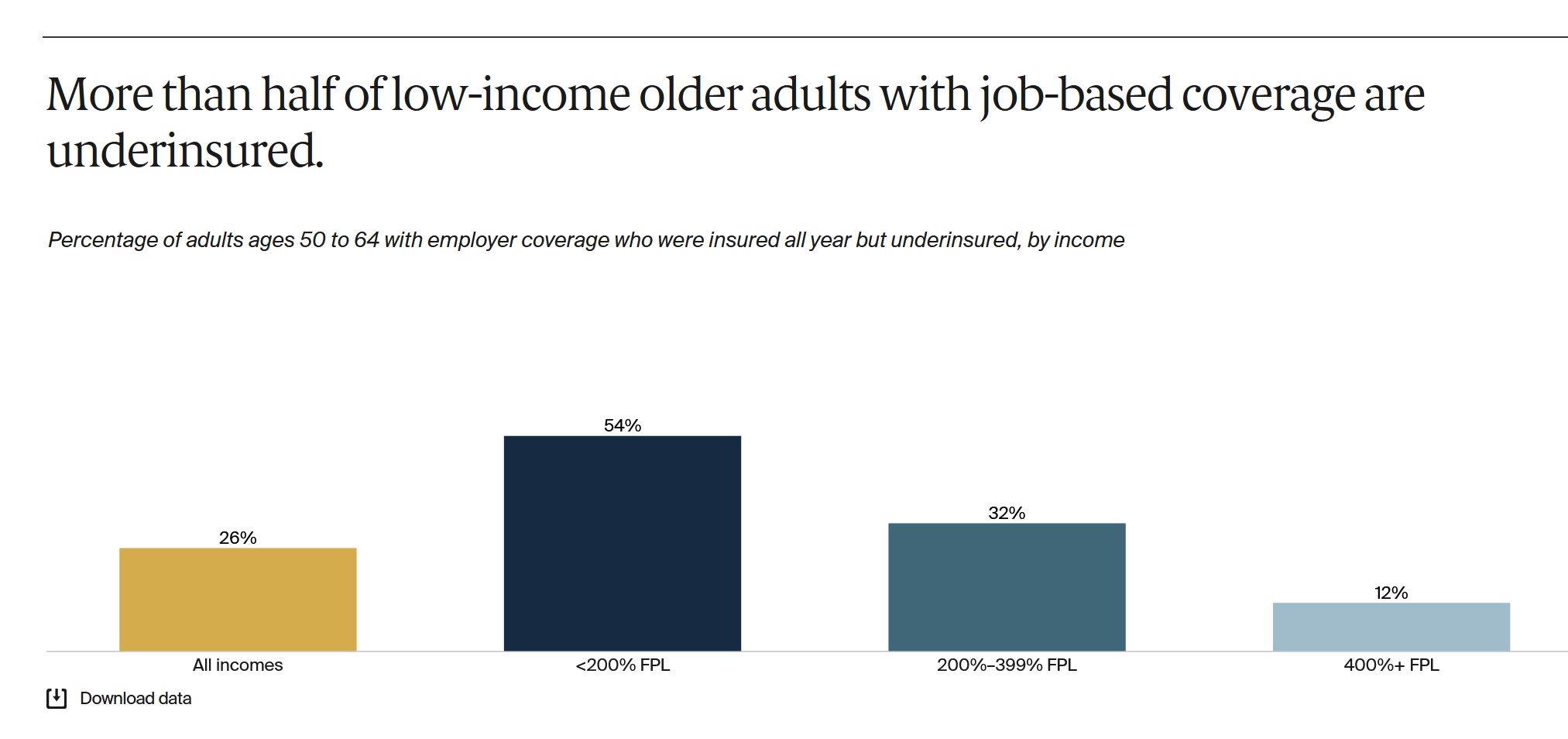
The Commonwealth Fund looked at the coverage and costs for older-but-not-yet-Medicare adults 50-64 in ‘Can Older Adults with Employer Coverage Afford Their Health Care?’ by Lauren A. Hayes and Sara R. Collins (August 10, 2023). A majority of these folks have private insurance through their employers (55%) with higher income (>400% of the Federal Poverty Level, FPL) at 82% and low income (<200% FPL) at 22%. It wasn’t enough. More than half of low-income and more than 1/3 of middle income (200-400% FPL) people had difficulty paying their premiums and didn’t get adequate medical care because of the cost. Unsurprisingly, those worst affected were not only low-income but sick; the issue of paying for health care is greatest when one has health problems.


The Kaiser Family Foundation study, ‘Medicare Households Spend More on Health Care Than Other Households’, by Nancy Ochieng, Juliette Cubanski, & Anthony Damico (July 19, 2023) examined adults over 65, those on Medicare. They found – well, what the title says. Again, not surprising; older people are sicker, and sicker people use more healthcare (duh!) and it costs them more. While Medicare is a federal government program, there are still out-of-pocket costs associated with it. For hospital care (Medicare Part A, funded by your paycheck deduction), traditional Medicare (TM) pays only 80% of approved charges, which means sick Medicare recipients have to come up with the other 20% (which can be a huge amount of money) or have a Medicare-supplement policy to cover it, which of course costs additional premiums. Medicare recipients also have to pay a monthly fee for Medicare “Part B” (the “outpatient” portion) which usually is deducted from their Social Security payments. At least this is tiered, so higher income people pay more and lower income less (or sometimes nothing). Also they have to pay for a drug plan (Part D). 


About half of Medicare recipients are now in “Medicare Advantage” (MA) plans, which are essentially HMOs. I have written about them previously, but because they are not actually Medicare (although paid for with Medicare dollars) but private insurance, they have the ability to deny coverage altogether. They have good perks if you don’t need expensive care (often no co-pays, no 20% coinsurance, drug coverage so no need for a separate Part D plan, coverage for some things TM doesn’t cover like glasses and hearing aids) which make them attractive to healthier seniors. But while TM covers (if only at 80%) the things it says it covers, and doesn’t deny individuals, MA can and does. So while Medicare Advantage can be advantageous for some seniors, its greatest advantage is to the insurance companies.

Indeed, that some people are better off with one type of plan and others with a different one is both understandable and OK. But that the difference is whether you are sick or not is dangerous, since the non-sick can quickly become sick, especially if they are elderly. That we try to segment public opinion by pitting the sick against the not-yet-sick (“I’m doing ok, and can afford my premiums and healthcare, for now”) is what is truly sick, and intolerable. It is a marker of a reprehensibly designed system.

The authors of the Commonwealth Fund report have a number of suggestions for addressing the problems that they identify, all of which are tweaks to our current system, and, in the unlikely event that they were implemented, would immediately be “gamed” by the power players – the insurance companies and the health systems – to ensure that there would still be lots of people left out, lots of people suffering. Their suggestions do not entail scrapping the entire for-profit insurance system that strangles the health of our people in favor of an adequately-funded single payer system, but rather the creation of new programs, and new rules to try to limit the damage caused to the health of older Americans by a system that simply should not exist

Seniors can be attracted to MA plans because of the costs TM doesn’t cover, especially the 20% of hospital bills. Those in MA plans, as well as those “younger” – still employed – older people in employer-based insurance plans can be financially screwed because those plans are operating with the goal of making money for the companies, not ensuring health care. The fact is that both problems could be addressed together – by getting rid of the profits and costs of insurance companies, enough money could be saved to cover 100% of all health care needs for Medicare recipients. One could say this is “ironic”, if it weren’t for the fact that irony implies lack of intentionality, and this criminally flawed and abusive system is clearly intentionally structured.

Dr. Don McCanne, who reported on this in his recent “Health Justice Monitor”, writes

Should that be the primary mission of our health care administrators? Of course not! Their primary mission should be to move health care to the people, the patients, all of the patients, and they need to use our health care dollars to do that. Our current system has demonstrated beyond any doubt whatsoever that private administrators have been and always will be on the wrong mission, and we need to replace them with public administrators who will always pursue a mission for the public good.”

Yes. Stop trying to make deals with the devil. Those companies, including insurance companies, taking money intended to provide healthcare as salaries and profit are evil, and it is hard to think of the legislators and executive-branch functionaries who facilitate and enable this as anything else.

Our government should use its (ie, our) money to fund our promises for healthcare to our seniors, not insurance companies who pay them back with graft.

Friday, July 7, 2023

Consumer experiences with health insurers: Not always good

I have often written about the particular burdens that people with no health insurance have accessing adequate healthcare. However, these problems affect Americans with health insurance as well. To look more into the experience of insured Americans, the Kaiser Family Foundation (KFF) did an extensive poll on consumer experiences with health care insurance to understand

how health insurance works involves exploring how people feel about their health coverage, how affordable that coverage is, how they interact with their insurance provider, the problems they experience, and, critically, how insurance works for people when they get sick.

The findings often seem to be in conflict, but this is largely because different people are experiencing different things. For example, 81% of people surveyed (91% of those with Medicare) rated their insurance as “excellent” or “good”, but for those who described their own health as fair or poor, that satisfaction was down to 68% (still a large majority, but a lot lower). This is to be expected; insurance in general is something you hope to not use, and when things are going well and you don’t need it, it functions well (except for those premiums). When you have not had a fire in your house, or a car wreck, or a close relative die, your homeowner’s, automobile, or life insurance are working just fine. What matters is how they function when you have a need. And health insurance is different from other forms of insurance because, for a bunch of bizarre historical reasons, it is the common, routine and accepted method of paying for your health care, not something you buy hoping to never have to use like other insurances. And, yet, when you get sick, and need hospitalization, surgery, cancer treatment, etc., is when the rubber meets the road, and why sicker people are less satisfied.


Let’s spend a little more time with this. It doesn’t matter much if you are happy with your health insurance when you are well if it is not going to serve you when you need it.  While that could be never, it is unlikely; if you are young and healthy, you will get old – or get sick sooner. If you are middle-aged or older and are healthy, terrific – until you are not. You may ‘not have been sick a day in your life’, and that is good, but then one day, you find out you have cancer. Or are in a car wreck. Or a pretty-well-controlled chronic condition gets out of control. Being concerned about the minority of people and their health and insurance coverage is not just a matter of social responsibility (although that is important) because there is a great likelihood you will be too, one day. Maybe not soon. Or maybe soon.

 Remember also that, although this poll (and others) are one-time snapshots, the group of people who are sick is not static. Over time (say looking at it each year), some people who used to be in that group leave it – either through recovery or death. Others join it. This is how the magic of consultants work – hire us and the 1000 most costly people you had last year will cost you, as a group, less this year. Of course.

Going beyond this issue, the KFF poll found other seemingly contradictory information. Despite expressing a high degree of satisfaction with their health insurance, people also identified a lot of problems.

A majority of insured adults (58%) say they have experienced a problem using their health insurance in the past 12 months – such as denied claims, provider network problems, and pre-authorization problems.

Unsurprisingly, this rate was higher (about 2/3) among sick people, but was still well over half of those in good health. And, furthermore, only half of those who had problems with their insurance were able to resolve those problems to their satisfaction; a significant number of folks simply did not get the health care that they need. And these problems were even worse among some groups of people, such as those with mental health problems.


Trying to understand these seemingly contradictory findings can be hard, but clearly some horrible psychological factor is present which allows the American people to think something is “good” when it is not because their expectations have been so diminished. It is likely that some of this is “well, it’s not as bad as I was afraid it might be” or “it’s not as bad as what happened to my neighbor or cousin”. If you set the bar low enough, a lot of bad can pass over it. Note that the cycle of bad that affects Medicaid recipients even more than others – poverty makes illness greater, and makes it harder to get treatment and to recover, and illness increases poverty. To be “satisfied” with your health insurance should not require you to be without healthcare needs!

Good healthcare is something quite different. It is getting all the care you need (and none of the care you don’t need) promptly, efficiently, courteously, and affordably. It should not require long waits to get into see a clinician or to get into a hospital. There should be adequate staffing, both of medical professionals such as doctors and nurses and other staff necessary. There should be no out-of-pocket cost for medical services (or a very minimal one which can be waived for the poor). It should be paid for proactively by “social insurance” (such as traditional Medicare) and adequately funded for 100% of the cost (unlike, currently, traditional Medicare). This does not mean the wealthy should not pay more, but they should do so through higher taxes to support this health system, not when they are ill. The randomness of “you pay today because you got sick or injured, I don’t (until, maybe tomorrow, when I am)” should be abandoned.

Standards for approved drugs and procedures should be established by independent scientific panels whose members are forbidden from taking corporate dollars. Such standards may be more or less restrictive, but must be applied equitably to everyone regardless of where they live or their ability to pay. Inequity has no place in healthcare.

And, of course, all profit-making must be eliminated. This means from both for-profit and ostensibly non-profit hospitals and other healthcare facilities like long-term care, insurance companies, device and drug manufacturers, and other parasitic leeches. Indeed, we could keep private insurance companies, provided they are adequately regulated – i.e., they must provide all the same benefits and must charge the same amount and not be permitted to make a profit. This would require them to compete on the only legitimate factor, customer service. Let the ones who don’t do a good job go out of business. This is more or less the Swiss model. There are several potential models, but all must include financial and service equity for all.

They should not be about being happy with your insurance because you didn’t get sick, or because they screwed you less than you feared they might!


If you want a little laugh, read this by Kendra Allenby from the New Yorker. But somehow, if you have ever been in the hospital, I don’t think you’ll laugh too hard because it will be too familiar.

Total Pageviews