Showing posts with label Don McCanne. Show all posts

Thursday, August 1, 2024

Racism and lack of social services: The status of women's health care in the US

A recent publication from the Commonwealth Fund is the 2024 State Scorecard on Women’s Health and Reproductive Care in which they rank all the states (plus DC) for how well that care is provided and the health status of women that results. The map below gives an overall sense (darker is worse), and the entire ranked list can be found in an interactive table in the document. 


The first thing that we see is that there are no real surprises. Massachusetts is at the top and Mississippi is at the bottom. The other top and bottom states are the usual suspects for almost anything that is beneficial to people, with the Northeast doing best and the old Confederacy doing the worst. There are always some minor shifts within those groups, and in this ranking we see that Louisiana* and South Carolina are only “worse than average” not in the “bottom performing states”, while disappointing to me, Arizona and New Mexico are in the lowest group. The reasons are a little different in different states; the Arizona legislature is (narrowly; we hope to flip it this year) controlled by Republicans who are as mean and nasty as those in the deep south. New Mexico is controlled by Democrats, but it is very poor. Poor is a big component of health status, and its fingerprints are all over this data on women’s health.  ‘Despite a small rebound in women’s life expectancy in 2022, it remains at its lowest since 2006,’ says the report.

Abortion care – access to it and the quality of it – has dominated the national political discussion. I don’t want to minimize it; it is incredibly important that women can have abortions, it is a privacy issue, and it will hopefully have major negative repercussions for the party whose agenda is to limit it. That the greatest restrictions on abortion are in the same states that have the worst women’s health status is neither a coincidence nor a surprise; the people who control these states and are anti-abortion are also racists and are unwilling to provide funds to improve the health standards of people who are women, minority, or poor – and especially all three. But it goes far beyond abortion:

For health outcomes, we measured all-cause mortality, maternal and infant mortality, preterm birth rates, syphilis among women of reproductive age, infants born with congenital syphilis, self-reported health status, postpartum depression, breast and cervical cancer deaths, poor mental health, and intimate partner violence.

Abortion is not the major component of poor reproductive health status. Maternal mortality rates are shockingly high in the southeast, and worst in the Mississippi Delta. The US overall does not do very well in this area, especially as it is the richest country in the world. Data from the CIA (!) shows that in 2020, the US maternal mortality rate overall was 21/100,000, tied with Lebanon, Grenada, and Malaysia and just slightly worse than the West Bank or (pre-war) Gaza Strip. This was (and remains) much higher than Canada (11), UK (10), and most of Europe, including eastern Europe at 5 or less! (Note, showing the same dramatic racist differences as in the US, Israel is at 3). Of course, this overall rate in the US is driven by the states with the highest rates, with the worst states having a range of 34.1-51.7! While this is largely the result of excessively high rates in minority women, it is worth noting that the maternal mortality rate for white women in the US is over 19!


This is a good time to discuss the segmentation of results for maternal mortality (and all-cause mortality, and really most things) by race or ethnicity. In the bizarre, perverted, and of course racist excuse provided by many (racists) for why the US’ maternal mortality is so high compared to civilized countries, it is often said “it’s the minorities that drive the rate up”. In addition to ignoring the excessively high rate for US whites (19) it is scarcely an excuse; indeed, it is an indictment. It is not only that the US, unlike civilized countries, does not provide health care for everyone, essentially free of charge at the time of service (that is, paid for by tax revenues, as well as costing a lot less because of the elimination of the incredible profits extracted by middlemen such as insurance companies in the US). It also provides lousy social services of all kinds, not ensuring, as civilized countries do, housing, food, and education for everyone. These (the “social determinants of health”) are even more important than medical care in creating improved health status. And, while other countries do spend much more money than we do on providing them, the total cost per capita is probably less than what the US spends on health care alone! Of course, much of the spending (particularly on social services and health care for the poor, like Medicaid) is on a state basis; that is why there are such differences between the Massachusetts’ and Mississippi’s in this Commonwealth Fund study. And what are the practices that work? Again, no surprise:

In our scorecard, states with the lowest rates of maternal mortality had:

·       more maternity care providers (Vermont #2, Connecticut #3)

·       fewer women with no prenatal care (Vermont #1, California #3, Connecticut #5)

·       fewer women with no postpartum checkups (Vermont #1)

·       fewer uninsured women ages 19–64 (Vermont #3)


It cannot be stated too strongly that public funds should support a public social safety net, not bloat the profits of private companies as they do here in the US! This is most well-documented for the piggish pharmaceutical industry and the entirely unnecessary (indeed, far worse than unnecessary, destructive and evil) for-profit health insurance industry, which I have discussed many times. But it is also the other parts of the health care industry, particularly delivery systems (e.g., hospitals). Yes, the for-profits, hospitals and nursing homes and other facilities, especially those run by corporations. But it is also the ostensible “non-profits”, which do their best to emulate for-profits by doing everything possible to exclude patients without insurance or with Medicaid, pay their CEOs (and other C-suite executives) exorbitant salaries, and channel huge earnings into subsidiaries that actually own or invest in for-profit enterprises! This is documented in Why many nonprofit (wink, wink) hospitals are rolling in money by Elisabeth Rosenthal (Washington Post, July 29, 2024) and discussed by Don McCanne in Health Justice MonitorNot-for-profit care begets profits’. Dr. McCanne cites a study by KFF showing even a program providing “street medicine”, healthcare for the homeless, in California is making money by getting huge amounts of Medicaid funds. Providing health care to homeless people is a good thing, something we need more of. If I had my druthers, I would rather see them making money than huge “non-profit” hospital systems (or of course straight for-profits, although those at least pay taxes), but they shouldn’t be either.

In health care, and in all social service, all the public money should go to providing direct care (OK, maybe with a 2% overhead, like Medicare – but NOT Medicare (Dis)Advantage – has). Zero dollars should go to profits (or “excess” income that can be invested for profit), bloated salaries, and the like.

We have too many people, women and others, dying because of the lack of such care.


*Louisiana just put the two drugs used for medication abortion, mifepristone and misoprostol, on its state’s controlled dangerous substances list, like narcotics. So look for LA’s ranking to drop!

Tuesday, August 22, 2023

Older adults cannot afford healthcare even if they are insured: Time for a new system!

Are health insurance companies the real enemy of Americans’ health? A strong argument can, and has been, made by myself and others that they are. More broadly, however, the enemy is all the companies that pursue making money as their primary goal, with providing healthcare a sideline (albeit a costly one). So many corporations are involved and responsible that it is hard to be sure that insurance companies are the main ones at fault. “Even” actual health care providers – mainly hospitals and “health systems” – try to squeeze out the poor and poorly insured and greatly prefer to deliver only the most high-profit-margin care. And, certainly, one cannot leave out the drug companies, making gigantic profits at the cost of our health (they remain #1 in profits, every year), or the less-well-known but also very dangerous “PBMs”, pharmacy benefit managers, who bundle our drug plans, and act as middlemen between the insurers and the drug companies and the providers. (You notice I didn’t say “consumer” or “patient”; they are no more than grist for the profit mill!)

But one can still make a strong case for insurance companies being at least a major cornerstone of the evil empire, sucking money out of government coffers, employer contributions, and, yes, your pockets, for the privilege of denying you care and padding their bottom lines. Long noted for their unwillingness to cover everyone, the insurance industry is moving the needle by providing poor coverage even to those it does insure. Two recent studies have looked at the financial burden on older adults provided by health care, one at those with private insurance and the other at those with Medicare.

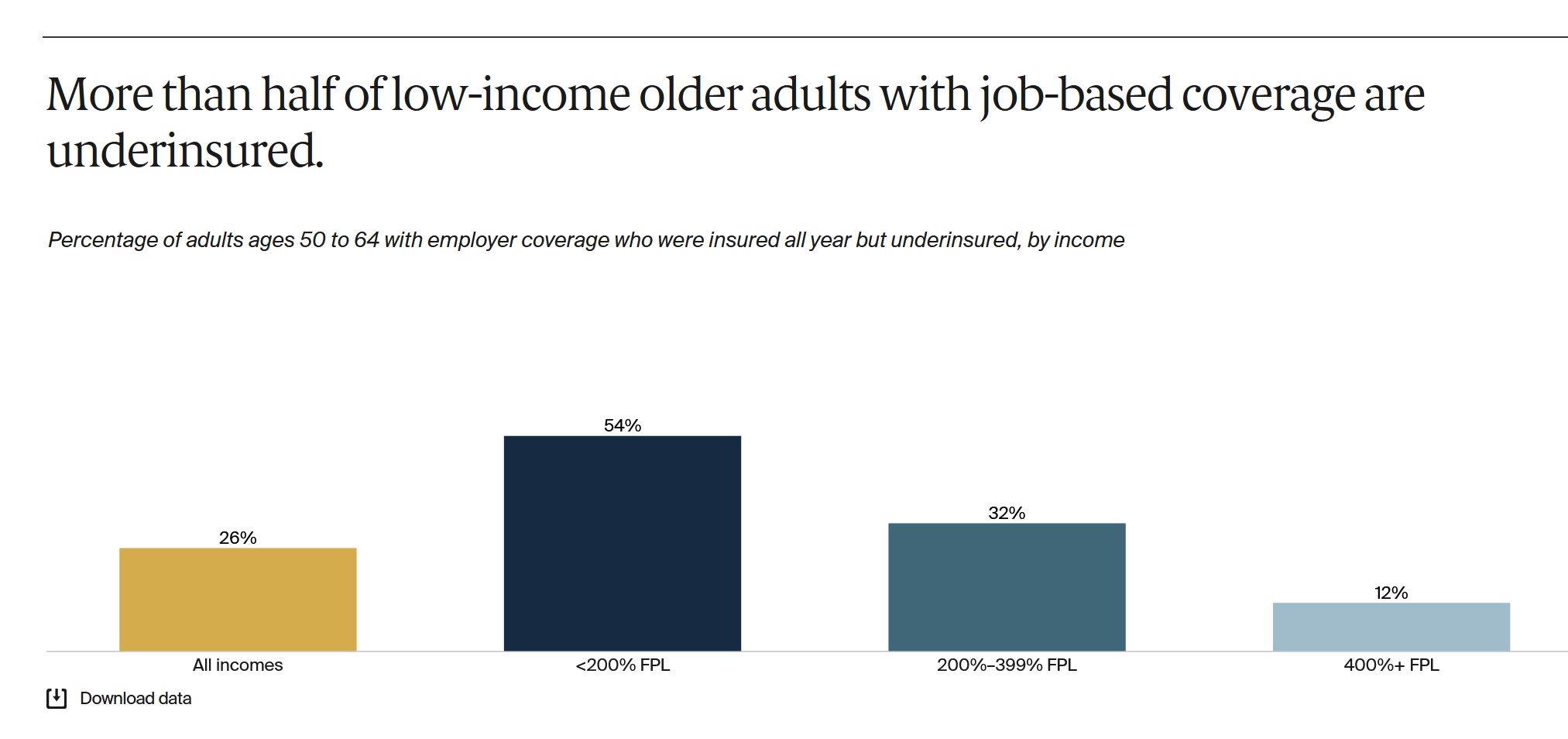
The Commonwealth Fund looked at the coverage and costs for older-but-not-yet-Medicare adults 50-64 in ‘Can Older Adults with Employer Coverage Afford Their Health Care?’ by Lauren A. Hayes and Sara R. Collins (August 10, 2023). A majority of these folks have private insurance through their employers (55%) with higher income (>400% of the Federal Poverty Level, FPL) at 82% and low income (<200% FPL) at 22%. It wasn’t enough. More than half of low-income and more than 1/3 of middle income (200-400% FPL) people had difficulty paying their premiums and didn’t get adequate medical care because of the cost. Unsurprisingly, those worst affected were not only low-income but sick; the issue of paying for health care is greatest when one has health problems.


The Kaiser Family Foundation study, ‘Medicare Households Spend More on Health Care Than Other Households’, by Nancy Ochieng, Juliette Cubanski, & Anthony Damico (July 19, 2023) examined adults over 65, those on Medicare. They found – well, what the title says. Again, not surprising; older people are sicker, and sicker people use more healthcare (duh!) and it costs them more. While Medicare is a federal government program, there are still out-of-pocket costs associated with it. For hospital care (Medicare Part A, funded by your paycheck deduction), traditional Medicare (TM) pays only 80% of approved charges, which means sick Medicare recipients have to come up with the other 20% (which can be a huge amount of money) or have a Medicare-supplement policy to cover it, which of course costs additional premiums. Medicare recipients also have to pay a monthly fee for Medicare “Part B” (the “outpatient” portion) which usually is deducted from their Social Security payments. At least this is tiered, so higher income people pay more and lower income less (or sometimes nothing). Also they have to pay for a drug plan (Part D). 


About half of Medicare recipients are now in “Medicare Advantage” (MA) plans, which are essentially HMOs. I have written about them previously, but because they are not actually Medicare (although paid for with Medicare dollars) but private insurance, they have the ability to deny coverage altogether. They have good perks if you don’t need expensive care (often no co-pays, no 20% coinsurance, drug coverage so no need for a separate Part D plan, coverage for some things TM doesn’t cover like glasses and hearing aids) which make them attractive to healthier seniors. But while TM covers (if only at 80%) the things it says it covers, and doesn’t deny individuals, MA can and does. So while Medicare Advantage can be advantageous for some seniors, its greatest advantage is to the insurance companies.

Indeed, that some people are better off with one type of plan and others with a different one is both understandable and OK. But that the difference is whether you are sick or not is dangerous, since the non-sick can quickly become sick, especially if they are elderly. That we try to segment public opinion by pitting the sick against the not-yet-sick (“I’m doing ok, and can afford my premiums and healthcare, for now”) is what is truly sick, and intolerable. It is a marker of a reprehensibly designed system.

The authors of the Commonwealth Fund report have a number of suggestions for addressing the problems that they identify, all of which are tweaks to our current system, and, in the unlikely event that they were implemented, would immediately be “gamed” by the power players – the insurance companies and the health systems – to ensure that there would still be lots of people left out, lots of people suffering. Their suggestions do not entail scrapping the entire for-profit insurance system that strangles the health of our people in favor of an adequately-funded single payer system, but rather the creation of new programs, and new rules to try to limit the damage caused to the health of older Americans by a system that simply should not exist

Seniors can be attracted to MA plans because of the costs TM doesn’t cover, especially the 20% of hospital bills. Those in MA plans, as well as those “younger” – still employed – older people in employer-based insurance plans can be financially screwed because those plans are operating with the goal of making money for the companies, not ensuring health care. The fact is that both problems could be addressed together – by getting rid of the profits and costs of insurance companies, enough money could be saved to cover 100% of all health care needs for Medicare recipients. One could say this is “ironic”, if it weren’t for the fact that irony implies lack of intentionality, and this criminally flawed and abusive system is clearly intentionally structured.

Dr. Don McCanne, who reported on this in his recent “Health Justice Monitor”, writes

Should that be the primary mission of our health care administrators? Of course not! Their primary mission should be to move health care to the people, the patients, all of the patients, and they need to use our health care dollars to do that. Our current system has demonstrated beyond any doubt whatsoever that private administrators have been and always will be on the wrong mission, and we need to replace them with public administrators who will always pursue a mission for the public good.”

Yes. Stop trying to make deals with the devil. Those companies, including insurance companies, taking money intended to provide healthcare as salaries and profit are evil, and it is hard to think of the legislators and executive-branch functionaries who facilitate and enable this as anything else.

Our government should use its (ie, our) money to fund our promises for healthcare to our seniors, not insurance companies who pay them back with graft.

Sunday, March 21, 2021

"Values" based care: Public Health, Primary Care, and Medicare for All

Recently, a class of undergraduate freshmen I teach debated the issue “Health Care is a Human Right”. Although we later determined that most of them personally supported that statement, the “no” team did a good job marshalling the arguments of opponents, often citing those of libertarian think tanks such as the CATO Institute (originally founded as the Charles Koch Institute, in case that helps), which identifies itself as promoting "free markets and individual liberty”. This includes identifying health care as a “commodity” and opposition to health care as a right (and thus to universal health coverage) as an infringement upon individual liberty. Essentially these two concepts boil down to the idea that the individual is free to decide what kind of health care they want, or don’t want, and what kind of insurance coverage they want, or don’t want, and can use their money (or not) to purchase this commodity (health care) as opposed to another (I don’t know, say a bass boat).

The hole in this argument is wide enough, though, to drive a bass boat through. It is that not everyone has such a large amount of disposable income that they have the financial options to make such decisions. An old point about commodities having to do with cars, when most Americans bought American brand cars, is that some folks can buy Cadillacs and others Chevrolets. But of course, even if we update this to Beemers and Kias, there are a huge number of people who are buying used cars – often old “junkers” – to try to get to work and shopping. And there are those who can’t afford to buy, insure, and run any car at all and are reliant on public transportation. If there is any public transportation where they live. People without a lot of money (often despite working multiple jobs, even those making quite a bit more than the federal minimum wage of $7.25/hour -- last raised in 2009 when $7.25 was equivalent to about $9 today) make regular trade-offs on what they will spend their money on. Rent? Food? Clothes for the kids? Heat? Electric bill? Gas for the car to get to work, if they have a car? Health and medical care are rarely right up there at the top unless they are actively ill. Indeed, often even chronic diseases don’t get adequately managed, with medications for common conditions such as diabetes and hypertension stretched out. This family – and to a greater or lesser extent, this is probably true of the majority of families – is trying to figure out how to juggle absolute necessities, not luxury goods. The students arguing the “anti” position gamely tried to respond to such concerns, but learned that, outside the walls of conservative think tanks, Congress, state legislatures, and country clubs, there is a limit to the effectiveness of continually repeating “individual liberty” and “commodities”.

Paying for the cost of health care is a real juggling act for the government, although for a different reason from the one the families above are doing. It is balance between wanting to spend less money and continuing to support the profits of health care corporations such as insurance companies, hospital systems, and drug makers. The rational solution to this problem is to decide that it is not the government’s business to guarantee the often obscene profits of such private corporations, but rather to spend the money on whatever maximally increases the level of health of the American people.

This should include at least two major changes: first, a national health insurance plan (such as “Medicare for All”, recently reintroduced with major improvements by Reps. Pramila Jayapal and Debbie DIngell) that ensures that everyone is covered – everyone, all in one plan, no exceptions by age, disease, etc.), and second, a massive and continuing re-investment in public health, the need for which should have been made clear by the COVID pandemic. Historically in the US, in Democratic and Republican administrations, funding for public health is about 1% of the health budget, with the rest going to individual medical care. When we have a crisis, we bemoan the lack of public health infrastructure for a while, but then it recedes. Yet this is the most important component of keeping us healthy. Fighting an active enemy (like COVID) can garner support, while maintaining programs of prevention absent an obvious crisis gets less. How often do we wake up and say “I’m glad I don’t have cholera today because we have clean water and sewage”? And, yet, recently folks in Mississippi and Texas can count themselves lucky that their lack of water did not come with cholera or another infectious disease.

Instead of such wholesale reimagining we have had programs like “value-based care” for Medicare, adopted with the ACA (“Obamacare) in 2010. When this was first rolled out, I was enthusiastic because I misunderstood it – I thought it was about providing care based upon values, presumably decent human values. Sadly, I was wrong. It was about spending less money. Did it work? To do what? If the goal was spend less, yes, to some degree (see Austin Frakt in the NY Times Upshot Oct 9, 2019, “more singles than home runs”). One of the big goals was to substitute “value” for “volume”. Paying for volume, the number of patients seen, was the accepted way to pay doctors. But what does paying for value mean? This whole issue is reviewed by Dr. Don McCanne in his “Quote of the Day” for March 17, 2021 “Policy community hung up on ‘volume to value’”. Dr. McCanne reviews the recent article “The Future of Value-Based Payment: A Roadmap to 2030” from the University of Pennsylvania on the topic, but in his comments he notes that

“All health care has “volume” – time, effort and resources devoted to health care. Volume varies tremendously depending on the clinical situation. Think of management of a common cold as opposed to management of severe multiple injuries in an accident. Can payment schemes ignore volume? Of course not. Volume is built into the problem.”

Here is a volume/value solution that I have discussed before but will now say clearly: Revise the way that physicians (and other providers) are paid so that family physicians and other primary care doctors make at least as much as those providing subspecialty care. This is the third step to add to universal health coverage and investment in public health. When I go to a shoulder orthopedist for the pain in my shoulder, that is the ONLY PROBLEM they deal with. Not BP, not abdominal pain, not my cold -- not even the arthritis in my knees.  My PCP would deal with every problem on my – and all their patients’ -- problem list (to greater or less extent, depending upon severity and acuity), and thus rarely has enough time for any on person. If you go to the cardiologist, and mention that you have knee pain, they say "I don't do knees; here is a referral to the orthopedist". And you go to the orthopedist, they make a recommendation, you come back to the cardiologist who says "I don't do knees; whatever they said". So, for the subspecialist, referral is a time saver.

But if you come to a PC doc and say your knee hurts, they make some diagnostic and treatment suggestions. After examining your knee, maybe ordering imaging and lab, and thinking about it, if they think it might need surgery, they might refer you to the orthopedist. Then you go and the ortho says "maybe surgery", so you come back and ask your PC doc’s opinion, so they read the whole consult and review the films and think about it and discuss it with you. Result: referral for a PC doc makes MORE work.

And they get paid less.

PC docs need more time with everyone, and thus fewer patients each day/week/year. How much money should they make? I don't care, pick a number, but it should be able to be earned by seeing no more than half the number of visits that they currently do. People's complaint is ALWAYS about not having enough time with the doctor.  

So, increase funding for public health, develop a universal single-payer health insurance system, and pay PC docs at least as much per hour or patient as the highest-paid subspecialist in the outpatient setting. 

Now we begin to have “value”!

Sunday, February 2, 2020

Yes, it's the insurance and drug companies, but it's the health systems also!

Much of the focus in discussions about the high (extremely high!) cost of the US healthcare system is on administrative costs (over 34%, per Annals of Internal Medicine article by Himmelstein, Campbell and Woolhandler)[i] and the profits taken by insurance companies and drug companies. This is totally right on, and are major reasons why a single-payer #Medicare4All system would save enough money to not only cover the tens of millions of Americans who currently do not have health insurance, but to provide decent, comprehensive coverage to the majority of Americans who have inadequate health insurance. This, of course, includes those who have marginal health insurance (like Blake Collie, an 8 year old boy with a cerebral aneurysm, whose parent bought a Christian insurance plan that was all they could afford, but would not pay for the treatment; the advice was “trust in God”), and those who have Medicaid, now aggressively being cut back, especially with new Trump Administration policies that allow states to slash it. And all the rest of us who pay large premiums but only find out what our insurance doesn’t cover and what our co-pays will be when we get sick. And then we get sicker.

In addition, we have Medicare Advantage (MA, also known as Medicare Part C) a deal which essentially can make a Medicare patient (for a little extra premium) an HMO patient.  For the patient this comes with the typical HMO advantages (such as vision and hearing and other coverages, and usually drug coverage so you don’t need a separate Part D insurance plan, and often little or no co-pay) and disadvantages (limited networks of doctors and hospitals, often poor out-of-area coverage), but it has real negative impact on the health system. MA programs get special treatment from the Center for Medicare and Medicaid Services (CMS), including a big increase in payments if they can demonstrate, with all the wizardry, bells-and-whistles, and large staff combing and padding the Electronic Health Record (EHR) that their patients are sicker. In fact, they are demonstrably less sick than traditional Medicare patients; indeed, the older and sicker MA patients are encouraged, subtly or not, to transfer to traditional Medicare. A recent article by Richard Kronick on the Health Affairs blog demonstrates that MA programs are being overpaid by $200 Billion. This is real money, and it is not by accident, as discussed by Don McCanne in his Quote of the Day.

But the less-discussed contributor to our high health costs are the hospitals and health systems that make big money. This is true even when those health systems are ostensibly not-for-profit. The for-profit hospitals and health systems are at least open about it, and they pay taxes. Non-profits do not pay shareholders, and also do not pay taxes. The presumed reason for this is because of the public service that they provide to their communities. But while this may be true of many small-town and rural hospitals, which are also in the most danger of closing and leaving their communities bereft of hospital care, it is often not at all the case for large urban health systems. They make money. For example, an interview on the NPR program “1A”, otherwise focused on the Peak Health System in Summit County, CO that has had some success in reducing costs in that rural tourist county, the Colorado insurance commissioner Michael Conway discusses the proposal for a “public option” in his state and notes that asking hospitals to give back a little is not too much for the urban hospitals making $2 billion a year (about 28 min in).

And, since they do not have shareholders to pay, the health systems reinvest most of the money they make into expanding hospital services or building new buildings. This could seem like a good thing, except that the choice of what services to expand is often (usually) based not on what services the community needs most, but what services will – make them more money! And, also, hopefully make them more desirable destinations for high-margin services than the other urban hospital systems with which they compete. So if, as is usually the case, cancer care and heart disease care and orthopedic care are big money-makers, they build fancy new cancer hospitals and heart hospitals and orthopedic hospitals to try to draw well-insured patients away from their competitors. Thus, we get redundancy and overcapacity in these high-end services in competitive cities, with each shiny new cancer center seeking to lure patients from the one that’s a few years older across town.

Meanwhile, these urban communities do have other, less lucrative, needs that are scarcely ever the target of major investment. In a rational system, the money made on those “profitable” services could be used to invest in and subsidize lower-profit (or in some cases money-losing) services that are in great demand in the community. These certainly include primary care, mental health/behavioral care, drug addiction treatment, and virtually any care delivered to poor or uninsured people. A reasonable health system would just subsidize this care, and not bill and dun people repeatedly for money that they do not have, and cannot and will not pay, ruining their credit, attaching their wages, and challenging their ability to pay for other things, like shelter, food, and clothing.

But privately-run health systems almost never work this way (even if “non-profit”) because their boards like them to make money. And reward them for making money. An article in GQ in April, 2019, reports that CEO salaries at our big health system are doing very well indeed; at the 62 largest, the 2018 salary averaged $18 million! The other “C-suite” executives (COO, CFO, CMO, etc.) are also very well paid; it would not be rare for a major hospital system to have 10 executives making over $1M a year. These CEOs are sometimes doctors, but often accountants or MBAs – basically they run their hospitals as a business, and often have no other context to relate to. When thinking about community benefit, they think of “community” as the “community of well-insured”, the “community of suburbanites”, and of course, especially the “community of potential donors” (cool that they can even get people to give them money and take a tax write-off!). They almost never think of the “community of need”. They are sometimes briefly interested as long as government will give them money for helping the needy, but return-on-investment (ROI) is always measured in dollars, not population health.

This is what happens when the private sector is given control of an industry; they pursue their own benefit. It is unconscionable that we do this in areas like health care which are needed by everyone. Virtually all decisions are made with their eyes on the bottom line. Is CMS going to pay for more residents? Let’s get more cardiology fellows to do procedures and make us money, not more family medicine residents who will go out and meet the needs of people, even if not in our hospital.

There are people who are concerned about government-run health care, and this spills over to their concern about government-financed health care, such as Medicare for All. The problem is that there is a status quo, and that status quo is destructive to the health of our people.

It needs to change.


[i] Himmelstein DU, Campbell T, Woolhandler S, “Health Care Administrative Costs in the United States and Canada,
2017”, Ann Int Med, doi:10.7326/M19-2818, published online Jan 7, 2020.

Saturday, March 2, 2019

Medicare for All, Compromise, and who gets left out


As the movement for Medicare for All gains steam, with the new bill, HR-1384, being introduced by Rep. Pramila Jayapal (D-WA) and 100 co-sponsors (video available on PNHP Facebook page), the attacks have, unsurprisingly, started coming. They are hard and soft, overt and subtle. The overt attacks on it from Republicans who call it “socialism” are probably the least important. They, and the folks for whom socialism is a buzzword that has them throwing up their hands in horror, were never going to support it or any effort to have universal health insurance, and are probably not going to support any less-extensive compromise. On the other hand, they could learn something by reading about the experiences of people in the all-the-other-industrialized-countries-in-the-world who have some form of universal health care. For example, the recent piece in the Washington Post by an American studying in Taiwan,  uninsured in either country, whose abdominal pain nonetheless led him to go to the ER at 3am. He was seen and given treatment in 20 minutes, had lab tests and imaging studies, was diagnosed with a stomach virus and given 2 medications, and sent off. Total cost: $80. (March 1, 2019)

The real threat, unsubtle and incredibly well-funded, is from the insurance and hospital corporations (and “non-profit” health systems) who are responsible for about 30% of all dollars spent on health care in the US being for administrative costs (including their huge profits) and not actually health care. They are a major cause of the high cost of health care in the US, and stand to lose the most if Medicare for All is implemented, because it will be funded in large part by taking that money away from them. Thus, they are highly motivated to attack any such attempt, organized to do so, and are already doing it, as clearly presented in Health Care and Insurance Industries Mobilize to Kill ‘Medicare for All’, NY Times February 23, 2019. This will ultimately be the real fight, incredibly wealthy companies that would lose a lot of money will do almost anything to keep it, even though it will prevent a change in the current crazy, costly, poor-result non-system that we currently have, that would benefit the health of all the rest of us.

The more subtle attacks, or perhaps “criticisms”, are from other Democrats and ostensibly liberal media, like the Times. Senator Bernie Sanders (I-VT) sponsors a single-payer Medicare for All bill in the Senate, S-1804, and many of the current candidates for the Democratic presidential nomination are co-sponsors, including Sens. Elizabeth Warren (D-MA), Kamala Harris (D-CA), Cory Booker (D-NJ), and Kirsten Gillibrand (D-NY), and Rep. Tulsi Gabbard (D-HI) is a cosponsor of HR-1384. Sen. Amy Klobuchar (D-MN) and Rep. Julian Castro (D-TX) are not. S-1804 is not quite as good or comprehensive as HR-1384 (the even-better successor to the old HR-676), but this is not the reason almost all of them (except, of course, Sen. Sanders) have stepped back a little from, or danced around, their position on a single-payer program in various interviews with the press. They worry it might go too far, and while want support from single-payer fans, they fear alienating others, or believe that Medicare for All cannot happen, and talk about compromise. Several senators have introduced another bill that would allow people over 50 to buy into Medicare ('Medicare for More', but only if they pay). The Times, however, is getting more supportive; in their February 16, 2019 editorial ‘How Much Will Americans Sacrifice for Good Health Care?’, they move to focusing on the cost and practicality, and no longer say single payer or Medicare for All is not a good thing.

Of course, other leaders of the Democratic Party do not even pretend to support Medicare for All, and cling to the falsehood that the Affordable Care Act (ACA) would be enough if the GOP had not let many of its components expire, and GOP governors had not refused to institute expanded Medicaid in so many states. The classic rendition of this song was performed by House Speaker Nancy Pelosi (D-CA), in an interview in a recent Rolling Stone. Dr. Don McCanne, in his great Quote of the Day, correctly says of Pelosi’s comments:
‘Perhaps most disappointing have been the responses of those who would prefer to continue to support the Affordable Care Act and add a public option - a Medicare buy-in for some…."All I want is the goal of every American having access to health care. You don’t get there by dismantling the Affordable Care Act." Further she says, "When they say Medicare for All, people have to understand this: Medicare for All is not as good a benefit as the Affordable Care Act." Has she been practicing composing Trumpisms? The Jayapal Medicare for All Act is vastly superior to ACA - absolutely no contest.’

“Compromise” is often touted as a good thing, and sometimes it is. Maybe it means you and your partner take turns deciding what movie to see or what to have for dinner. But often compromise is, as noted by business guru Stephen Covey, it is a “lose-lose”, where everyone gives up something they want. If we can find something that is “win-win”, it is of course better. Medicare for All might actually be a “win-lose”, a win for the American people (comprehensive health care for less money) but a loss of enormous profit for the big health and insurance corporations (no tears here).

The most obvious flaw in the logic of the mainstream Democrats is harping on the cost. Yes, it will cost a lot, but the average American family will pay less than they are now in premiums, deductibles and co-payments. The big saving would be in the elimination of the money being made by insurance companies, drug companies, and health systems, and apparently Speaker Pelosi is not ready to cut off their access to the trough. Already, the government pays almost 60% of all health costs (Medicare, Medicaid, coverage for government employees, tax breaks for employer contributions to health insurance, etc.) This means that, in our country, the government already pays more per capita than in most countries that cover everyone. Yes, HR-1384 would expand the benefits of Medicare (‘Improved and Expanded Medicare for All’) to be basically everything with no copays or deductibles, and this would be costly, but those of us who can afford it pay for them anyway, and those who cannot currently do without.

But there is another flaw. All of the folks advocating for less-than-universal-coverage, Medicare-for-More, buy-in to Medicaid for folks not poor enough to qualify now, let’s-not-let-the-perfect-be-the-enemy-of-the-good, are missing something. What they are missing is those people who are not covered or covered with poor insurance that won’t meet their needs if they are sick. All the compromise politicians and pundits seem to forget that these are real people, not just numbers (yes, if fully implemented the ACA covers 90%, but is that enough?). As I wrote in my very first blog post (“Universal Health Coverage”, November 28, 2008), ‘When was the last time, even in private but certainly in public, you ever heard someone say “I’m really suffering without health coverage, but don’t worry about including me and my family in your health reform plan. We don’t want to let the perfect be the enemy of the good.”?’ Those advocating for less than universal coverage need to get out there and tell us who it is that they don’t think needs good health coverage, who can be left out. You? Your Uncle George or Aunt Minnie? Your neighbor? Who are the Americans who they are advocating leaving out?

I can tell you one thing. It won’t be them or their families.

Tuesday, June 26, 2018

Bezos, Buffett, Dimon and Gawande: Better quality in health maybe; a solution, no


A big item of health news in recent weeks is the planned establishment of some sort of health delivery operation by three major corporations personified by their CEOs: Warren Buffett of Berkshire-Hathaway, Jeff Bezos of Amazon, and Jamie Dimon of JP Morgan. We have no details about what it will actually look like, but we are assured that it will be high-quality, efficient, and cost-effective, utilizing the most modern methods of achieving those goals, which our creaky, antiquated, and resistant-to-change health system does not. It will also be non-profit, important given that none of these companies are, but this is the most common model for health care in the US and in itself says very little. As the first concrete step toward its creation, and clue to what it may be, they have appointed Dr. Atul Gawande as its CEO. Presumably he will be instrumental in creating this new venture, and his views on quality and efficiency may provide guidance on what might characterize it.

Dr. Gawande, a Harvard surgeon and senior writer for the New Yorker, has provided us a prolific body of writing in that magazine and in several books, (including the best-seller about issues occurring at the end of life, “Being Mortal”), to help inform us of his views. He has a wide scope of interest in health care and a demonstrated willingness to learn from other industries. Perhaps his most famous article is “The Cost Conundrum”, which appeared in June 2009 and highlighted the wide variation on expenditures by Medicare for similar populations, focusing on the highest cost region, McAllen, TX, and comparing it to a similar population in El Paso, TX, where costs were much lower. Later, in January 2011 “The Hot Spotters” highlighted the work of Dr. Jeff Brenner in Camden, NJ, and others, to use modern geo-mapping techniques to identify the areas with the highest levels of emergency (911) utilization (unshockingly, in Camden, the two highest were a low-income senior citizens housing unit and a long-term care facility) and try to develop methods for addressing their health needs before they became emergencies. In “Big Med”, August 2012, he discusses application of some of the principles that work in restaurants such as the Cheesecake Factory to health care. The principles include enough variety to meet everyone’s needs without expensive unnecessary redundancy; he shows how this applies in orthopedic surgery and how quality is improved and costs saved when every surgeon in a hospital doesn’t use his (or, more rarely among orthopedists, her) favorite implant device and there is some standardization (commented on in this blog on August 24, 2012, Quality and price for everyone: Bigger may be better in some ways, but not all). A very good review of Gawande’s work and probable priorities has been done by the outstanding Dr. Don McCanne in his “Quote of the Day” on June 22, 2018 “Don’t wait for Atul Gawande”, and I will not repeat it here.

Of course, the employees of Berkshire-Hathaway, JP Morgan, and Amazon already have health insurance, so that this new scheme will not reduce the rate of uninsurance. It is possible that it – whatever “it” turns out to be – will allow enrollment from other employers, or possibly even individuals who are currently insured by another mechanism, whether through Medicare, the ACA-sponsored exchanges, or even Medicaid. This will depend in part on what “it” is – mostly an insurance plan, mostly a care delivery system, or a combination of both like many HMOs.

It is possible that this new operation may indeed succeed in achieving, or at least significantly moving toward, the “Triple Aim” of higher quality, greater patient satisfaction, and lower cost. Certainly the third of these is a major focus of businesses that provide health insurance to their workers, and we will grant these people the benefit of the doubt that they also wish to achieve the first two. Some HMOs have had significant success in doing so already, most notably Kaiser Permanente. Other HMOs that were once “consumer cooperatives” (eliminate the middleman and pay less for the same care or the same for more and better care) have almost all been bought by insurance companies, and it is obvious that the “save money” (or really “make more money”) leg of the #TripleAim is of far greater importance to their business model than patient satisfaction or quality. The bar, as has been demonstrated ad infinitum, including in the work of Dr. Gawande as well as other policy analysts from
academia, the foundation world, and journalism, is so low that large improvements in quality can come from things that it is we already know how to do. The major obstacle to this has always been how providers are paid, and this is where the behemoth strength of this new triumvirate may have significant impact.

Unfortunately, though, there is no suggestion that this new operation would do anything to help those currently either frozen out of the system (including poor people in states that have not expanded Medicaid, undocumented people, and those who cannot afford insurance premiums even with ACA support). The average salaries at JP Morgan and Berkshire-Hathaway are high since so many of the employees are high-level finance types, raising the mean and median. However, Amazon is a different story. Jeff Bezos may be the richest person in the world, he did not get there by paying his employees a living wage; the median income for an Amazon employee is $28,446. While they may have health insurance, it would not be surprising if many of Mr. Bezos’ employees qualify for food stamps, and have difficulty making their copays; that median salary is about the poverty level for a family of four, and if it is the median, many workers make less.

It could be argued that is unfair of me to criticize a program – especially one still in the planning stage -- for not achieving what it does not set out to achieve. However, there is nothing wrong – and indeed it is quite correct – to note that it is far from being a health care panacea. By not setting out to ensure access for everyone, it will not solve the basic problem in achieving the Triple Aim. I mean, it’s good to be focusing on quality, cost and patient satisfaction but without a plan to assure that everyone has access to care it can ring a little hollow.

As was observed by Schiff, Bindman, and Brennan more than 20 years ago, and quoted by me before (Medical errors: to err may be human, but we need systems to decrease them, August 10. 2012), denial of care – or lack of access to care for financial, geographic or other reasons -- is the “gravest of all quality defects”.

Total Pageviews