Showing posts with label deaths. Show all posts

Tuesday, December 31, 2024

Healthcare and Public Health: Issues from 2024 will continue into 2025

As we end the year and begin a new one, what can we say was the most important health-related story of 2024, and what will be the biggest in 2025? Certainly, late in 2024 a huge story was the murder of Brian Thompson on the streets of New York. This was not in any way a random killing, but an assassination of someone the killer believed was responsible for hundreds or thousands of deaths in his role as CEO of UnitedHealthCare, the nation’s largest health insurer. As I discussed in my December 8, 2024 post ‘Murder of a Health Insurance CEO: People HATE the companies and the people who run them’, Thompson was guilty of presiding over a company whose role was to make money by collecting premiums and denying care. He also was guilty of having made this problem worse by bring in artificial intelligence algorithms, which had been shown to be wrong up to 90% of the time, to deny health care to his supposed customers – I say “supposed” because the only customers health insurance companies really have is their stockholders; the people they insure could be called “victims”. 
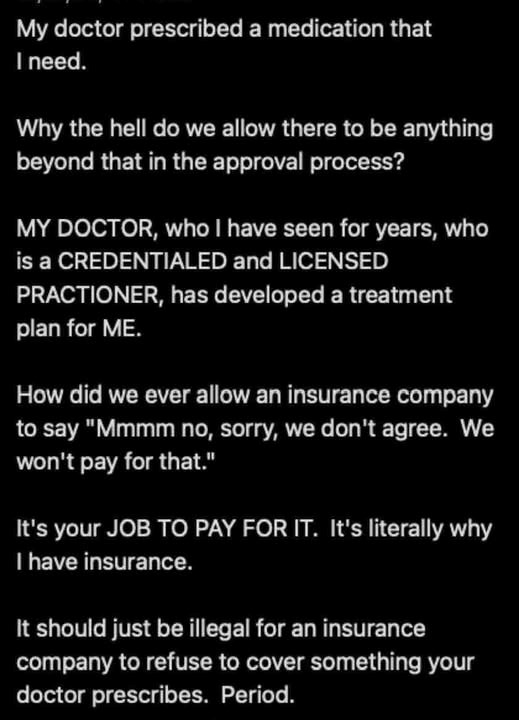
 Although much of the mainstream media tried hard to focus attention elsewhere – on the accused killer and his personality, on self-serving nonsensical essays like the one by Thompson’s boss, UnitedHealth Group’s CEO Andrew Witty run as a NY Times Op-Ed, etc. – the real story is the outpouring of fury at the health insurance industry from the great mass and majority of the American people. While most did not applaud the murder itself, virtually no one outside themselves and their paid punditry had anything good to say about US health insurance. Probably the overall public sentiment reflected that of Chris Rock: “He actually killed a family, a man with kids. I have condolences for the healthcare CEO. This is a real person, but sometimes drug dealers get shot.”

Another huge story, which will become even bigger in 2025, is the planned nomination by President-elect Donald Trump of profound enemies of public health to the positions responsible for ensuring that health. Foremost among these, of course, is Robert Kennedy, Jr. to be Secretary of Health and Human Services. Kennedy is well-known as a vaccine “skeptic”, which essentially means vaccine opponent, and if he is confirmed as Secretary and is able to implement policies reflecting the positions he has long advocated, we will see the resurgence of many diseases long gone from American life with accompanying deaths, as I discussed on November 15, 2024 in ‘Raw milk, vaccines, and RFK, Jr: Some dates worth remembering’. Remember polio? Measles? I do, but most do not. Check out the numbers on this picture. This is an incredible threat to the public’s health.

But, ultimately, the real story of 2024 – and probably 2025, and sadly beyond – is the fact that the American people remain the only ones in the developed, rich or really even middle-income, world that do not have universal health insurance or care. This is what would prevent the crises, delays, denials, and deaths that the private health insurance industry heaps upon our population and that engenders the wrath of so many. Indeed, that wrath continues to grow because the people who are affected, either personally or through someone they love such as a family member, who realize the inexcusable evil that the actions of these companies inflict, grows over time. While only a small percent of the ostensibly insured will have a terrible event each year, with more years more people and families experience such terrible events. Also, of course, the practices of the health insurance companies become more restrictive and more draconian, leading to both more delays and denials and deaths and more out-of-pocket costs for more people. In other countries, this happens, essentially, very little or not at all. The following chart presents the dates when other countries implemented universal health care, and when they got rid of it because it wasn’t working. Look at it carefully and you might discern a trend:


The US has a higher mortality rate than many of these countries. Jim Kahn, in the Health Justice Monitor, makes an effort to quantify the extent to which health insurance (or lack of it) contributes to this. It is an estimate, but as he notes, whether 170,000 or 220,000, it is too much. And, more, we spend much more than all these other countries on what we call “healthcare” despite so much of it going to corporate profit, that the fact that there is any excess mortality due to lack of health insurance is even more intolerable.

This might come as a shock to many Americans, especially those who have yet to personally experience the delays, denials, and deaths that the for-profit health insurance industry heaps upon its victims, because we are regularly and consistently told by politicians and pundits that a universal health insurance system would be a bad idea, that it wouldn’t work for Americans. That it would be too costly. That it would limit our freedom. We need to recognize that this is not true. Few of us want to have the freedom to choose which insurance company takes our money and then tries its best to limit our access to care (although, if we can afford it, we might choose the one that does it least). What we do want is the freedom to choose the doctors and hospitals that we believe will provide us the best care for our health needs and have our insurance pay for it. Of course, this is not the freedom that they are talking about; what they mean is the freedom of insurance companies (and to be fair, many health care providers) to make as much money as possible, which is what would be limited in a universal government-run health insurance system. And, oh, by the way, provide the funds to pay for it. Imagine that our health care dollars, from our pockets and those of our employers and our government (from the taxes we pay; the large corporations and billionaires who own them don’t) could be spent on providing us with health care rather than lining corporate pockets!

There are actual examples of “single payer” health care in the US. Military retirees and families are covered by government-funded health insurance through the VA or TriCare. In the military itself, for active duty service members, health care is not only single-payer, it is government run. The other big example of single-payer available to Americans is traditional Medicare, for those over 65 or disabled. Medicare. The most popular government program since…Social Security. Under traditional Medicare, health care services are approved for people who need them and have them ordered by a doctor, not micromanaged for each individual with people (or AI!) denying them willy-nilly. In an alternative to Medicare, people can opt for enrollment in an HMO/PPO like system run by the same insurance companies that insured (and often screwed) them before they became eligible for Medicare, and have it paid for by Medicare funds. This program, misnamed “Medicare Advantage”, takes away the guarantees of traditional Medicare and puts you back a the mercy of those for-profit health insurance companies that have treated you so well before!

This is exactly what we don’t need – erosion of Medicare. We need Medicare to be improved, to pay for 100% of all needed medical care, and expanded to cover every American, cradle to grave, paid for by the money now going to insurance company and pharmaceutical and device company and health system profits. The reason to do it is because it would benefit people, remove the major cause of heartache, loss and bankruptcy in the US, and make us more secure and happy people. The reason not to do it is that these huge corporations would no longer be making their exorbitant profits by taking premiums and denying health care, and thus would not be able to make such large contributions to the legislators who should be acting, instead, for the American people.

What do you want? Maybe in 2025 it is time to let your legislators know!


A final thought from Bernie Sanders:


Thursday, July 25, 2019

Opioids, deaths, and capitalism: It's the capitalism, people!


The opioid epidemic is real. Far more opioids (the term that includes opiates, naturally-derived from opium, and synthetic drugs) are consumed than could conceivably be used for medical reasons, whether for short-term use post-surgery or injury, or chronic use for terminal diseases like cancer. The explanation, at one level, is the excessive use of opioids for pain relief for chronic conditions (like back pain, for which other drugs are often more effective) or excessive duration for what should be short-term (acute) reasons, and the fact that they are very addictive. This last has led to the creation of new addicts, who have been placed on prescription opioids for pain, and means that they can be used to substitute for opiates (such as heroin) for those who became addicted to street drugs. This is especially true with the increased availability of extremely potent synthetic opioids, such as fentanyl (50-80 times more potent than morphine), but can go both ways; when those who have become addicted to prescription opioids find the supply drying up, they often move to heroin.

But, like most things, it is complicated. The biggest complication is that many of those who have become “hooked” on opioids are suffering in pain, and opioid withdrawal is, to put it mildly, not fun. The pain relief is greater than that of other pain relievers, for many (but not all) problems, but opioids increase tolerance, so the doses people need to take to relieve their pain, or get their high, continually increases. The “consensus” pendulum has swung, from the message that people are not getting sufficient pain relief (“pain is the fifth vital sign”) to “doctors are creating addicts by overprescribing opioids”. Patients – people -- are caught in the middle.

Another complication is, as is usual in any big issue in the US, race. Opiate addiction and problems were a focus more of criminalization than treatment when it was perceived as mainly a problem for minority populations. The increasing revelation of white, albeit often poorer, less educated, and more rural, white people suffering from the prevalence of opioid abuse, has changed the discussion. Not that this is unimportant – the message that for the first time in a century a portion of the population – middle aged white people – have an increasing death rate (discussed in Rising white midlife mortality: what are the real causes and solutions?, November 14, 2015, and based on the work of Case and Deaton, “Rising morbidity and mortality in midlife among white non-Hispanic Americans in the 21st century”) is shocking. So is the finding that poor white women born in 1950 will live shorter lives than their mothers born in 1920 (“Life expectancy, socialism, and the determinants of health”, February 14, 2016). None of this to deny or ignore the fact that death rates for minorities, although dropping are still higher than those of whites.

The New York Times has had a series of exposé articles on the opioid crisis, and a recent installment completely pulls back the curtain on the marketing and sales practices of opioid manufacturers. “3,271 Pill Bottles, a Town of 2,831: Court Filings Say Corporations Fed Opioid Epidemic” reveals that many manufacturers, not simply Purdue, the maker of Oxy-Contin®, and many pharmacies including all the big chains, have been complicit in the spread of this epidemic. Its content is damning, and the evil acts of these companies are made public, and the information needed to ascertain the reason for the problem is clear.

But the Times does not explicitly call it out. That is because the problem is capitalism, specifically “unfettered” capitalism, essentially unregulated capitalism that not only permits, but encourages, anything that will make more money, regardless of the cost, including (and perhaps especially) the human cost. These corporations are responding to the pressure of Wall St. and their stockholders not only to make more money, but to “exceed expectations”. The value of a stock is not based on whether the company is actually earning a profit, but whether it is earning enough of a profit to please the casino players. This is augmented by the incentives for often huge bonuses for the top management based upon – how much profit the company makes. There are no bonuses for actually helping more people, or even not killing them, or not destroying the world. Sorry, you who die from opioids or suicide, you are collateral damage. Oh, yes, you also, future generations.

To be clear, this is not a result of Republican or Trumpian policies, although they have been both more open about it and have further pushed the envelope with their gargantuan tax cuts for corporations and the 0.1%. It has been the policy of every government at least since Reagan in the 1980s, Clinton and Obama certainly included. Of course, every US government has been pro-capitalist, but for much of the 20th century, starting with (Republican) Teddy Roosevelt, there were both implicit and explicit limits set. Even conservative economic guru Milton (“the only goal of a business is to maximize shareholder profit”) Friedman believed that monopolies were ultimately not a problem because technology and the market would take them down. He was wrong; there are no limits to what they will do for more money.

So we have Americans dying by the tens of thousands from opiate and opioid overdose, and from the “suicides of despair”. We have children being separated from their parents and migrants being housed in prisons because it makes money for the private prison industry, a major donor to politicians. (Kudos to Illinois for being the first state to ban private prisons.) We have the environment being irreparably destroyed for the profit of some companies, with government complicity. We have wars being fought across the globe, killing hundreds of thousands, and each being the potential spark that could destroy the world more quickly through nuclear war. We continue to increase the defense budget although we already spend several-fold more than all our potential adversaries put together, because it is the way that the federal government subsidizes US industries.

Why do we do these things? Our oligarchs (a term the media seems to reserve only for foreigners, especially Russians, even though the US has so many more of them) demand it, and pay for it, essentially through kickbacks. They care not for the future, even for their grandchildren, or for whether there is a world.

They must be stopped. Our health, and our lives, depend upon it.

Total Pageviews