Showing posts with label Tricare. Show all posts

Tuesday, December 31, 2024

Healthcare and Public Health: Issues from 2024 will continue into 2025

As we end the year and begin a new one, what can we say was the most important health-related story of 2024, and what will be the biggest in 2025? Certainly, late in 2024 a huge story was the murder of Brian Thompson on the streets of New York. This was not in any way a random killing, but an assassination of someone the killer believed was responsible for hundreds or thousands of deaths in his role as CEO of UnitedHealthCare, the nation’s largest health insurer. As I discussed in my December 8, 2024 post ‘Murder of a Health Insurance CEO: People HATE the companies and the people who run them’, Thompson was guilty of presiding over a company whose role was to make money by collecting premiums and denying care. He also was guilty of having made this problem worse by bring in artificial intelligence algorithms, which had been shown to be wrong up to 90% of the time, to deny health care to his supposed customers – I say “supposed” because the only customers health insurance companies really have is their stockholders; the people they insure could be called “victims”. 
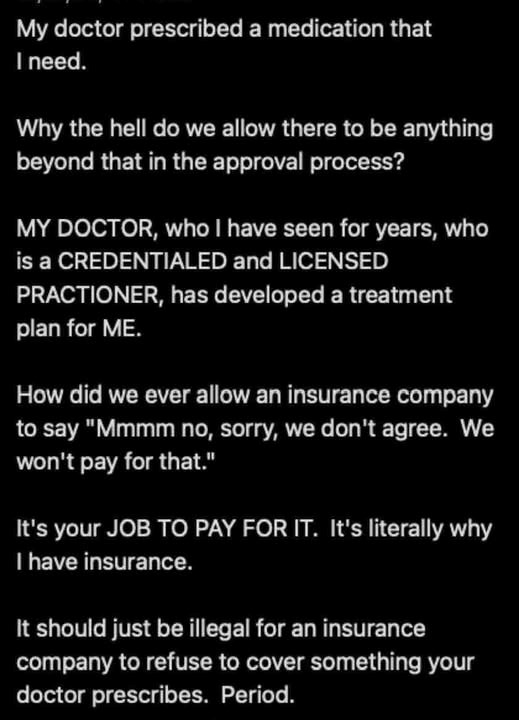
 Although much of the mainstream media tried hard to focus attention elsewhere – on the accused killer and his personality, on self-serving nonsensical essays like the one by Thompson’s boss, UnitedHealth Group’s CEO Andrew Witty run as a NY Times Op-Ed, etc. – the real story is the outpouring of fury at the health insurance industry from the great mass and majority of the American people. While most did not applaud the murder itself, virtually no one outside themselves and their paid punditry had anything good to say about US health insurance. Probably the overall public sentiment reflected that of Chris Rock: “He actually killed a family, a man with kids. I have condolences for the healthcare CEO. This is a real person, but sometimes drug dealers get shot.”

Another huge story, which will become even bigger in 2025, is the planned nomination by President-elect Donald Trump of profound enemies of public health to the positions responsible for ensuring that health. Foremost among these, of course, is Robert Kennedy, Jr. to be Secretary of Health and Human Services. Kennedy is well-known as a vaccine “skeptic”, which essentially means vaccine opponent, and if he is confirmed as Secretary and is able to implement policies reflecting the positions he has long advocated, we will see the resurgence of many diseases long gone from American life with accompanying deaths, as I discussed on November 15, 2024 in ‘Raw milk, vaccines, and RFK, Jr: Some dates worth remembering’. Remember polio? Measles? I do, but most do not. Check out the numbers on this picture. This is an incredible threat to the public’s health.

But, ultimately, the real story of 2024 – and probably 2025, and sadly beyond – is the fact that the American people remain the only ones in the developed, rich or really even middle-income, world that do not have universal health insurance or care. This is what would prevent the crises, delays, denials, and deaths that the private health insurance industry heaps upon our population and that engenders the wrath of so many. Indeed, that wrath continues to grow because the people who are affected, either personally or through someone they love such as a family member, who realize the inexcusable evil that the actions of these companies inflict, grows over time. While only a small percent of the ostensibly insured will have a terrible event each year, with more years more people and families experience such terrible events. Also, of course, the practices of the health insurance companies become more restrictive and more draconian, leading to both more delays and denials and deaths and more out-of-pocket costs for more people. In other countries, this happens, essentially, very little or not at all. The following chart presents the dates when other countries implemented universal health care, and when they got rid of it because it wasn’t working. Look at it carefully and you might discern a trend:


The US has a higher mortality rate than many of these countries. Jim Kahn, in the Health Justice Monitor, makes an effort to quantify the extent to which health insurance (or lack of it) contributes to this. It is an estimate, but as he notes, whether 170,000 or 220,000, it is too much. And, more, we spend much more than all these other countries on what we call “healthcare” despite so much of it going to corporate profit, that the fact that there is any excess mortality due to lack of health insurance is even more intolerable.

This might come as a shock to many Americans, especially those who have yet to personally experience the delays, denials, and deaths that the for-profit health insurance industry heaps upon its victims, because we are regularly and consistently told by politicians and pundits that a universal health insurance system would be a bad idea, that it wouldn’t work for Americans. That it would be too costly. That it would limit our freedom. We need to recognize that this is not true. Few of us want to have the freedom to choose which insurance company takes our money and then tries its best to limit our access to care (although, if we can afford it, we might choose the one that does it least). What we do want is the freedom to choose the doctors and hospitals that we believe will provide us the best care for our health needs and have our insurance pay for it. Of course, this is not the freedom that they are talking about; what they mean is the freedom of insurance companies (and to be fair, many health care providers) to make as much money as possible, which is what would be limited in a universal government-run health insurance system. And, oh, by the way, provide the funds to pay for it. Imagine that our health care dollars, from our pockets and those of our employers and our government (from the taxes we pay; the large corporations and billionaires who own them don’t) could be spent on providing us with health care rather than lining corporate pockets!

There are actual examples of “single payer” health care in the US. Military retirees and families are covered by government-funded health insurance through the VA or TriCare. In the military itself, for active duty service members, health care is not only single-payer, it is government run. The other big example of single-payer available to Americans is traditional Medicare, for those over 65 or disabled. Medicare. The most popular government program since…Social Security. Under traditional Medicare, health care services are approved for people who need them and have them ordered by a doctor, not micromanaged for each individual with people (or AI!) denying them willy-nilly. In an alternative to Medicare, people can opt for enrollment in an HMO/PPO like system run by the same insurance companies that insured (and often screwed) them before they became eligible for Medicare, and have it paid for by Medicare funds. This program, misnamed “Medicare Advantage”, takes away the guarantees of traditional Medicare and puts you back a the mercy of those for-profit health insurance companies that have treated you so well before!

This is exactly what we don’t need – erosion of Medicare. We need Medicare to be improved, to pay for 100% of all needed medical care, and expanded to cover every American, cradle to grave, paid for by the money now going to insurance company and pharmaceutical and device company and health system profits. The reason to do it is because it would benefit people, remove the major cause of heartache, loss and bankruptcy in the US, and make us more secure and happy people. The reason not to do it is that these huge corporations would no longer be making their exorbitant profits by taking premiums and denying health care, and thus would not be able to make such large contributions to the legislators who should be acting, instead, for the American people.

What do you want? Maybe in 2025 it is time to let your legislators know!


A final thought from Bernie Sanders:


Sunday, July 23, 2023

Why are we paying wealthy corporations billions to limit our healthcare?

In an excellent “Guest Essay” in the New York Times (July 18, 2023) Linan Eirav and Amy Finkelstein ask a very important question: ‘We’re Already Paying for Universal Health Care. Why Don’t We Have It?’ It is a question that many people, including me, have asked many times over many years. This article answers several important concerns. One, as indicated in the title, is that the economic argument against it (“It will cost too much”) is nonsense, as we (the US) already pays more from public funds (per capita and overall) than other countries that have universal healthcare coverage. This has been documented for decades by authors such as Woolhandler and Himmelstein; when we consider Medicare, Medicaid, government employees and retirees at all levels, military retirees and families, and (least obvious) the lost revenue from the taxes not paid on employee health insurance contributions by employers (when it would be if it were salary) it is not only more than other countries pay for covering everyone, it is more than half US health expenditures.

The authors emphasize that while the emphasis is often on those Americans who are uninsured (and despite decreases as a result of the ACA, it is still far too many), there is also great suffering and uncertainty among those who have health insurance. This is because 1) their health insurance may be of poor quality, not covering all their health needs, and subject to the whims of insurance company denials, and 2) because there is uncertainty about whether they will continue to have it. The former is a real concern:

Many insured people still face the risk of enormous medical bills for their “covered” care. A team of researchers estimated that as of mid-2020, collections agencies held $140 billion in unpaid medical bills, reflecting care delivered before the Covid-19 pandemic. To put that number in perspective, that’s more than the amount held by collection agencies for all other consumer debt from nonmedical sources combined.

And the latter, losing health insurance, can be because temporary government programs end or because employer coverage (and amount of employee contribution) changes. Or because the requirements for qualifying for many programs can leave people out because they didn’t know they were eligible, because they weren’t aware of or able to fill out the paperwork, or for many other reasons. The most simple, profound, and perhaps important paragraph in the article is:

The risk of losing coverage is an inevitable consequence of a lack of universal coverage. Whenever there are varied pathways to eligibility, there will be many people who fail to find their path.

This is incredibly important. The risk of losing coverage is an inevitable consequence of a lack of universal coverage.  The cobbling together of different mechanisms for covering different groups of people (employer based insurance, various government funded insurance, self-pay, etc.) intrinsically leaves the opportunity for people to lose their insurance coverage. Only one solution prevents this, one so subtle and elusive that every other wealthy – and most middle income – country in the world has done it: cover everyone. Period. No qualification, no sign-up, no criteria, and preferably in one program. Just cover everybody. You are American, you are alive, you are covered.

That would take care of who is covered – everyone – but in itself is insufficient, as the coverage must be good coverage. It must pay for all needed healthcare and none that is unneeded. Thus, if we were to accomplish this by passing Medicare for ALL, that Medicare program would need to pay 100% (not 80%) of what is covered and cover all health needs include mental health, eyeglasses, hearing aids, and long-term care, without payments from users at the time of service. Unlike Eirav and Finkelstein, I do not think that the best answer is to provide basic coverage to everyone and allow wealthier people (or their employers) to purchase “upgrades”  as if it were an airline. Indeed, the best way to ensure that poor, uneducated, or unempowered people get the coverage and care that they need is to require the wealthy, educated, privileged and empowered to be in the same program. They will make sure that it works for them, and that will mean it works for everyone. The “upgrades” (if you like that term) should only be to allow people to purchase things they’d like but are not medically needed (most commonly cited is purely cosmetic surgery).

The money is there. It is currently going into the pockets and profits of insurance companies and pharmaceutical manufacturers (see, for example, How a Drug Maker Profited by Slow-Walking a Promising H.I.V. Therapy in the Jul 22, 2023 NY Times). Their greed is without limits. As I have discussed (Why do drugs cost so much? And what can we do about it?, Apr 18, 2023) Medicare is the only drug purchaser in the US with sufficient clout to negotiate down drug prices (other than the VA and TriCare, which already do). In response, the administration has carried through with its promise to the American people to let it do so, originally forbidden by the pharma-supported legislation creating the Medicare drug program, “Part D” (Fantastic (& fantastical) hospital charges: The industry + insurers + Pharma making money hand over fist!, Mar 26, 2023). This is  incredibly popular among Americans of all political persuasions, but not, of course, among the drug companies, who the NY Times reports are going all out to keep us paying the highest drug prices in the world (Drugmakers Are ‘Throwing the Kitchen Sink’ to Halt Medicare Price Negotiations, NY Times, Jul 23, 2023).

The money is also there and being pocketed by the owners of hospitals, health systems and practice groups, whether for-profit (often owned by private equity) or ostensibly non-profit but making and socking away money hand over fist. It is outrageous, but these companies are able to limit people’s access to healthcare and provide administrative or paperwork obstacles that discourage access, as shockingly demonstrated in another recent article by Chavi Karkowsky, (NY Times July 20, 2023), The Overlooked Reason Our Health Care System Crushes Patients. In discussing how her patient almost died because of the bureaucracy, Karkowsky says

This is the story of our medical system — quick, massive, powerful, able to assemble a team in under an hour and willing to spend thousands of dollars when a patient is sick.

This is also the story of a medical system that didn’t think my patient was worth a $12 medication to prevent any of this from happening.

This patient’s story is a result of the space between the care that providers want to give and the care that the patient actually receives. That space is full of barriers — tasks, paperwork, bureaucracy. Each is a point where someone can say no.

Why should we want to say no? In a rational system, everyone would be eligible and get the same benefit. No obstacles are necessary. Then the money we already spend would not only get us better healthcare, it would leave enough left over to begin to ensure that people have sufficient housing, food, and education.

All that would suffer would be the already bloated wealth of billionaires and huge corporations. And that should have zero weight.

Sunday, March 26, 2023

Fantastic (& fantastical) hospital charges: The industry + insurers + Pharma making money hand over fist!

On March 15, 2009, in “Bargaining down the medical bills”,

I told the story of my hernia surgery – outpatient, in at 7 am, home by noon – and the $10,000 hospital (not doctor) charge. My insurance company paid $1,600, told me to pay $400, and the hospital wrote off the $8,000 as “contractual adjustment”. But if I was uninsured I would have gotten a $10,000 bill!

That was outrageous. Not so much the amazingly high charge, rather the fact that they were willing to accept $2,000 from an insured person, while they would have dunned and bankrupted an uninsured one, someone more likely to have less money! Of course, that would only be true if they had agreed to do such an elective surgery on an uninsured person in the first place.

Things have, apparently, not gotten better. Maybe worse. I recently had another outpatient surgical procedure (different hospital, different town) and the hospital – again, not doctor’s – charge was over $69,000! I was there for a few hours! Now I have Medicare, and a Medicare supplement plan, so I paid none of it. Medicare paid $2400, 80% of their approved charge for that procedure, and the supplement plan paid the rest. But $69,000 as a charge? I thought that the old one, charging $10,000 for a procedure that the insurer would pay $2000 for, was bad, but charging $69,000 for a procedure that you know Medicare has approved for less that 4% of that? What is the point?

Maybe an billionaire, or a royal from another country, will show up at this hospital and be willing to pay $69,000 in cash. Dream on. But the vast majority of the people that you would bill this amount would be uninsured because they couldn’t afford insurance. And the hospitals do not expect to collect anywhere near that amount from them, but they will keep billing them, and ruin their credit, and eventually sell off the bill to a collection agency for about 10 cents on the dollar. That agency will increase the dunning.

So what is the point of having such a high charge on the “chargemaster” (the name for the pricelist no one sees) if the only people who are going to be billed that much are those who are least likely to be able to pay? There has to be a reason, and there are in fact several, which include hoping that some insurer will, if not pay the whole amount, pay a fixed percentage of the billed charge, and so the higher the charge, the higher the reimbursement. But, of course, this makes no sense with Medicare (which has fixed approved charges that it will pay for procedures regardless of what the institution charges) or with insurers for which they have already negotiated reimbursement; in fact, the latter is usually determined as a “multiple of Medicare”, e.g., 2 or 3 times what Medicare pays. There are other arcane reasons, many of which have to do with the complex interplay between the “providers” (hospitals) and the payors (insurance companies), and who has the most clout in a certain area in a given situation. Assuredly, the interest of the patient does not enter into this discussion.

[I was going to add the following paragraph as a comment, but I thought it belonged here...]

A colleague pointed out another important reason why the prices for services in “non-profit” hospitals are so high. They don’t pay taxes because they are (supposed to, but often don’t) deliver “community benefit”. One way this is measured is reducing the debt of those who can’t pay! So if you can take, say $3000 from an insurer for a procedure but your “official” charge is $10,000, then if you accept $3000 from an uninsured person you can call the $7000 “community benefit”! And if your charge is ostensibly $69,000, you can meet the requirements for your tax-free status without losing a dollar…
 

Trying to find a pricelist with any meaning is almost impossible, but it doesn’t have to be that way. I go to the dentist in Mexico (I don’t have, but it accepts, US dental insurance). They can tell you before they do anything exactly what it will cost. Cleaning, $60. Gum trimming, $160. Same for repairing cavities, making crowns (on site, in an hour) or implants. No surprises. In the US, not even the doctors or hospital administrators know what the actual price will be for the patient.

This absurd pricing is yet another example of a “healthcare” (or maybe “healthdon’tcare”) system that is predicated on making money for the power players, and the technical details about which of them benefits most (sometimes, in the case of inner-city and rural hospitals, suffers most) dominates the policy discussion and political rule making. Politicians like to talk about regulating health insurers (and sometimes hospitals), and for sure drug companies because of their exploitation of patients. They rarely, however, do anything much about it. When they do something, it almost always 1) is very watered down by “compromises” with the big-contribution lobbyists from the regulated industries, and 2) when it does help people by reducing their cost, it always continues to make money for the (maybe) regulated companies, just a little less exorbitant than before. 

 Drug costs are a prime example of both. The legislation that created the Medicare drug plan (Medicare Part D) passed during the George W. Bush administration. The positive benefit to patients was that, prior to it, many Medicare patients did not have coverage for their prescription drugs and often went broke trying to buy them; it required all Medicare recipients to have a plan.  The obvious benefit to the corporations was that now all Medicare recipients had to buy drug coverage from an insurance company, and drug companies would now get paid for all these people’s medications. A less obvious, but incredibly important benefit to drug manufacturers was that the Part D legislation forbid Medicare from negotiating drug prices! So big bonus – everyone has to have drug coverage and they have to pay what we charge! Medicare is the only civilian purchaser of drugs (and other healthcare services) large enough to force prices down, as they do for hospital services (see the anecdotes at the start of this piece). But that they might do the same for drug prices really worried Big Pharma – after all, the VA and TriCare, the only other purchasers big enough to have real clout, did negotiate lower drug prices for their members, and this decreased their profits. Indeed, in most states Medicaid negotiates drug prices, and the manufacturers don’t like that at all. Luckily (for them), they have hundreds of highly paid lobbyists in DC, and make millions in contributions to politicians, so they were able to get this great deal. A great example is former Rep. Billy Tauzin (R, LA) who was chairman of the House Energy and Commerce Committee when Part D was passed, and, “On January 2005, the day after his term in Congress ended, he began work as the head of the Pharmaceutical Research and Manufacturers of America (PhRMA). a powerful trade group for pharmaceutical companies.” (Wikipedia)

Drug company profiteering is also a good example of the second point, that drug companies always continue to do fine and make big profits even after a reform has decreased them a little. A more current example is the push (including from the Biden administration) to lower the cost of insulin, a drug that is literally a daily necessity of life for those with Type 1 diabetes and very commonly needed for the much larger number of people with Type 2 diabetes. The 2020 Prescription Drug Pricing Report from the Office of the Assistant Secretary for Planning and Evaluation of the U.S. Department of Health & Human Services states that

The average gross manufacturer price for a standard unit of insulin in 2018 was more than ten times the price in a sample of 32 foreign countries:$98.70 in the U.S., compared with $8.81 in the 32 non-U.S. OECD countries for which we have prescription drug data. The U.S. prices for the mix of insulin used in the U.S. were 8.1 times prices paid in all non-U.S. OECD countries combined. !!

Verywell Health reports that “As of March 2022, the price for a vial of insulin ranges from $50 to over $1,000, and a pack of pens ranges from $45 to over $600.” News organizations such as the BBC have reported on the impact of this on actual people. No wonder limiting the price of this life-saving drug is something concerning to both Republicans and Democrats. President Trump talked about it a lot, and President Biden is actually moving to limit the cost. With the administration-backed Inflation Reduction Act, not only did the price get controlled, but Eli Lilly (one of the 3 major manufacturers of insulin for the US, along with Sanofi-Aventis and Novo Nordisk, and the company that was given the patent for insulin from Banting and Best for $1) announced a 70% reduction in their charges. The White House briefing fact sheet on this legislation’s effect is interesting, and contains some information on who in the US has diabetes. The answer is a lot of people, over 11% of the US population, and minority groups, the poor, and the poorly educated have an even greater burden of this disease.


But don’t cry for Eli Lilly, or the other insulin, or any drug, manufacturers. That they will be doing fine and continuing to make huge profits after the price restrictions go into effect is further evidence that before they were making outrageous, unjustifiable, and indeed (given that insulin is needed to keep many people alive) murderous profits.

It is hard to discuss rapacious profiteering in health(don’t)care without drug companies, but let us not lose sight of the fact that the insurance companies and the big hospital and “health systems” are also making out like bandits, ripping us off, and endangering our health.

Total Pageviews