Showing posts with label quarantine. Show all posts

Monday, August 15, 2022

The new CDC "No Quarantine" recommendations: Do they increase your risk? (Spoiler: Yes)

Recently, the Centers for Disease Control and Prevention (CDC) revised its COVID-19 recommendations to eliminate the quarantine for infected people. Previously this had been reduced from 10 to 5 days. It is now not recommended at all, although masking for 5-10 days is still recommended after being infected, and there are suggestions -- “strategies that people may want to consider in order to reduce their risk” – such as avoiding crowded areas and maintaining a distance from others.

‘“We know that Covid-19 is here to stay,” Greta Massetti, a C.D.C. epidemiologist, said at a news briefing on Thursday,’ which about sums up their perspective. It is apparently their justification for the (lack of) safety recommendations and precautions. The author of the article notes that the loosening of the guidelines free ‘schools and businesses from the onus of requiring unvaccinated people exposed to the virus to quarantine at home.’

As far as that author (Emily Anthes) and the editors are concerned, there seems to be universal approval of this change from the medical and epidemiologic community, at least based upon those that are quoted in the article:

‘“I think they are attempting to meet up with the reality that everyone in the public is pretty much done with this pandemic,” said Michael T. Osterholm, an infectious disease expert at the University of Minnesota’; 

‘“I think this a welcome change,” said Amesh Adalja, a senior scholar at the Johns Hopkins Center for Health Security. “It actually shows how far we’ve come”’ ;

‘“This really will help to minimize the impact of Covid-19 on education,” said Christina Ramirez, a biostatistician at the University of California, Los Angeles.’

One commentator, ‘Mercedes Carnethon, an epidemiologist at the Northwestern University Feinberg School of Medicine, said that she did not view the changes, even the elimination of quarantines in favor of 10 days of masking, as a loosening of the agency’s guidance.’

Dr. Carnethon continues ‘“We certainly know that wearing a high-quality mask is going to provide some of the strongest protection against spreading it to somebody else, and quarantine is logistically burdensome. That could be seen as a relaxing of guidelines, but I think it’s a much more appropriate and targeted solution.” Except, of course, that the CDC is not recommending that we mask in public areas. Whoops.

Ross Douthat, NY Times Op-Ed columnist, writes (Aug 13, 2022) that “The CDC continues to lead from behind”. His take is essentially that “everyone” has already been doing (or not doing) the things that the CDC is now recommending (or not recommending). I would agree that that is true (at least in the US), but to me it suggests that the recommendations are driven politically, not by “the science”.  Certainly it has been “an onus” for schools and businesses to comply with the recommendations (often conflicting) from different governmental agencies and others to protect their students, staffs, and customers. People do not like having to wear a mask in public, even in crowded indoor spaces, nor having to distance, nor staying home and quarantining and missing school or work. Or, even missing social interactions, from casual to parties. If CDC is “leading from behind”, making recommendations that much of the population has already been implementing, then this new step will encourage those who have already been doing so to further relax their carefulness. They may do so from a desire to get an education, make a living, interact with family and friends, or to party and use drugs or have wild sex, but these are, essentially, quantitative and not qualitative, differences. The fact that the article in the Times could not (or at least did not) find any countervailing views from epidemiologists, scientists, physicians, and other experts further endorses the “opening up” that people want. It is political in that having restrictive requirements is generally unpopular and could lose votes for politicians.

The only problem, of course, is that COVID is still out there and we are still at risk. What we are at risk for varies a lot, depending upon who we are, from “mild” illness (usually not so mild!) to severe illness to hospitalization, to death. The people who are most at risk are those who are immune compromised, either because of age, or illness, or (my favorite) the drugs that they are taking to treat illness, including the drugs widely advertised on television for cancer and rheumatic diseases. Plus anyone, of any age or prior health status, can get “long COVID”, with persisting symptoms that can be very severe and debilitating.

The World Health Organization observes that “7.9 billion people” (the world’s population) are still at risk for COVID, and that thousands are still dying every week. This poster makes those points, and also that new variants continue to emerge and can quickly become dominant. It also recommends things like keeping your distance and wearing a mask, abandoned by most Americans.


Of course, the risk of COVID also varies from country to country, which could justify why WHO and CDC have different recommendations. After all, in some countries there is greater risk than in others, and the struggle is just to keep their people alive. This might be reassuring to Americans if it were not for the fact that the US is one of those, remaining the leader in deaths.
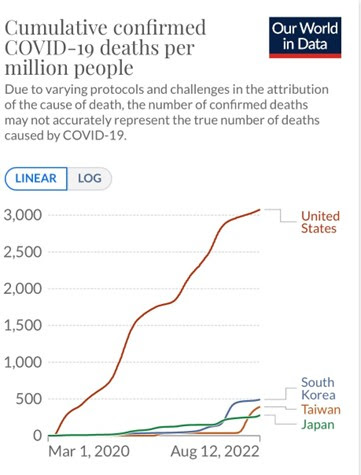
(https://ourworldindata.org/coronavirus)


One of the key determinants of how a society functions is the balance between the rights of an individual to do what they want and the benefit to and protection of society. In the US, we have always tended toward the individual, but public health laws, regulations, rules, and recommendations are based upon the benefit to society. This makes sense because infectious diseases do not limit themselves to only those people who have consciously and willingly made the decision to take the risk of acquiring them. They also affect those who, absent governmental requirements to protect them, are forced to come to work and risk being infected or lose their livelihood, and those who are old or sick but come into contact (even in families) with those who have acquired infection because protecting themselves was just too much trouble.

The logic is flawed; what if laws against killing and stealing were made recommendations to be adopted by those who wished to be cautious? It would not just affect those who made the decision to not adopt them. Sure, we have people killing and stealing and being killed and being robbed despite the laws against it, but those laws protect us far more than a general recommendation that folks not kill or steal would. So too it is with the virus; if you go shopping and few others are wearing a mask despite rules or recommendations that they do, you are at risk. If those rules are repealed and the recommendations rescinded, then more and more people will think they are safe not doing so.

Vaccines are good and protect a lot. They do not by any means eliminate the danger. The changes in recommendations mean the politicians to whom CDC answers will be more popular, and be more likely to get re-elected.

And that more people will die.

Wednesday, March 18, 2020

COVID-19 emphasizes the necessity of Medicare for All


This will not be much of a reprise of “what should you do about COVID-19”, you know, wash your hands, use hand-sanitizer, avoid groups whenever possible, stay home if you are sick-but-not-too-sick (if you’re really short of breath, go to the ER; if you have signs of a heart attack or significant trauma, go to the ER, even though both increase your risk of infection). It will also not be much of reprise of what not to do: have big parties to celebrate the cancellation of classes, like many of the students at Cornell (https://cornellsun.com/2020/03/15/while-some-cornellians-self-quarantine-others-pack-parties-in-response-to-campus-shutdown), who at least have to “excuse” of being both young and thus less likely to die and young and thus have underdeveloped frontal cortexes (where judgement resides). Or the racquetball players at my local racquet club who had a tournament this weekend gathering at least 40 people in a relatively small space and sharing finger food like fruit and cheese and crackers (and who are decidedly NOT young! Although they may lack judgement…).


At the debate on Washington DC on March 15, Bernie Sanders emphasized the degree to which having a universal health program, a single-payer program, Medicare-for-All would help in this crisis. Yes. It would have and it will in the future, when another epidemic comes calling. It will not, by a long shot, solve all the problems that have existed in our (and other nations’) response to COVID-19, but it would have helped a lot, particularly in alleviating the still-valid fears that people have of getting crippling bills if they seek care.


This is not to minimize the incredibly incompetent, not to mention destructive, role that the federal government has played. The Executive Branch, led by President Trump, has bloviated, lied, misled, created fear, and provided incredible misinformation to the American people. This has been extensively covered by the media; criticizing the buffoonery of Trump is apparently fair game among the mainstream press. There has also been some, albeit less, coverage of the purposeful decimation of the nation’s public health infrastructure by the Trump administration prior to the advent of SARS-CoV-2. The federal epidemic response task force was eliminated by the administration. Federal support for state and local health departments was cut. Once the administration finally acknowledged that it was a big problem (one for which the President took no responsibility), the response was anemic and ineffectual.


Trump named science-denier Mike Pence to lead the effort. Jared Kushner has it added to his portfolio; he consulted his brother’s father-in-law, who is, after all, a doctor, and a Facebook group. Trump called it the “China virus”, but SARS-CoV-2 was not intimidated. Concerned about a stock market taking its biggest dive since 2008 (something that really worries him!) Trump proposed cutting payroll taxes paid by employers by $700B, both remarkably stupid (takes a long time, and cuts funding for Social Security, and helps neither the economy or the stock market) and typically directed to benefit the best-off, ignoring the plight of those most affected, the poor. The response to the epidemic, including especially the unavailability of tests for SARS-CoV-2, has been scandalous. We are at least a year from having a vaccine, but the President continued his moronic approach by apparently trying to buy a vaccine developed in Germany for use “only in America”.


But it was not just the administration. The Congress also did not demand a public health infrastructure. The states and local governments, in part because of decreased federal funding, have grossly underfunded their own health departments, which were woefully unprepared in most areas and are struggling to begin to catch up. Luckily, the health department in Seattle/King County Washington, where the virus has hit hardest in the US, was one of the ones in better shape.


So there is no question but that poor planning, addressing core health needs only when there is a crisis, focusing on tax cuts for the wealthiest and not planning for “the big one” (just as we have not planning for climate change or war) has crippled the US and its response. There is also no question that having a president who plays to his right-wing base who see him as the one “in charge”, and enablers like Fox News’ Sean Hannity, made it even worse. The system that does exist in the US has long been focused (“focus” = funded) on individual care of individual people (called “patients), and particularly on those who have money or good insurance and even more on those whose diseases (such as cancer) are very well reimbursed by those insurers. Public health suffers because, other than in epidemics (SARS, H1N1, Ebola) it is not in the public consciousness, so the government can work on tax cuts for the rich and the health system can work on making money on the insured sick. Sins of omission are less obvious; I have noted previously that people do not wake up each morning saying “thank goodness I don’t have cholera because we have a clean water supply!”


But there is another part of the story, which will become even bigger as folks get sick. This is because the US does not have universal health care, does not have a national health system. It has not even addressed who will pay for COVID-19 testing (a local university recently suggested it would charge its own students $200, until it was embarrassed out of it!), or a vaccine if it becomes available. It certainly has no reasonable plan for paying for the care of people who fall ill with disease, need hospitalization in intensive care units need to be on ventilators, but have no or rotten insurance. We hear that the VA will be a backup health system; great, if it can. When will we federalize the for-profit and “non-profit” hospitals?


We have also, of course, had policy decisions on closure made by each individual business/organization/school/local government, based on its own perception of risk (epidemiologic, financial, peer pressure) without adequate consideration of its impact on the entire social structure. Stay home from work? Work from home? What about the (generally lower paid) folks whose work depends on being there (cleaners, health workers, etc.)? What about those who don’t have sick leave? What about those who don’t get paid, or lose their jobs, if they don’t show up? What about school closures putting parents in the position of choosing childcare vs work (or calling upon grandparents, in the higher risk group)?


Planning for and implementing a response to an epidemic is different from having an organized national health system. Many European countries including Italy and Spain have their citizens all covered but are struggling terribly. But having such a system does create the infrastructure basis for national health policy and national health response; see how South Korea dramatically ramped up its COVID-19 testing, and was able to implement it because of a national health system. Spain has indeed nationalized all private healthcare to battle this crisis. Norway suggested that its citizen living abroad come home. It is urging its citizens abroad to return home, especially if they are "staying in a country with poorly developed health services and infrastructure and/or collective infrastructure, for example the USA"! We planned poorly and we won’t necessarily provide care for them, or indeed for “us”!


Much terrific insight is provided by Dr. Seiji Yamada in his terrific Counterpunch piece “Coronavirus for All”: ”These days U.S. health system is run by health care executives, with their business smarts, their lean operations (except for their compensation packages), achieving just-in-time delivery.”


Health care should be a human right. This crisis illustrates the need to have a robust, continuously-funded public health infrastructure. It also illustrates the need for a universal health care system that can take care of all of us. Bernie Sanders may not win the nomination, but the fight for universal health care for all of us must continue.


As Dr. Yamada notes:

Certainly it’s true in the U.S.A. it is easier to imagine the end of the world than to imagine the end of capitalism. On the other hand, it’s also obvious that capitalist health care is going to faceplant in the face of the coronavirus. It’s going to be a choice between Medicare for All or Coronavirus for All.

Total Pageviews