Showing posts with label WHO. Show all posts

Saturday, September 21, 2024

Once again, the US trails rich countries in health care -- except in cost! Why do we tolerate it?

Sometimes the news is good, sometimes it is bad (too much of the latter!!). Sometimes it is surprising, and sometimes it is not. Often it is more of the same, and sometimes this is surprising because we had thought or hoped that it had changed, preferably for the better, and sometimes it is not surprising because we knew it had not.

A good example of this is international health rankings, in which the US consistently and continually ranks at the bottom of the wealthy nations and has a health status that is in the middle of what are known as “middle income countries”. These are called middle-income because they are better off than the really poor countries, but compared to the US and similar countries, they are poor.  In 2000, the World Health Organization (WHO) published a ranking of health system performance in their member nations, based on 1997 data, in which the US ranked #37 in the world, between Costa Rica and Slovenia, on overall performance. When many were aghast that the US could be like Slovenia, the prime minister of that nation took offense and pointed out that his country had been making significant advances. In the area of Disability Adjusted Life Expectancy (DALE) the US in fact ranked #72! I had reproduced these tables in  US Health Rankings remain low and #Trumpcare will make them worse!, June 18, 2017, and do so again now.

Of course, 1997 is a long time ago. Maybe, since then, we, like Slovenia, have gotten better. Except we haven’t. This is the sadly non-surprising part of the news.

While the WHO has not redone that 2000 survey, in 2017 Bloomberg published its Global Health Index, and, as I said then,

Now, we have new rankings to refer to, the Bloomberg Global HealthIndex from 2017. It would be nice to be able to say that the US had moved up from the 2000 WHO report, but now, at #34 (and still just behind Costa Rica) the change is really insignificant. Slovenia, it might be noted, has moved up, to #27, so maybe their efforts are paying off!


For an ongoing comparison, the Commonwealth Fund publishes a report every few years called “Mirror, Mirror on the Wall” comparing US health outcomes and cost to other high-income countries. I have cited it, in its various editions, on many occasions (Mirror on the Wall: Commonwealth Fund report continues to show US has poor outcomes at high cost, June 26, 2010, ACA: Where are we? And where should we go?, July 27, 2014, US Health Rankings remain low and #Trumpcare will make them worse!, June 18, 2017, Our health system: Not equitable, not effective, and not even efficient. Bad business!, March 24, 2022), and address it in detail in my 2015 book “Health, Medicine and Justice: Designing a fair and equitable health system” (Copernicus). The relative performance and ranking of the other countries varies a bit over the years, but the position of the US at the bottom of the heap, #1 only (and consistently) in cost, and worst in performance, is unchanging. The most recent report, “Mirror, Mirror 2024: A portrait of a failing US health system” has just come out, and the title provides the answer: not good. Not better. Failing. And, probably, failing worse. The study’s conclusion, in the Summary, is:

The U.S. continues to be in a class by itself in the underperformance of its health care sector. While the other nine countries differ in the details of their systems and in their performance on domains, unlike the U.S., they all have found a way to meet their residents’ most basic health care needs, including universal coverage.

Here is the table of rankings:


And, if you prefer a visual portrayal about how much worse the US health system is performing:


But we do lead in spending:


And, logically, trail the pack by a lot in value for dollar spent:


This is the non-surprising non-news. But, while not surprising, it should be very concerning. It’s not getting better, and there is little reason to think that it will, if past performance is a predictor of future performance. And we’re talking more than two decades of consistent past performance. It is not a question of what the fact are, of what is true, no longer if it ever was. The US health system performs terribly as a health (or even medical care) system. Costs are enormously high, outcomes are consistently poor, and we dramatically underperform every other country that has in any way comparable resources (and many, many with far fewer resources). It is incredibly inequitable. See, for example, some of the countries grouped around the US in the 2017 Bloomberg rankings, such as Qatar, Brunei, and Bahrain – countries with money and inequitable distribution. So, the question is why are we not doing anything about it?

The answer simply requires a little re-framing of the data presented above. I, and likely you, see the incredible cost/performance ratio as a negative, something to be addressed and fixed. But all that money that is being spent is going somewhere, and certainly a large amount of it is not going to provide high-quality healthcare. It is going to profits for insurance companies and pharmaceutical companies and the Wall St. investors that own them, and for enormous salaries for the C-suite executives who run them, as well as those in the ostensibly non-profit sector (see Why many nonprofit (wink, wink) hospitals are rolling in money by Elisabeth Rosenthal (Washington Post, July 29, 2024). For them the current system is working very well, thank you, they are getting very rich. Your problem, and mine, is that we think that this system should be about providing high-quality and cost-effective care for the American people, at which it is obviously failing. But if we understand it as a cash-cow for these corporations, as a method for transferring money from the rest of the economy to them, it is working great. And, because it is working so well and they are making so much money and spending a great deal of it contributing to politicians, it is unlikely to change.

Unless YOU make it change.  There is, and has been for decades, a loud and effective rant from the corporations and individuals profiting from your health care dollars and their employees (or shall we say “beneficiaries of their largess”) in the legislative, think tank, and punditry arenas, that the Democratic party, and particularly its progressive wing, are radical socialists who are anti-American. This has been very successful. See above, we have kept to the unique American way of doing things. The one that takes money from you in premiums, co-pays, and deductibles and provides you with poor outcomes. That every other wealthy capitalist country has found a way of delivering higher quality for less money is the evidence that it is possible and will not destroy the country. But it will destroy the conveyor belt that takes your money and puts it into their pockets, and this is a terrifying thought, so that they will do anything to prevent it.

Their tactics include both painting mainstream Democrats who merely want to tinker around the edges of the system as flaming radicals, and funding organizations such as the Heritage Foundation to come up with truly radical proposals like Project 2025 (pdf of the health section here) that would institutionalize the worst, most anti-human practices going on today. The strategy is that if they can get half the country to support politicians who support those policies (whether those voters actually support those policies or not), it moves the center of the discussion to the “right” and means compromise will be much less threatening to them. But much more threatening to you.

People want good healthcare for themselves, for their families, and for their friends. They don’t want to pay ever-more for health insurance only to have the insurers deny their care, often as a matter of routine, when they need it. They deserve, as do the people of other countries, a health system that is intrinsically structured to provide the best possible health care for our people and not to make money for Wall St., big corporations, insurance companies and health systems. We know it can be done as it has been done everywhere else.

Make it the thing you vote for and let your representatives know it; you want health care, as the old saying goes, for people and not for profit!


Monday, August 15, 2022

The new CDC "No Quarantine" recommendations: Do they increase your risk? (Spoiler: Yes)

Recently, the Centers for Disease Control and Prevention (CDC) revised its COVID-19 recommendations to eliminate the quarantine for infected people. Previously this had been reduced from 10 to 5 days. It is now not recommended at all, although masking for 5-10 days is still recommended after being infected, and there are suggestions -- “strategies that people may want to consider in order to reduce their risk” – such as avoiding crowded areas and maintaining a distance from others.

‘“We know that Covid-19 is here to stay,” Greta Massetti, a C.D.C. epidemiologist, said at a news briefing on Thursday,’ which about sums up their perspective. It is apparently their justification for the (lack of) safety recommendations and precautions. The author of the article notes that the loosening of the guidelines free ‘schools and businesses from the onus of requiring unvaccinated people exposed to the virus to quarantine at home.’

As far as that author (Emily Anthes) and the editors are concerned, there seems to be universal approval of this change from the medical and epidemiologic community, at least based upon those that are quoted in the article:

‘“I think they are attempting to meet up with the reality that everyone in the public is pretty much done with this pandemic,” said Michael T. Osterholm, an infectious disease expert at the University of Minnesota’; 

‘“I think this a welcome change,” said Amesh Adalja, a senior scholar at the Johns Hopkins Center for Health Security. “It actually shows how far we’ve come”’ ;

‘“This really will help to minimize the impact of Covid-19 on education,” said Christina Ramirez, a biostatistician at the University of California, Los Angeles.’

One commentator, ‘Mercedes Carnethon, an epidemiologist at the Northwestern University Feinberg School of Medicine, said that she did not view the changes, even the elimination of quarantines in favor of 10 days of masking, as a loosening of the agency’s guidance.’

Dr. Carnethon continues ‘“We certainly know that wearing a high-quality mask is going to provide some of the strongest protection against spreading it to somebody else, and quarantine is logistically burdensome. That could be seen as a relaxing of guidelines, but I think it’s a much more appropriate and targeted solution.” Except, of course, that the CDC is not recommending that we mask in public areas. Whoops.

Ross Douthat, NY Times Op-Ed columnist, writes (Aug 13, 2022) that “The CDC continues to lead from behind”. His take is essentially that “everyone” has already been doing (or not doing) the things that the CDC is now recommending (or not recommending). I would agree that that is true (at least in the US), but to me it suggests that the recommendations are driven politically, not by “the science”.  Certainly it has been “an onus” for schools and businesses to comply with the recommendations (often conflicting) from different governmental agencies and others to protect their students, staffs, and customers. People do not like having to wear a mask in public, even in crowded indoor spaces, nor having to distance, nor staying home and quarantining and missing school or work. Or, even missing social interactions, from casual to parties. If CDC is “leading from behind”, making recommendations that much of the population has already been implementing, then this new step will encourage those who have already been doing so to further relax their carefulness. They may do so from a desire to get an education, make a living, interact with family and friends, or to party and use drugs or have wild sex, but these are, essentially, quantitative and not qualitative, differences. The fact that the article in the Times could not (or at least did not) find any countervailing views from epidemiologists, scientists, physicians, and other experts further endorses the “opening up” that people want. It is political in that having restrictive requirements is generally unpopular and could lose votes for politicians.

The only problem, of course, is that COVID is still out there and we are still at risk. What we are at risk for varies a lot, depending upon who we are, from “mild” illness (usually not so mild!) to severe illness to hospitalization, to death. The people who are most at risk are those who are immune compromised, either because of age, or illness, or (my favorite) the drugs that they are taking to treat illness, including the drugs widely advertised on television for cancer and rheumatic diseases. Plus anyone, of any age or prior health status, can get “long COVID”, with persisting symptoms that can be very severe and debilitating.

The World Health Organization observes that “7.9 billion people” (the world’s population) are still at risk for COVID, and that thousands are still dying every week. This poster makes those points, and also that new variants continue to emerge and can quickly become dominant. It also recommends things like keeping your distance and wearing a mask, abandoned by most Americans.


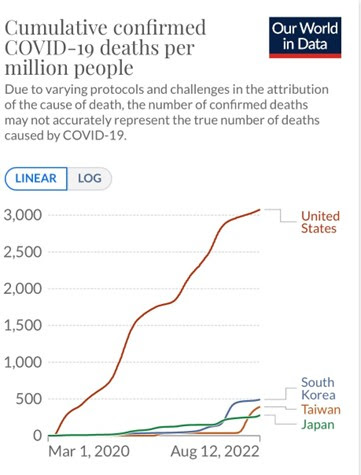
Of course, the risk of COVID also varies from country to country, which could justify why WHO and CDC have different recommendations. After all, in some countries there is greater risk than in others, and the struggle is just to keep their people alive. This might be reassuring to Americans if it were not for the fact that the US is one of those, remaining the leader in deaths.

(https://ourworldindata.org/coronavirus)


One of the key determinants of how a society functions is the balance between the rights of an individual to do what they want and the benefit to and protection of society. In the US, we have always tended toward the individual, but public health laws, regulations, rules, and recommendations are based upon the benefit to society. This makes sense because infectious diseases do not limit themselves to only those people who have consciously and willingly made the decision to take the risk of acquiring them. They also affect those who, absent governmental requirements to protect them, are forced to come to work and risk being infected or lose their livelihood, and those who are old or sick but come into contact (even in families) with those who have acquired infection because protecting themselves was just too much trouble.

The logic is flawed; what if laws against killing and stealing were made recommendations to be adopted by those who wished to be cautious? It would not just affect those who made the decision to not adopt them. Sure, we have people killing and stealing and being killed and being robbed despite the laws against it, but those laws protect us far more than a general recommendation that folks not kill or steal would. So too it is with the virus; if you go shopping and few others are wearing a mask despite rules or recommendations that they do, you are at risk. If those rules are repealed and the recommendations rescinded, then more and more people will think they are safe not doing so.

Vaccines are good and protect a lot. They do not by any means eliminate the danger. The changes in recommendations mean the politicians to whom CDC answers will be more popular, and be more likely to get re-elected.

And that more people will die.

Sunday, June 18, 2017

US Health Rankings remain low and #Trumpcare will make them worse!

On many occasions this blog has made the point that, despite frequently-repeated claims that the US has “the best healthcare in the world”, we do not. This point is also made by dozens of other sources, recently including Kaiser Health News (KHN) editor-in-chief Elisabeth Rosenthal in her book “American Sickness”. In my book, “Health, Medicine and Justice: Designing a fair and equitable health care system”, and in many lectures I have given to physicians and students, I have cited the “37th in the world”  ranking the US achieved in the comprehensive World Health Organization (WHO) report of 2000. The report’s Table 10, available as a pdf at that site, indeed lists the US as #37 in Overall Performance, just below Costa Rica and just above Slovenia. On an equally telling scale, Performance on Health Level (measured by Disability-Adjusted Life Expectancy, DALE) the US ranked #72, between Argentina and Bhutan. When many US news media led their stories with “Just ahead of Slovenia!”, the Slovenian ambassador took exception, noting that his country was working hard to improve their people's health status.

But, as I also pointed out in my lectures, this table is old, based on 1997 data, and I use it because it is the last time that WHO released such rankings. I supplement it with newer data, such as the Commonwealth Fund’s “Mirror, Mirror on the Wall” from 2014. This compares fewer countries, albeit appropriate, developed, wealthy, OECD countries. In this study, the US also ranks last overall and in many subscales; I have published this graphic before as well.  

Now, we have new rankings to refer to, the Bloomberg Global HealthIndex from 2017. It would be nice to be able to say that the US had moved up from the 2000 WHO report, but now, at #34 (and still just behind Costa Rica) the change is really insignificant. Slovenia, it might be noted, has moved up, to #27, so maybe their efforts are paying off!

Given the recalcitrance of US health status to improvement, it is obviously important to look at the ”why” as well as the “what could be done?”. This is especially now, given that these ranking do not yet reflect any negative impact that may happen through the repeal of the Affordable Care Act (ACA) and its replacement by a a Republican plan (#Trumpcare). The contents of the bill that the Senate is currently working on, and which Majority Leader McConnell hopes to bring to a vote by July 4, remain secret not only to the public but also, apparently, to many or most senators. Therefore, the bill passed by the House of Representatives, the American Health Care Act (AHCA) remains our best guide to what the final plan may look like.

And it is not encouraging; the Congressional Budget Office (CBO) estimates that 23 million Americans willlose health insurance, about equally from loss of Medicaid expansion and from  cuts to support for the health insurance exchanges set up by ACA. This will unquestionably mean that the overall health status of Americans will go down, both in absolute terms and relative to other nations. Without health insurance, people will not access health care, especially for prevention and “minor” problems (or problems that are not really minor but so far not, or minimally, symptomatic). This means that by the time that their health is so bad that they seek care, they are less likely to survive or do well, and also that the cost of their care will be far higher. This is not a plan to most efficiently use healthcare dollars to maximize the health of the American people.

So what is going on? In a recent blog post (“Pre-existing conditions and profit-taking: the causes of our healthcare problems, May 29, 2017)  I wrote “The AHCA is basically a tax-cut-for-the-1% bill, with the money coming from the health care coverage for the rest of us.” That is true, but the question that still needs to be answered is “why”? Ultimately, it is a question of values: if the goal was to have the best possible health status for the American people, rich or poor, white or black, native born or immigrant, rural or urban, this would not be the system that we have and #Trumpcare would be designed to fix the problems with the ACA, not to exacerbate them. President Trump and the GOP have emphasized, in the campaign and since, that for many the ACA has not made insurance accessible because the premiums are too high. This is a good point, and a solution would be great; unfortunately, the AHCA would make them higher, and price out far more people. The values of the Republican leadership are clearly to maximize tax cuts and other financial benefits to the richest American people and corporations, and this AHCA will do. The perpetrators are not among those at the margins; even those congresspersons and pundits who are not truly wealthy have outstanding health insurance for life, and are certain that they will not be in the marginalized group, and that they will be able to access the “best health care in the world”.

Of course, even when you have great insurance and access to “everything”, it is not always better. Sometimes if you are too well-insured you get too much care, tests and procedures and drugs that can put you at risk of harm. And even in the “best” facilities things don’t always go well – medical errors are common, communication can be poor, and even when there are no screwups bad things can happen. Donald Berwick, head of the Institute for Healthcare Improvement (IHI), and former interim head of the Center for Medicare and Medicaid Services (CMS) talks about the US perhaps having the best “rescue care” in the world. But even that is not so good; many IHI initiatives are focused on changing that system to work better, including improvement capability, patient safety, and population health. Anyone who has been sick, or in the hospital, or had a close friend or relative in such a situation recently, can testify to the failings of our health care delivery system even for the well-insured.

So the situation in the US was not good up until now, and will almost certainly get worse with #Trumpcare. Many of the people who will suffer most are those who voted for the President and the GOP members of Congress. Maybe they think that the bad things will not happen to them and their families, but only to “others”.  But they will, and we need to move up in the rankings, to be closer to other OECD countries.

Maybe the solution for the US is not to mimic France, or Italy, or Canada. But whatever the solution is, it has to pass the empiric “does it make our people’s health better?” test. And clearly #Trumpcare will not.

Total Pageviews