Showing posts with label Abelson. Show all posts

Saturday, June 24, 2017

McConnell, the GOP and Trumpcare: We care about lowering taxes for the rich, not your health care!


First, let’s start with a reminder about how insurance works. Money (“premiums”) is collected from everyone, or as many people as possible, and when the bad thing happens (insurance is almost always about protecting against bad things, like car accidents, or fires, or death, or illness), the victims are compensated. If it pays out more than it collects, then the insurance company goes bankrupt and can no longer pay out. This works for all types of insurance, whether for-profit (as most is in the US), not-for-profit (like many health-insurance companies in other countries), or social insurance where everyone is a client and government is the insurer. Insurance companies, especially for-profit insurance companies, have to build in a profit margin as well. In addition, they prefer insure people who are at low risk of requiring payout, and not to insure or charge higher premiums to those who are at higher risk (e.g., younger drivers, for car insurance). This process is known as “underwriting”.

If an insurance company is forced to insure a lot of high-risk people (as they were under ACA) and can’t charge them really a lot (under ACA they could charge 3 times as much), they need a lot of low-risk people to pay premiums to be able to fund their probable payouts; thus the “individual mandate”. For social insurance, such as government financed health insurance programs (as in many other developed countries, or Medicare and Federal employee and military programs in the US), it is actually not necessary that more money come in from premiums than is paid out, because the government can (if it wishes) subsidize the loss from other funds. This is, of course, a political decision on how to allocate tax dollars and how many tax dollars to collect.

The Senate Republican leadership has made its position on this completely clear with its recently unveiled “health care” bill, the “Better Health Care Act” (BHCA). Crafted by Majority Leader McConnell and a small group of white men from a small group of places (for example, 2 senators each from Utah, Wyoming, and Texas). It will and should be called #Trumpcare; while the President didn’t write it, he has endorsed it and will sign it if it passes the Senate and the House reconciliation. It is clearly a tax-cut-for-the-wealthy bill that derives funding from the reduction (and sometimes elimination) of health care coverage for a very large percent of Americans; this is detailed by the NY Times’ Margot Sanger-Katz in “Shifting Dollars From Poor to Rich Is a Key Part of the Senate Health Bill”, June 22, 2017. The Times also has a piece by Sanger-Katz and Haeyoun Park that contains a clear listing of what will be cut from the ACA in order to fund these tax cuts, “How Senate Republicans plan to dismantle Obamacare”, summarized in the graphic. However, the details are important; even the parts of the ACA that the BHCA “keeps” are largely undercut by other parts of the bill. For example, it keeps the requirement that insurers must issue policies to people with pre-existing conditions (which can range from heart disease and cancer to endometriosis and broken bones and everything else), which is good. But it raises the amount that insurers can charge these people from 3 times as much under ACA to 5 times as much. This is a big deal, and a bad deal, for people with disabilities and for older people who are, (surprise!), much more likely to have pre-existing conditions.

While BHCA (Trumpcare) repeals the individual mandate, which will make some people happy (until they get sick) and the employer mandate (which will make employers happy), it also repeals the subsidies for out-of-pocket costs and decreases funding for subsidies to make policies on the exchanges affordable. The new bill would make either premiums or deductibles (or both) unaffordable for many Americans. It limits and sometimes eliminates the requirement that insurers provide “essential health benefits”, like preventive care and contraception, allows insurers to set annual and lifetime limits on how much they have to pay, and makes major negative changes to Medicaid. Medicaid is currently largely paid for by the federal government, 50%-80+% depending on the average state income, and 90-100% for people covered by Medicaid expansion. The “changes” include (gradually, so the impact won’t be seen for the 2018 election) cutting and capping the amount the federal government pays, shifting costs to the states, which often will not be able (or willing) to cover them.
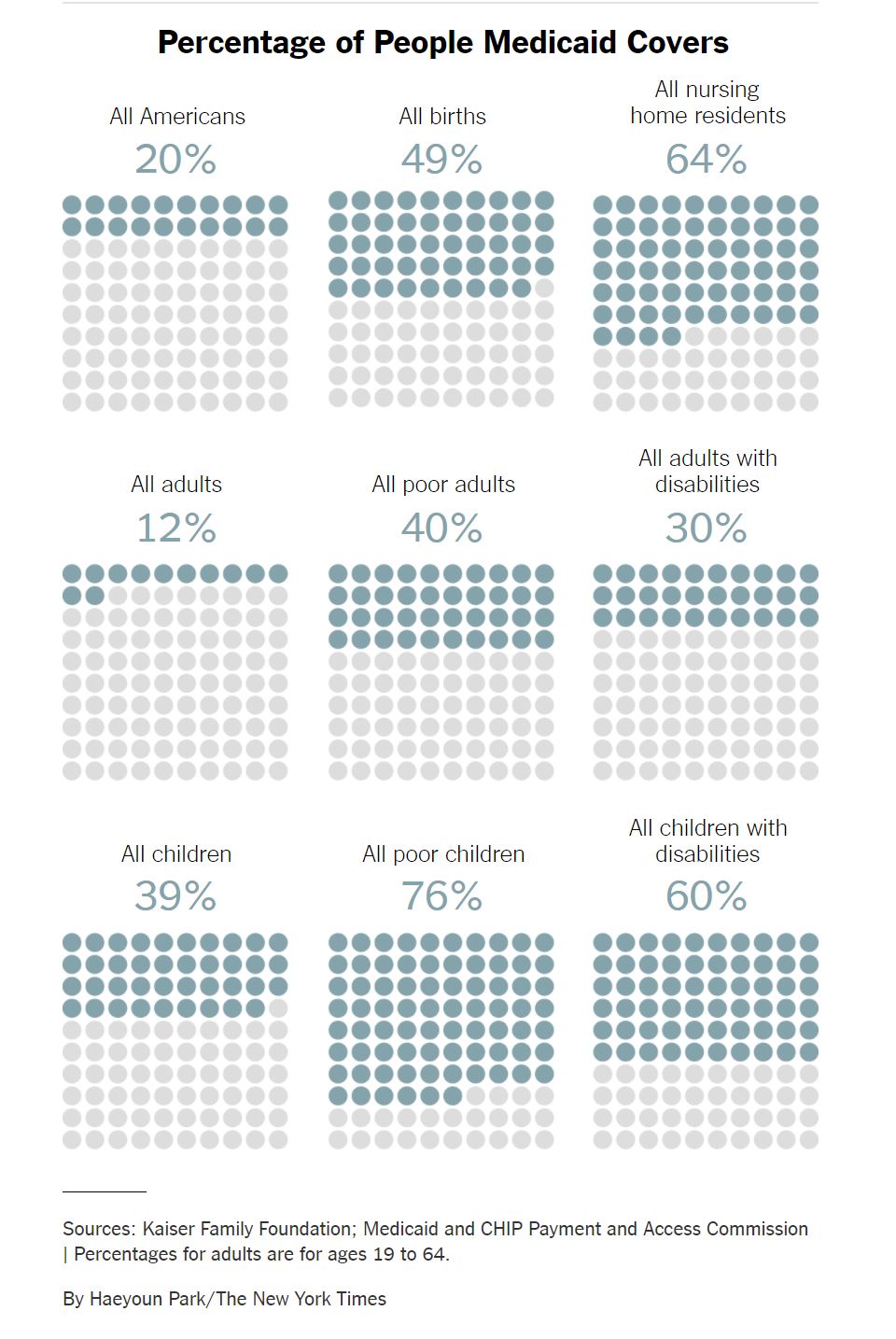
This will affect a lot of people. Medicaid is now the largest insurer in the US, covering 69 million Americans, even though many states did not expand it under the ACA to cover poor adults. What it does is summarized in “How Medicaid works and who it covers” by Abby Goodnough and Kate Zernike. It covers, as seen in the accompanying chart, 79% of poor children (and more than a third of ALL children), 64% of nursing home patients (many of whom were middle class before the NH wiped out their savings!), 60% of children with disabilities, 49% of births, 30% of adults with disabilities. The people who will suffer from Medicaid cuts are old people in nursing homes, children, and disabled people (many of whom are able to stay in the community and even keep jobs rather than being in nursing homes because of this support). With the caps on lifetime benefits, it means, as Dr. Eve Shapiro points out in an Op-Ed in the Arizona Daily Star, that a premature baby on private insurance could exceed her lifetime limit on coverage before she even leaves the hospital”! And, with the right convergence of decisions by the state, the same could happen to an infant with Medicaid.

This is a big deal. Ideologues and pundits and politicians like to debate theoretical issue to see who scores the most points. They want to be the “most conservative”, the most “anti-abortion”, the most “pro-industry”, the most “anti-tax”. If they are articulate they may think that making their smarmy points makes them win. And I guess it does. Except the losers are not those on the other side of a debate podium, they are the majority of the American people, the politicians’ constituents, who don’t get treatments, don’t get diagnosed, do get sick and die. Lives, not ideologies, are at stake.

Except, of course, it is about ideology. This is made clear in “A debate that shows what each party cares about” by Neil Irwin the Times. No one, certainly not a senator who has to run for re-election, wants to say that they are about making it harder or impossible for many (often the majority) of their constituents to be able to access health care, or to pay for it, or to get the treatments and therapies they need. But make no mistake: every senator who votes for this bill is saying exactly that, that they value tax cuts for the most privileged above basic health care for the rest of us. “This plan will improve the affordability of health insurance,” lied Sen. McConnell in a recent opinion piece in the Cincinnati paper.

Yes, “Mr. McConnell has always taken pride in protecting his members.” And his donors. It is too bad that he has no interest in protecting the rest of us.

Sunday, October 16, 2016

What is right about the ACA, and how to address what is not

There has been much criticism of the Affordable Care Act (ACA, Obamacare) both from the Right, which is apparently horrified that public funds are actually being used to help needy people rather than bail out banks, and from the Left, which thinks it hasn’t gone far enough to help meet people’s healthcare needs. Count me in the latter camp, for reasons I will address soon.

However, first to address the criticisms from the Right.  On the whole they are wrong (no pun intended). The fact is that the ACA has done good. About 10,000,000 people who were previously uninsured have now gained health insurance coverage, both from the health insurance exchanges (that include subsidies for the low income) and through expansion of Medicaid, in those states that have opted to do so. This is a GOOD THING. One of the major reasons that the ACA has not done more good is a result of the specific actions that the Right has taken. The most obvious is the failure to expand Medicaid in states that they control, a fiscally unwise decision that is based entirely on a combination of ideology (Malthus as seen through the fantasy novels of Ayn Rand) that is about helping the wealthiest become even wealthier, and the politics of meanness (we will get votes by appealing to folks who don’t want to help them, usually code for racial and ethnic minorities). It is fiscally unwise because, in contrast to traditional Medicaid in which the federal government pays 60-80% of the cost (based upon the income levels of the state), under expansion it pays 100% of the cost for 4 years and then 90%. Medicaid expansion covers everyone under 137% of the poverty line. In contrast, in Kansas, for example, it only covers people who are BOTH very poor (under 30% of poverty) AND have another “qualifying” condition – most commonly mothers of young children and those children, and the disabled. Obviously, this excludes many people in Kansas, and millions across all of the states that have not expanded Medicaid.

There have been many other efforts to limit people benefiting from ACA. Many states (like Kansas) refused to open state-sponsored exchanges, and have tried to obstruct the federal exchanges, even trying to intimidate those working to sign people up. It tried to block passage of the ACA in Congress, and when it gained majorities has blocked every effort to expand funding, and blocked the creation of a “public option” to compete with private insurance companies. The entire series of efforts on the Right to block, limit, and try to kill ACA make its criticisms reminiscent of the person who killed his parents and asks for mercy from the court on the grounds that he is an orphan!

And yet, although it is largely their fault, some of the criticisms of ACA are spot on. Premiums have continued to go up in many places, making the policies available on the exchanges unaffordable to many. Combined with the fact that, despite the “individual mandate”, the penalties for not participating are far less than the cost of insurance, people are not buying it. Or they are buying terrible policies, also permitted by the ACA, that turn out to be worth very little when their purchasers actually get sick. In some places, major insurance companies (like Aetna and Humana) are pulling out of the exchange marketplaces altogether because, even with such high premiums, they are losing money.

The reason for this phenomenon is well-described in Health Care Law’s Beneficiaries Reflect Its Strengths, and Its Faults by Abby Goodnough and Reed Abelson in the New York Times of October 14, 2016. People with chronic diseases, many of whom had been previously uninsurable because of these pre-existing conditions, have flocked to buy insurance on the exchanges. They now have coverage, and are using it; they are among the 5% of people who cost 50% of health dollars (described by me in Red, Blue, and Purple: The Math of Health Care Spending, October 20, 2009), or 75% under the exchanges (per an official of Blue Cross/Blue Shield of Tennessee cited in the article). The difference is because the first estimate is based on all people in the country, and the BC/BS experience in Tennessee and elsewhere is based upon people who have actually signed up for coverage in the exchanges. In a vicious circle, low-income but (currently) healthy people, especially the young, have chosen to not sign up; this leaves the pool of those covered disproportionately ill and thus costly. Without premiums coming in from the people who would cost little or nothing, insurance companies’ outlay for care (the “medical loss ratio”) is too high for them to make a profit (or, at least, as much profit as they want to), and so premiums continue to rise, driving more people (and insurers) out of the marketplace. In addition, the competing demands of survival among low-income people are tremendous, as documented in the October 31, 2016 issue of The Nation, by Monica Potts in “The American social safety net does not exist”. (H/t Bob Bowman, on the Medicine and Social Justice Facebook page.)

This is the basis of the criticism from the Left – that the private insurance-based model of the ACA was designed to benefit the insurance companies (which is now sometimes failing). This was the purpose of the individual mandate, to get everyone, healthy or not, to buy in. But the solution is not to raise the penalty for not signing up, which is obviously counterproductive, but to automatically put everyone in the same pool, regardless of income, pre-existing conditions, age, or the state that they live in. This is what would happen in a national health insurance program, as advocated by Senator Bernie Sanders. Conceptually, it can be seen as putting everyone in the federally-run Medicare program (which already has, by virtue of insuring the old and disabled, the highest risk people). All of us are in, whether we need medical care or not. It is “insurance” only in the broadest sense, because everyone is in the pool, and the public sector – all of us, from our taxes and income-based premiums, pays for it.

Some people know that they are sick. They have one, or often more, chronic diseases. They may have cancer. They may have had trauma requiring multiple surgeries. These are the people who cost the most today. But all of us are at risk for joining that group, when we find out tomorrow that we have cancer, or are in an accident, or have a premature baby, or just gradually gather more chronic conditions as we age. These are those of us who find ourselves without coverage because, when we were healthy, it was too expensive. But it doesn’t have to be that way; a single-payer national health program covers all of us all the time.

The core concept of most insurance is that you only “win” by losing; you collect when your house burns down, or you are in a car accident, or you die. Health care should not be that way. We all should get preventive care, acute care, and care for our chronic conditions, physical and mental.


We can do this. We should. Now is the time. Now is way past time.

Wednesday, April 9, 2014

Medicare payments to doctors: the big issue is the underpayment for primary care

The Center for Medicare and Medicaid Services (CMS) just published how much money individual doctors get paid from Medicare. This initial version is without names, but undoubtedly the names will eventually be revealed. Enough information is available for Reed Abelson and Sarah Cohen, who wrote the article for the New York Times on April 9, 2014Sliver of Medicare Doctors Get Big Share of Payouts”,   to identify many of the specialties and locations. About ¼ of all Medicare payments, the article tells us, go to about 2% of all doctors. “In 2012, 100 doctors received a total of $610 million, ranging from a Florida ophthalmologist who was paid $21 million by Medicare to dozens of doctors, eye and cancer specialists chief among them, who received more than $4 million each that year.” The largest amount of money was accounted for by office visits, $12B, but this was for 214M visits, with an average reimbursement of $57, in contrast to the Florida ophthalmologist, or to the “Fewer than 1,000 radiation oncologists, for example, received payments totaling $1.1 billion.”

Much of the discussion in the article, and in the comments attached, relates to why so few doctors get so much of the $77B Medicare pays out each year. There are, obviously, concerns about fraud; not only is Medicare seemingly fixated on looking for fraud everywhere but there is good evidence that it has occurred, at least historically. For example a highly paid (by Medicare) Florida ophthalmologist is apparently linked to a previous Medicare fraud scandal in which there was some implication of New Jersey Senator Robert Menendez. “The Office of Inspector General for the Department of Health and Human Services, which serves as a federal watchdog on fraud and abuse for the agency, released a report in December recommending greater scrutiny of those physicians who were Medicare’s highest billers.” I would have to say that this is a much wiser, fairer, and probably more productive strategy than simply trying to find largely unintentional errors in coding for outpatient visits, or checking each hospital admission to see if it could have been an “observation”, which is reimbursed less because it is considered outpatient status, as is done by Medicare’s Recovery Audit Contractors (RACs, or as I have called them, bounty hunters). Also, as I have previously discussed, these efforts are harmful to the patient in a direct financial way; as an “outpatient”, a Medicare recipient in the hospital has much higher out-of-pocket costs than if they are admitted as an inpatient. This is, of course, why CMS wishes to limit some stays, but if a person medically needs to be in the hospital, Medicare should pay for a hospitalization, and not play these games that not only financially penalize the hospital and doctors but more importantly the patient.

The other big area discussed is whether, if not exactly fraud, there is substantial difference in practice (e.g., getting CTs before each procedure, using more expensive drugs, etc.) that some specialists who are highly reimbursed by Medicare are doing more of than others. In addition, the question is “are they doing more procedures” or doing procedures with less strict indications? It is worth looking at; there is no guarantee that, even if some doctors are doing more procedures, having looser criteria for them, using more expensive drugs and tests, that this is not the better way to practice, but there is no guarantee that it is the better way to practice. If some doctors are outliers in their specialty, and their practice characteristics “happen” to end up making them a LOT more money than others, then this is certainly a reasonable basis on which to look more closely at how they are practicing, and what is the evidence basis of appropriate practice.

A third issue is that many of the recipients of the most money from Medicare, particularly oncologists (cancer doctors) and ophthalmologists are using very expensive drugs, which they have to buy first and which Medicare reimburses them for. Thus, this skews their reimbursement upward even though the money (or most of it) does not go to the doctor, but rather to the pharmaceutical company. The article refers to a drug called ranibizumab, injected into the eye by ophthalmologists monthly for age-related macular degeneration. It is very expensive, as are many drugs which are made through recombinant DNA (a lot end in “-ab”) used by oncologists, neurologists, rheumatologists, and gastroenterologists as well. One comment notes that he as a physician only makes 3% on the drug. While it can be argued that this is a significant markup (for example, making $3000 on a $100,000 drug), and that this doesn’t include the doctor’s fee for administering it (substantial), it is unfair to count the full cost of the drug as income for the doctor. Of course, it is income for someone (the pharmaceutical company) which suggests there needs to be substantial investigation into pricing of these drugs. And, of course, if a physician is found to be using a lot of a drug where he (or she) makes a 3% markup rather than prescribing an equally effective drug (if there is one) where there is no markup profit, this would be a bad thing.

However, the most important thing revealed by this data, I believe, is the enormously skewed reimbursement by specialty. It is an excellent window into the incredible differences in reimbursement for different specialties, with the ophthalmologists, radiation oncologists, etc. making huge incomes while primary care doctors (and nurse practitioners) are making $57 for an office visit. This is major. The fact that Medicare pays so fantastically much more for procedures (and, as a note, it is likely that all of the doctors, including the 202 family doctors in the highest-paid 2%, are getting it for doing a lot of procedures) leads to private insurers paying similarly more. And makes these specialties very attractive to medical students because they are lucrative (and often, though not in the case of many surgical specialties, involve fewer hours of work). Which leads to fewer primary care doctors, and a dramatic shortage in this country.

Medicare could change this. It could dramatically, not a little bit, change the reimbursement for cognitive visits to be closer to the payment for these procedures. If it did, so would private insurers. If the income of primary care doctors was 70% of that of specialists (instead of say, 30%) data from Altarum researchers and from Canada suggest that the influence of income on specialty choice would largely disappear. More students would enter primary care, and in time we would begin to see a physician workforce that would be closer to what this country needs, about 50% doctors actually practicing primary care.

It is fine if CMS and the OIG look at these highest billing doctors to make sure that they are not committing overt fraud. It is also fine to look at them and see if they are using criteria for procedures that are not supported by current evidence, or doing too many other tests, or taking kickbacks. It is also a good idea to look at the cost of drugs, especially the portion going to the drug company, as well as the markup for physicians, and to re-present the data excluding that portion of the money the doctor does not get (goes to the pharmaceutical company) from their income.

But the most important result of this report should be to be shocked at the way Medicare enables the continued practice of reimbursing for procedures at such high levels, and to kickstart a complete revision of the Medicare fee schedule to bring reimbursement for different specialties into better balance.
That would be a great outcome!


Sunday, February 2, 2014

Health care systems should not be run for profit, but rather for people's health

I wrote in a recent blog (“How can a health care system lead not to ruin but to, actually, health?”, December 28, 2013) that our health care system ”…is a parallel to our financial services industry: private enterprise is given a license to make money from everyone, and the government finances it. The only difference is that for financial services, the government steps in to bail them out only after they have already stolen all our money, while in health services the profit margin is built in from the start.” A recent article in the New York Times, “Hospital chain said to scheme to inflate bills”, by Julie Creswell and Reed Abelson (January 24, 2014) takes this a bit farther.

Discussing the Department of Justice’s decision to join several whistleblower (“qui tam”) lawsuits against the for-profit hospital chain HMA (not to be confused with the nation’s largest, HCA) for aggressive policies that seek to maximize profits by “encouraging” (at threat of termination) doctors to over-admit patients, they quote Sheryl R. Skolnick from CRT Capital, who wrote “Investors seem to think that D.O.J. investigations, qui tam suits and allegations of serious Medicare fraud are simply a cost of doing business.” That’s right. Illegal activity has a price – fines – but the fines are small enough that they do not discourage the illegal activity. The authors write “Many settlements run only into the tens of millions of dollars. That’s a corporate slap on the wrist for companies whose stocks typically soar when executives push the profit envelope. Only if the penalty is at least $500 million, Ms. Skolnick said, are corporations likely to find the cost a deterrent.” Or, of course, if the heads of these corporations are sent to prison, but in another parallel with the financial services industry, this is not happening. Not to Lloyd Blankfein of Goldman Sachs or other financial titans (such as CEO Jamie Dimon of JPMorgan, featured in the same issue of the Times, JPMorgan, fined billions, approves raise for its chief”!), or to Rick Scott, former head of Columbia/HCA when it was fined $1.7 billion in 2003 for massive Medicare fraud). Scott, of course, is now the Governor of Florida.

It is difficult to imagine the hubris and arrogance of the “masters of the universe” who run the financial services industry, or the large hospital corporations. At least, it is for me, and possibly for other people who believe that the health care system should be first, second, third, and last about benefiting people’s health. It does not seem to be for the C-suite executives of even moderate-sized hospitals, who often come from accounting and finance backgrounds. The argument is that if there is “no margin” there is “no mission”, and that in the competitive environment of health care it is necessary to have good business managers to make it possible for a hospital – or hospital system – to even survive, not to mention to prosper.

Good management is important. Good management means the ability to run an organization efficiently, to create effective systems and effective working relationships, to enhance quality and limit unnecessary costs. It is absolutely necessary to build a system that is about benefiting the health of people. This includes financial knowledge and financial management ability. But increasing profit, increasing market share, taking “desirable” customers away from “competitors” has no such place; the health system has no business in being organized in such a way that these things are even possible.

This statement is so completely at odds with the way the health system is currently structured that it bears repeating. There should be no financial incentive for competition in health care. There should not be more services available than a community needs because every hospital wants to provide it and take “customers” from their competitors. If, for example, a community is large enough that it needs one MRI scanner, there should be only one (or 2, or 3, or whatever the medical need is). In the current structure, however, the hospital with that one would have a competitive advantage over other hospitals in the community, so everyone needs one. The same is true for any profitable service: cancer treatment, heart procedures, neurosurgical procedures, etc. Profitable “product lines” are, thus, in oversupply, and this means that they are overused, often with risk to the recipients, and certainly the cost to everyone is increased. Conversely, necessary services that are not profitable, such as burn and trauma care, are rarely in oversupply, frequently relegated to the community’s public hospital, and sometimes not available at all.

A community should have all the health care resources its people need, but should not duplicate – and triplicate – services so each can compete. It is bad in terms of the overall cost, and the oversupply of profitable services, and it is arguably worse in that all these hospitals are competing to get the same patients – those who are well-insured with “high profit” diseases, and to not care for others – uninsured, poor, and those needing services that are not well reimbursed.

This is craziness. Health care is not luxury condominiums, or expensive watches. It is something that every single person should get all of that they need, and no one should get what they do not need. There should be competition between hospitals to be excellent, and measures of excellence should include comprehensiveness, quality, cost-effectiveness, and caring for everyone equitably (not equally, but based upon their health care needs). And, if there are to be financial rewards, they should come for doing this well. There must be no services that are particularly “high-profit”, nor patients whose economic status makes them “undesirable”.

We have a long way to go. Various strategies have been tried in the past, from certificate of need (CON) programs that decided whether a community needed a new pieceof capital equipment in the 1970s and 1980s, to disproportionate share funding for hospital caring for higher percentages of uninsured people and quality improvement organizations more recently. But all of these efforts have been gamed, because there was no comprehensive plan in place to ensure that no patient, and no disease, was more or less profitable than another. We need to have a system in which each person with a health care problem is provided the care that they need. No gold cards. No profitable conditions. Not hard to understand.

The time for this to happen is now.

Total Pageviews