Showing posts with label Trumpcare. Show all posts

Saturday, June 24, 2017

McConnell, the GOP and Trumpcare: We care about lowering taxes for the rich, not your health care!


First, let’s start with a reminder about how insurance works. Money (“premiums”) is collected from everyone, or as many people as possible, and when the bad thing happens (insurance is almost always about protecting against bad things, like car accidents, or fires, or death, or illness), the victims are compensated. If it pays out more than it collects, then the insurance company goes bankrupt and can no longer pay out. This works for all types of insurance, whether for-profit (as most is in the US), not-for-profit (like many health-insurance companies in other countries), or social insurance where everyone is a client and government is the insurer. Insurance companies, especially for-profit insurance companies, have to build in a profit margin as well. In addition, they prefer insure people who are at low risk of requiring payout, and not to insure or charge higher premiums to those who are at higher risk (e.g., younger drivers, for car insurance). This process is known as “underwriting”.

If an insurance company is forced to insure a lot of high-risk people (as they were under ACA) and can’t charge them really a lot (under ACA they could charge 3 times as much), they need a lot of low-risk people to pay premiums to be able to fund their probable payouts; thus the “individual mandate”. For social insurance, such as government financed health insurance programs (as in many other developed countries, or Medicare and Federal employee and military programs in the US), it is actually not necessary that more money come in from premiums than is paid out, because the government can (if it wishes) subsidize the loss from other funds. This is, of course, a political decision on how to allocate tax dollars and how many tax dollars to collect.

The Senate Republican leadership has made its position on this completely clear with its recently unveiled “health care” bill, the “Better Health Care Act” (BHCA). Crafted by Majority Leader McConnell and a small group of white men from a small group of places (for example, 2 senators each from Utah, Wyoming, and Texas). It will and should be called #Trumpcare; while the President didn’t write it, he has endorsed it and will sign it if it passes the Senate and the House reconciliation. It is clearly a tax-cut-for-the-wealthy bill that derives funding from the reduction (and sometimes elimination) of health care coverage for a very large percent of Americans; this is detailed by the NY Times’ Margot Sanger-Katz in “Shifting Dollars From Poor to Rich Is a Key Part of the Senate Health Bill”, June 22, 2017. The Times also has a piece by Sanger-Katz and Haeyoun Park that contains a clear listing of what will be cut from the ACA in order to fund these tax cuts, “How Senate Republicans plan to dismantle Obamacare”, summarized in the graphic. However, the details are important; even the parts of the ACA that the BHCA “keeps” are largely undercut by other parts of the bill. For example, it keeps the requirement that insurers must issue policies to people with pre-existing conditions (which can range from heart disease and cancer to endometriosis and broken bones and everything else), which is good. But it raises the amount that insurers can charge these people from 3 times as much under ACA to 5 times as much. This is a big deal, and a bad deal, for people with disabilities and for older people who are, (surprise!), much more likely to have pre-existing conditions.

While BHCA (Trumpcare) repeals the individual mandate, which will make some people happy (until they get sick) and the employer mandate (which will make employers happy), it also repeals the subsidies for out-of-pocket costs and decreases funding for subsidies to make policies on the exchanges affordable. The new bill would make either premiums or deductibles (or both) unaffordable for many Americans. It limits and sometimes eliminates the requirement that insurers provide “essential health benefits”, like preventive care and contraception, allows insurers to set annual and lifetime limits on how much they have to pay, and makes major negative changes to Medicaid. Medicaid is currently largely paid for by the federal government, 50%-80+% depending on the average state income, and 90-100% for people covered by Medicaid expansion. The “changes” include (gradually, so the impact won’t be seen for the 2018 election) cutting and capping the amount the federal government pays, shifting costs to the states, which often will not be able (or willing) to cover them.
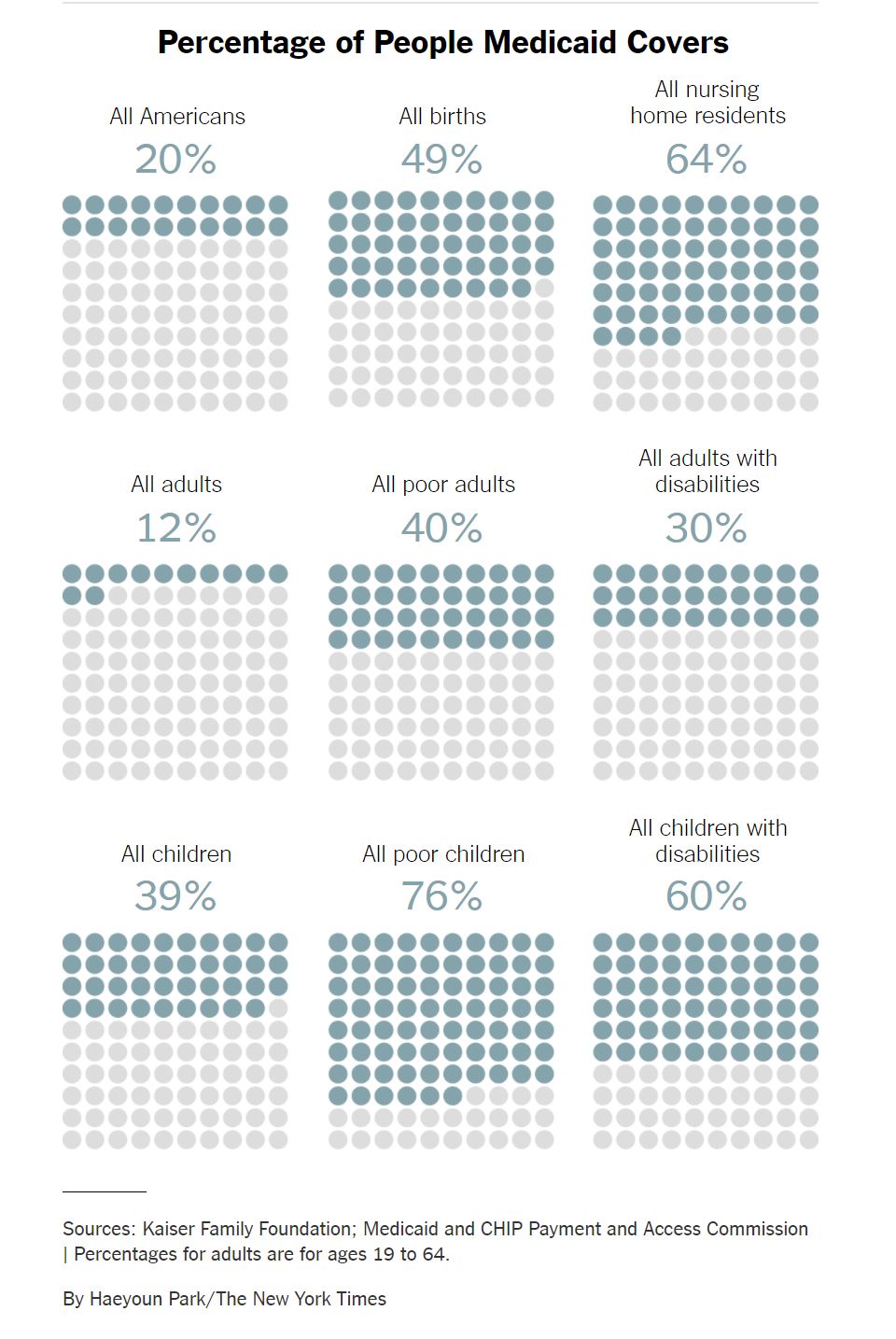
This will affect a lot of people. Medicaid is now the largest insurer in the US, covering 69 million Americans, even though many states did not expand it under the ACA to cover poor adults. What it does is summarized in “How Medicaid works and who it covers” by Abby Goodnough and Kate Zernike. It covers, as seen in the accompanying chart, 79% of poor children (and more than a third of ALL children), 64% of nursing home patients (many of whom were middle class before the NH wiped out their savings!), 60% of children with disabilities, 49% of births, 30% of adults with disabilities. The people who will suffer from Medicaid cuts are old people in nursing homes, children, and disabled people (many of whom are able to stay in the community and even keep jobs rather than being in nursing homes because of this support). With the caps on lifetime benefits, it means, as Dr. Eve Shapiro points out in an Op-Ed in the Arizona Daily Star, that a premature baby on private insurance could exceed her lifetime limit on coverage before she even leaves the hospital”! And, with the right convergence of decisions by the state, the same could happen to an infant with Medicaid.

This is a big deal. Ideologues and pundits and politicians like to debate theoretical issue to see who scores the most points. They want to be the “most conservative”, the most “anti-abortion”, the most “pro-industry”, the most “anti-tax”. If they are articulate they may think that making their smarmy points makes them win. And I guess it does. Except the losers are not those on the other side of a debate podium, they are the majority of the American people, the politicians’ constituents, who don’t get treatments, don’t get diagnosed, do get sick and die. Lives, not ideologies, are at stake.

Except, of course, it is about ideology. This is made clear in “A debate that shows what each party cares about” by Neil Irwin the Times. No one, certainly not a senator who has to run for re-election, wants to say that they are about making it harder or impossible for many (often the majority) of their constituents to be able to access health care, or to pay for it, or to get the treatments and therapies they need. But make no mistake: every senator who votes for this bill is saying exactly that, that they value tax cuts for the most privileged above basic health care for the rest of us. “This plan will improve the affordability of health insurance,” lied Sen. McConnell in a recent opinion piece in the Cincinnati paper.

Yes, “Mr. McConnell has always taken pride in protecting his members.” And his donors. It is too bad that he has no interest in protecting the rest of us.

Saturday, March 25, 2017

Doctors and health reform: maybe they do stand for health!

The new GOP health plan, the American Health Care Act (AHCA), aka “Trumpcare”, has crashed to defeat. The President, who pushed hard for it, looks like his greatest nightmare, a “loser”. It is worth thinking, however, about who opposed it. In Congress it was Democrats and (the few) moderate Republicans and very right-wing Republicans are against it, for different reasons. From outside government the response was pretty negative, with a 17% approval rating (amazing they could still think they could pass it!). Far-right “conservatives” thought that AHCA was too much like Obamacare in that it actually provides some federal support for some people, and  they don’t believe in the government ever helping anyone, except maybe themselves and their friends. (Oh, yes, and fabulously rich people. They deserve a lot of help.) The criticism from most of the rest of the universe (to say “the left” would be inaccurate, since it includes many quite a bit right of center, since, in fact, “Obamacare” started life as a Republican plan) was mostly because it would be a disaster for health coverage for Americans. Projections by the Congressional Budget Office (CBO) were that 24 million people would lose their health insurance, that access to care would be more and more limited, especially for the middle class and poor, and that costs would rise for patients exponentially. Also that the public health and preventive health infrastructure would be gutted and many of our advances in those areas lost.

The main “positive” in the CBO’s projection was that it would reduce the federal deficit by $337 billion over 10 years. This was only because it shifted costs to others, to states and employers and individuals. Those who could not pay with money would pay with their health and sometimes their lives. While, as I have pointed out (‘We have a bill! The GOP's plan to cut taxes on the rich and health care for the rest of us, March 16, 2017) many would have lost their insurance because of cuts in subsidies through the exchanges, the biggest impact would have been through the loss of Medicaid. This is clearly explained by Dr. Daniel Derksen, a family physician and director of the University of Arizona’s Office of Rural Health in a video on MedPage Today.

Among the many groups criticizing the draconian cuts in health care (as well as taxes on the rich) are almost all of the major hospital associations (including the American Hospital Association, the Catholic Hospital Association, and others), and physicians’ groups, most notably the American Medical Association (AMA) as well as most specialty societies including the American Academy of Family Physicians (AAFP), the American College of Physicians (ACP), as well as many others. They have been joined by the major nursing organizations and by patient advocacy groups. It should not be surprising, I suppose, that most of these groups would be critical of such a devastating attack on health care for Americans, but if it isn’t, it is at least a relief. The AMA is important in part because of its major role in opposing most historical expansions of health care access by the government, including President Truman’s attempt to get a national health insurance program (where they were successful) and President Johnson’s creation of Medicare and Medicaid (where they were not).

Of course, not all health providers and certainly not all physicians opposed the AHCA’s changes. MedPage Today published quotes from a number of physicians, and some were quite supportive; Darrell S. Rigel, a dermatologist at NYU, for example, said “It looks like it is a significant improvement over the ACA [the Affordable Care Act, aka Obamacare].” The most noteworthy physician advocate for the AHCA and Trumpcare was naturally Tom Price, MD, the Secretary of Health and Human services. As I discussed before his appointment (“Trump, Price, and Verma: Bad news for the health of Americans, including Trump voters, December 3, 2016), Secretary Price, as a congressman from Georgia was a leader in the Tea Party caucus and an opponent of ACA or any other program to expand health coverage to Americans. Another recent voice to both support AHCA and channel the administration and GOP’s contempt for regular people is Rep. Roger Marshall, an obstetrician from Great Bend, KS who is the Representative from Kansas’ “Big First” district. Dr. Marshall told the Washington Post that “the poor just don’t want health care”. He kind of walked back those remarks later, but his analysis is telling:

“Just like Jesus said, ‘The poor will always be with us,’ ” Marshall said in response to a question about Medicaid, which expanded under Obamacare to more than 30 states. “There is a group of people that just don’t want health care and aren’t going to take care of themselves.” He added that “morally, spiritually, socially,” the poor, including the homeless, “just don’t want health care….The Medicaid population, which is [on] a free credit card as a group, do probably the least preventive medicine and taking care of themselves and eating healthy and exercising. And I’m not judging; I’m just saying socially that’s where they are,” he told STAT, a website focused on health-care coverage. “So there’s a group of people that even with unlimited access to health care are only going to use the emergency room when their arm is chopped off or when their pneumonia is so bad they get brought [to] the ER.”

I may not be the best person to comment on his bizarre interpretation of the Gospel, but I can say that for many of us the challenges that poor people face in just getting through their lives are reasons why we need to make health care accessible, not reasons to just write them off. I also wish that I could say that, in my experience, physicians with attitudes like those of Price and Marshall are rare, but sadly they are not. To some degree, there are differences by specialty, with primary care physicians and psychiatrists more likely to support government-involved health care and even single payer plans than surgeons (including orthopedists). I am sure that at least in part this difference is driven by income; while all physicians have relatively high incomes compared to most Americans (top 10%), some specialties, including orthopedics (at the top), radiology, cardiology, surgery, and dermatology make much more; the mean reported income for orthopedists, about $467K (which seems low to me based on those I know) is about the cutoff for the top 1%. When a friend of mine (who later became a surgeon) was on his surgical rotation in medical school, he was impressed by all the talk in the surgeon’s lounge about the “Big Board” – until he found out they meant the stock market, not the board listing upcoming surgeries! And primary care doctors are not immune; when I lived in Texas one family physician regularly railed against the liberal government spending our money. One day, however, his attacks were on delays in payments to doctors from Medicare. Umm…

Doctors are, of course, like other people. Their perspectives vary widely, with most being caring and some caring mostly for themselves. My family physician colleague’s self-centered view is not so different from that of those Trump voters who are now against the AHCA because they see that their benefits are being cut; see “Trump budget cuts put struggling Americans on edge”, NY Times March 18, 2017. The authors cite a retired nurse with lung cancer whose heat was cut off in the middle of the winter; she was rescued by a heating subsidy funded by the federal government and likely to be cut. “I understand what he’s trying to do, but I think he’s just not stopping to think that there are people caught in the middle he is really going to hurt,” she said. Somehow, I suppose, she thought that the cuts would only be to other people…

So, while it is true that doctors, like others, often share the perspectives of their class, and callously disregard or rationalize opposition to ensuring health care for everyone, they often do understand the situations their patients are in and serve as advocates for them. In 2001, the AMA passed its “Declaration of Professional Responsibility: Medicine’s Contract with Humanity”.  It includes the following “Advocate for social, economic, educational, and political changes that ameliorate suffering and contribute to human well-being.”  The AMA was on the right side of the AHCA fight. I hope that most doctors agree with, and even practice, that principle.


I hope Tom Price and Roger Marshall are aberrant exceptions.

Thursday, March 16, 2017

We have a bill! The GOP's plan to cut taxes on the rich and health care for the rest of us

Every day it gets more difficult to write about the new “American Health Care Act” (AHCA) that has been introduced in the House of Representatives by Speaker Paul Ryan because every day there is so much more news about it, and so much more criticism of it that appears in the press. Even before its introduction, the bill was attacked for being likely to significantly increase the number of uninsured Americans while providing windfall tax cuts for the wealthiest.

It did not disappoint. Consistent with predictions, the nonpartisan Congressional Budget Office (CBO) estimates that initially 14 million people will lose coverage, with the number rising to 24 million in 10 years. These estimates are discussed in detail, and clarified, in “Deciphering CBO estimates” at the Kaiser Health News site. The largest number of people who will lose coverage will do so because of the changes – but let’s call them what they are, “cuts” – to federal funding of Medicaid (discussed by the Health Affairs blog), which would shift costs to the states, most of which will be unable or unwilling to absorb these costs. The 31 states that have expanded Medicaid to all those under 138% of the federal poverty level  under the Affordable Care Act (ACA) will be faced with having to fund a lot more from their own coffers; poor people in the states that have not expanded Medicaid eligibility will continue uncovered. The other group that will lose coverage will be those who have bought subsidized insurance on the ACA-created marketplaces and who will no longer be able to afford the premiums. Yes, the new GOP plan calls for tax credits to help pay premiums, but they will be far less than under the ACA and far from enough to cover the actual cost.

This change will have the biggest impact on the older, sicker poor who are not yet eligible for Medicare (and, while I we will not address it here, the GOP leadership certainly has plans for cutting Medicare!), whose premiums will go up because of two important changes the AHCA will make. It will end the “individual mandate” of ACA, so that those who feel that they do not need health insurance can pass on buying it, which means the pool of insured will lose those healthier people and have a pool more skewed to those who are sicker and will actually use health care. This will tend to drive premiums up for them, and the AHCA also allows insurers to charge 5 times as much to older people as younger. As reported by Thomas Kaplan and Robert Pear in the NY Times on March 13, 2017
Under current law, in 2026, a single 21-year-old earning $26,500 with an insurance policy that costs $5,100 a year would get a tax credit of $3,400 and would have to pay $1,700 of the premium. Under the Republican bill, that person’s share of the cost would drop to $1,450.
By contrast, a 64-year-old earning the same amount would fare much worse. That person’s $15,300 health plan would be offset by a $13,600 tax credit under current law, leaving the consumer responsible for $1,700. Under the Republican plan, health insurers would be free to charge older people more, raising that person’s premium to $19,500. But the tax credit would be only $4,900, and that person’s share of the premium would then be $14,600.
That’s a bite! And, ironically, as pointed out by Noam Levey in the Los Angeles Times (March 12, 2017), it will hurt Trump/GOP voters more than Democratic voters, because those Trump voters – and the counties and states which went for Trump in which they live -- are more likely to be in this older, sicker, group. This group of Republican voters did not like Obamacare because the premiums, co-pays, and deductibles were going too high and the coverage was not always great, especially for the plans they could afford. Trump, and the GOP, promised them high-quality, affordable coverage. These folks believed them. They voted for them. And they are not going to get it, certainly not from the AHCA. Levey notes that “…In nearly 1,500 counties nationwide, such a person stands to lose more than $6,000 a year in federal insurance subsidies. Ninety percent of those counties backed Trump…[a]nd 68 of the 70 counties where these consumers would suffer the largest losses supported Trump in November.” What can you do. Politicians lie. This one was a whopper.

What is the reason for this? Many of Congress’ and Washington’s leading “conservatives” say that they believe that the role of government should be as close to zero as possible, and certainly think that the government has no business being involved in the insurance marketplace to ensure that people without resources have health coverage; to them, the AHCA is too much like the ACA in that it actually makes some effort to help some people, if weakly. There are a few of these “conservatives”, in and out of Congress, who really believe this and act on such beliefs. Uniformly, they are not poor, are not close to poor, and are not likely to be negatively affected. There is a much larger contingent that only believe government should not help most people. They support legislation that benefits rich people, like the AHCA, which uses the money it will save (and the CBO says that it will reduce the deficit over 10 years by $337 billion) to give tax cuts, not evenly distributed, but very much skewed to the highest incomes. This is where the [mean] rich people come in; they fund the Congresspersons, and this is what they want. Rep. Michael Burgess (R, TX), Chairman of the Energy and Commerce subcommittee on health, is quoted in the Times on March 11 (“The GOP’s high-risk strategy for health law repeal”) as saying “If you ask someone to give up something, there will be resentment,” and he is correct. That it is regular people who are being asked to give up something by Mr. Burgess and his colleagues, so that his rich patrons can save even more on their taxes, is something he doesn’t focus on.

One of the most iconic differences between ACA and AHCA focuses on equity: the subsidies (and tax credits for those who paid taxes) under ACA were tiered to income. The tax credits that replace subsidies under AHCA are tiered to age. Of course, as I have noted, older people are more likely to be sick, but they are not all of the same need; some older people have lots of money, and some have none. The same is true for younger people, including those with medical need. In any case, the tax credits in AHCA will not, as demonstrated above, be sufficient for those without significant other resources to buy health coverage, even if they are in the more-highly-subsidized older group. The Times’ Alan Rappeport reports on March 16, “One certainty in health bill: tax cuts for the wealthy”, with 40% of the cuts going to the top 1%, and the bill providing the necessary basis for further tax cuts for the rich. Rappeport quotes Mike Mulvaney, the White House budget director: “We promised at the outset that we were going to repeal all of the taxes. Who cares if someone else benefits?” Well, maybe the people who will suffer for their benefit? The same issue of the Times contains a brief and informative piece by Mr. Pear, “Putting Republicans’ plan on the Obamacare scale”, examining the criticisms of ACA and how the AHCA solves them (or not).

President Trump apparently feels conflicted; he promised the repeal of ACA, and the Congress wants to do that. He also knows that any plan that comes out that does this will be called “Trumpcare”, just as the ACA was called “Obamacare”. Enough Republican senators are concerned that the House’s AHCA will make it too hard for too many people to afford insurance that they might vote against it, so “Mr. Trump was left to strike a balance between siding with House Republicans while also distancing himself from the details, with top aides conceding that the legislation needed modifications before it could pass the full Congress,” (”G.O.P. Senators Suggest Changes for Health Care Bill Offered by HouseNY Times, March 14).

For the rest of us, it is an impending disaster.


Total Pageviews