Showing posts with label nursing homes. Show all posts

Wednesday, March 1, 2023

Making people healthy or making money: What should be the goal of our health system?

In the February 16, 2023 issue of The Nation, epidemiologist Gregg Gonsalves writes about The Fight for the Soul of American Medicine. It is a particularly good and thorough review of the corruption of American medicine by the quest for profit, and the growing resistance of many physicians to its adverse effects on themselves and, more important, the health of their patients.

He cites several other recent articles that emphasize different aspects of this situation. Eric Reinhardt, writing in the New York Times about physician burnout, calls for increased unionization of physicians to counter the power of the corporate controllers of US medical care. Gonsalves also cites a JAMA Viewpoint by former CMS administrator Don Berwick calling out the many ways that greed perverts and destroys American healthcare, using the old Pompeiian phrase Salve lucrum, “Hail Profit”, and naming it an existential threat. Finally, he cites an article in the Journal of General Internal Medicine by Gondi, Kishore, and McWilliams called “Professional Backgrounds of Board Members at Top-Ranked US Hospitals” which identifies the fact that US hospitals are run by people with finance, not healthcare, backgrounds:

At top-ranked US hospitals, the most common professional background for board members is finance, far exceeding representation from physicians, nurses, and other health care workers. Over half (~56%) of board members are from finance or business, while a small minority (~15%) have clinical training or are from the health services sector.

Gonsalves notes how the perversion of healthcare, particularly medical care, by an explicit profit motive leads to the US having both the greatest cost and the worst health outcomes of the wealthy countries of the world, but then goes beyond that to further criticize our reliance on medical care as the avenue to people’s health. He cites the National Academy of Sciences estimate that medical care accounts for only 10-20% of health, with social determinants (and, one could convincingly argue, social determination) accounting for the other 80-90%. Social determination is found in the structure of our society, conceived perversely on democracy and plutocracy, rooted in the extermination of one set of peoples and the enslavement of another, and the racist roots that continue to poison our social structures today. Social determinants – including poverty, housing, food, education, childcare, and others -- are well documented, and are profoundly poorly addressed by us in the US.

This is more than coincidental. Gonsalves refers to a book by Bradley and Taylor, The American Health Paradox: Why spending more is getting us less (which I discussed, along with a NY Times op-ed they wrote, in a blog post To improve health the US must spend more on social services Dec 18, 2011). The essential point of that book is that, while the US spends far more than other wealthy countries on medical care (twice as much as a few and three times or more as much as most others), it spends far less on other social services and social supports. Furthermore, as Bradley and Taylor document, the US is unique in that of all its spending on social service and medical care, the vast majority is on medical, dwarfing expenditures on food, housing, childcare, job training, and social supports that are far more important in maintaining health and preventing disease, while medical care is focused on treating disease once it is there (for those who can access it, at enormous cost).

These are all true things. Our society spends most of its “social services” money on medical care, and it is directed at the most expensive types of care, those that generate the most profit for the big corporate and venture capital players in the hospital, nursing home, and ambulatory care fields as well as the better-documented profiteers in the pharmaceutical and insurance industries. The burnout of physicians from overwork is real and is simply what industrial workers used to call “speed-up”, the demand for more production in the same hours (and for the same pay). In industrial workers, speed-up was and is well known to increase the rate of accidents, both minor and major, and to destroy the psychological health of those workers, so that it is unsurprising that it does the same to doctors and other health workers. What is more surprising is that it has taken so long for them to realize it; over a few decades corporations have taken over almost all of health care delivery, with independent physicians and physician groups that own themselves almost disappearing.

Most hospitals, or “health systems”, are controlled by large corporations – or so they are called if they are for profit. The non-profit health systems, however, including academic health centers, behave scarcely less like corporations, chasing increased revenue (if not “profit” per se), and are, as Gondi et al., demonstrate, just as likely to be led by people with financial backgrounds, rarely medical ones. The good aspect of for profit relative to non-profit hospitals is that they, at least, pay taxes rather than be the recipients of government largesse through being tax-free in return for ostensible, and increasingly unrealized, community benefit. The bad side is that they provide even less community benefit, and generally have worse quality care, than non-profits. In addition, the positive side of the non-profit ledger is enhanced by inclusion of those hospitals in rural areas and inner cities that actually do care for the needy. These, however, are the very ones that are at greatest risk of going bankrupt, and closing because their patients are uninsured or are underinsured, including by Medicaid and even Medicare. A NY Times article recently addressed the increasing closure of rural hospitals, and an even more recent one documents how many rural hospitals are closing their maternity units, because it is a high-cost, low-revenue “service line”, causing rural women to have to travel dangerous distances for pregnancy care and delivery.

In terms of other healthcare operations, such as physician practice groups and nursing homes, “private equity”, venture capital groups, are playing a larger and larger role. Nursing homes have long been primarily private, and of generally poor quality, but they are increasing being acquired by such private equity or health corporations. Those physician practice groups that are not already owned by hospital systems (including academic ones) are often being acquired by the same groups. The results can be disastrous for their patients, particularly when encouraged by the government, as in the ACO/REACH program which I recently discussed (Privatizing Medicare through "Medicare Advantage" and REACH: The Wrong Way to Go!, Jan 20, 2023). Of course, one reason these (misad-)ventures are successful is that their downsides tend to only be apparent once you need care, when you are sick, when the less obvious odious characteristics of such arrangements can stymie you effective access to care. And, of course (and thankfully!) most of us are not sick at any given time.

I have often written that profit, in any form, does not belong in health care. This is absolutely true. The most egregious forms are the corporations that make and sell pharmaceuticals and the insurance companies that existence as parasitic middlemen between health care and patients, not only sucking off money but also limiting care in ways that actually and frequently harm people. But that is only the tip of the corrupt iceberg. Being “non-profit” does not prevent a health system from acting in the same fashion, to maximize revenue, and reward “successful” (i.e., money-making) management accordingly in seven figures.

It is time to have no incentives of any kind that allow any person or organization in health care to make money beyond that which is required to run a high-quality operation and pay workers a reasonable salary or wage. Indeed, the impact on the health care of patients should be the sole criterion for anything that is done or reimbursed.

AND, then, we need to start taking much of the money saved by having less or none going to insurers, pharma, and hospitals and health systems and spending it on ensuring everyone has good financial health care coverage and the social systems needed to support the social determinants of health are in place.

Friday, September 16, 2022

"Private Equity": Profiteers in nursing homes, Medicare Advantage, DCEs, and all of healthcare

What happens “When private equity takes over a nursing home” is the subject of a recent New Yorker article. What happens is not pretty, at least not if you are concerned about the care of the people housed in it. Presumably it is good for the private equity investors, if all they care about is making money (probably). Compared to the days when the particular home examined in the article was run by the Catholic order of Little Sisters of the Poor, it is more crowded, more poorly staffed, dirtier, and the people living there are sicker, get less care, and are more likely to die. Good thing it is making money for the investors!

Private equity, a bland-sounding term for ‘rapacious profit-seeking capitalist investors’, is taking over a lot of things these days, in healthcare and in other areas formerly run by non-profits or government, as well as traditional businesses. Sometimes this is occasioned by circumstances largely outside “the market” or government policy, which is true (to a degree) in this case -- fewer women are becoming nuns, and the “10 sisters to a home” ratio that they aimed for became impossible to keep up. Sometimes it is “the market”, without outside interference (hard to come up with these examples). Sometimes it is a result of government policy, driven by people (largely but not only Republicans) who believe anything run by the government is bad and should be run privately, and probably anything run by a non-profit would be run better by a profit-seeking company. They are starry-eyed idealists who actually believe this despite all the evidence to the contrary. Much or most of the time it is a combination of the last two, that is market forces created by government policies that give tremendous advantage to profit-seekers, including direct subsidies of public funds and freedom from the restrictions placed on non-profits and government agencies themselves. The most common form of the latter in government, of course, is to starve the budgets, underfunding public agencies so that the public gets legitimately upset by the lack of service, and “private equity” rides in like a “white knight” to save the day.

Of course, it almost never works. That is, if “works” means “performs the ostensible functions of the company or agency better”. That they almost never do, and they also almost never save money, and almost always end up costing more – paid either the taxpayer or ratepayer or public that purchases their product. If by “works”, however, we mean “makes money for the investors”, it frequently does. This scenario plays out across many industries and formerly public functions, but it has a particularly bad smell when the “product” that is being invested in and turned over to profiteers is people, and people’s health.

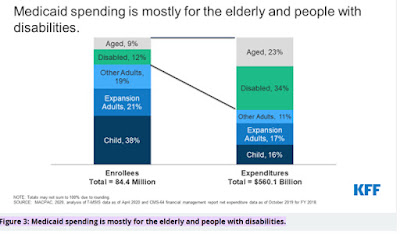
People in nursing homes are very vulnerable. That is why they are in nursing homes. Even the best ones face problems with staffing, a big issue in any industry owned by profiteers since the best way to fix this is to hire more staff and pay them better and the prescription for “success” by investors is to have fewer staff and pay them less. Such problems, however, are generally even greater for those nursing homes that care for patients on Medicaid, who include the always-poor and the even larger number of “never-were-poor-before-but-are-now-after-trying-to-pay-for-long-term-care”. While the large majority of people on Medicaid are young women and their children (Medicaid, a federal/state partnership, makes it exceedingly difficult for single adults or men to receive benefits in most states), the large majority of its spending is on the aged and disabled requiring long-term care including in nursing homes. (Medicare, the federal program for aged and disabled people, does not generally pay for nursing home care, except a few days after some hospitalizations.) The Kaiser Family Foundation notes that although only 5.5% of Medicaid recipients are in nursing homes, they account for 34% of its spending.

This lesson is a key one to keep in mind: everyone does not (and should not) use an equal share of health care, or account for an equal share of healthcare costs. Sick people cost more. Sicker people cost even more. Most people are not sick or costly in any one year. The aged, disabled, and those who have multiple chronic diseases are the sickest and among the costliest, and that is not most of us. The rest of us are not in that group until we are, either from gradually entering it as we age or suddenly falling into it from an accident or developing cancer. In general, not just nursing homes, about 3% of people account for 50% of health care costs and about 50% of the people account for 5% of costs. (see my post “Red, Blue, and Purple: The Math of Healthcare Spending”, Oct 20, 2009. It hasn’t changed much.)

Nursing homes are not the only healthcare institutions being turned over to “private equity”. Medicare, the most important health care funding advance of the last century, has been especially under attack. Traditional Medicare (TM) has two components; Part A, which pays for hospitalizations, is paid for by the Medicare Trust fund (your paycheck deductions), and Part B, which pays for outpatient care, by monthly premiums paid by recipients. Part C, now known as Medicare Advantage, is a privatized version of Medicare which, if you choose it, puts you essentially in an HMO, for good and bad. The good, the “advantage” is that it usually pays for all your hospitalization (TM only pays 80% of its approved charges, requiring most TM recipients to have a “Medicare supplement” insurance plan), and gives other services, including (sometimes) hearing and vision care, and even gym memberships! The bad is that, as in an HMO, you have a limited choice of doctors and hospitals, and except in an emergency they are usually in a limited geographic area. The worse is that these plans, mostly owned by insurance companies and increasingly by private equity, are only required to spend 80% of their premiums on actually delivering health care (and they pad even this with non-healthcare expenses, including executive salaries). The worst is that they don’t want you if you are sick (and thus will cost them money); those gym memberships cost little but hospitalizations cost a lot! They have many ways of encouraging healthy seniors to sign up (“cherry picking”) including lots of TV commercials, and even more inventive ways of discouraging sick people from staying in (“lemon dropping”). The money from this and other policies that funnel your taxpayer dollars to private companies is addressed in detail by former CIGNA executive Wendell Potter in his Substack where he documents how 72% of United Health’s income is from public funds!

The newest wrinkle, particularly good for private equity (and bad for Medicare recipients) is called Direct Contracting Entities (DCEs). These were created to address the problem investors had with Medicare Advantage identified above, that is, the ‘if you choose it’ part. Because with DCE you don’t have to! The DCE contracts with your primary care physician (or usually the company or health system that employs them; the physician often doesn’t even know about it!) and then all those physician’s patients are enrolled in the DCE even though they may not know it! This allows the private equity company to collect your Medicare $$ without your permission! And they have even addressed another ‘problem’: the DCE can keep 40% of your Medicare money as profit! What a deal! (BTW, this program will be renamed REACH in 2023, so don’t be confused. And Accountable Care Organizations, ACOs, have many of the same characteristics.)

So, look at how good this is! We get the government out of providing efficient cost-effective care by both starving the agencies for funds and encouraging (by $$) private investments. It works great! Well, for the investors. For you, probably not so much. But there is also a good chance it is working for your senators and representatives who may not only be getting campaign contributions, but even have stock in these companies.

We NEED a single-payer program that covers EVERYONE, such as an improved (covers every necessary service 100%, no 20% copay). We do NOT need scams such as Medicare Advantage and DCE/REACH that move us in the wrong direction!

Tuesday, December 22, 2020

Protecting the community: Essential workers, nursing homes, and the incarcerated

The COVID-19 pandemic continues, resurging across the US and in many other places. Different strategies have been adopted in different places, with varying degrees of success in slowing the spread of infection and death. This should provide us with information on what works well, and what strategies we should be adopting. For one example, family medicine colleagues in São Paulo, Brazil, report on their experience in nursing homes in the Royal Australian Journal of General Practice. They used public health management techniques including no visitors, rigid use of testing, recommended PPE and isolation, and others, as well as medical management and psychosocial management working with families and patients to help them through this process. They have had only 4 cases in the last 90 days (as of the November publication date), no people in isolation, and a low death rate.

 In Arizona, as in the US, case rates and mortality continue to rise.  We have more cases than ever, and fewer hospital and ICU beds. The state has chosen to address this issue by lifting restrictions on businesses, opening restaurants, bars, salons and gyms. Based on all evidence from everywhere, this is likely to further increase infections and deaths (“Health chief changes benchmarks so no Arizona business will be shuttered in pandemic”.)

Thie new policy is clearly in response to business owners concerned about their livelihoods and the probability that they will even survive. This is a real problem for them, and for us, in the horrific economic downturn that has accompanied the pandemic for most people (for major investors, however, the stock market has done well). Pima County, where Tucson is, has taken a more aggressive and restrictive approach; after more than 320 cases reported among county employees, including the chief health officer, it has furloughed 20% of the work force for 3 weeks. Of course, this will be an economic hardship for those people’s families.

Thus we have the situation where we know what to do to prevent increased infections and deaths, but have to also address the serious financial impact on regular people who lose their jobs and businesses and incomes. Sadly, efforts to reopen have been almost linearly associated with increased infection rates and deaths. The efforts taken by our Brazilian colleagues were effective in an important and high-risk, but ultimately limited, venue, that of nursing homes. The fact that the increased infection and death rate in our communities will take its greatest toll on the elderly and those with chronic disease, not those whose exposure to others in workplaces, schools, and meetings (although they are also at risk, and not immune) makes it even more complicated. The leadership at the federal level, sometimes inaccurately described as “lack of leadership” when in fact it is actively leading us in entirely the wrong direction, is making things much worse, and creating and exacerbating an incorrect understanding of the disease among many people.

Those who work in high-risk occupations, who cannot “phone (or Zoom) it in” but rather have to be present, most often among the lowest paid, those who live in multi-generational and multi-family households, are paying the highest price. These people are not only members of racial and ethnic minority groups, but those groups are far over-represented in their numbers. A recent article in the New York Times again makes the point that Black and Latinx people are hardest hit, not because of any genetic or biologic reason but because of their social and economic situation resulting from centuries of structural racism. Race, it is clear but requires repeating, is a social, not a biological construct. The negative impacts on health, income, longevity, education, and everything else is not from “race” but from “racism”; indeed, the only significance of “race” is that it is the basis for racism.

Now there is a vaccine (actually, two, maybe soon three, vaccines) and administration of them is rolling out, especially in the wealthy countries that have acquired most of the doses (of course, in the US the Trump administration jeopardized this by passing on an opportunity to acquire more doses of the Pfizer vaccine, and this was certainly not to help out the poor parts of the world!) The debate now moves to who should get it first and in what order. In most places in the US, priority is going to health care workers and nursing home patients, which makes sense. They are, respectively, the most likely to contract and transmit the infection and the most likely to die from it. And then? Who? Those with the highest risk or those with the best connections? In many hospitals we hear reports of the C-suite executives (the “front office”) being at the front of the line for vaccine, despite the fact that they do no health care. Nice of them to want to “model” behavior, but the vaccine should go first to those who see patients. The priority should be those who not only interact with the public, but who cannot do their jobs if they don’t actually show up for work, and among those, people who would be the worst off if they lost their jobs (and those who have already been laid off but might be able to come back and begin working again). The last would be those who can continue to work from home, or are retired without major health risks, and can continue to isolate themselves.

Another major group that is finally getting some media attention, even if it is unlikely to get much vaccine, is the incarcerated population. The AP reports that “1 in 5 prisoners in the US has had COVID-19, 1,700 have died”. This could be predicted; it is a group crowded together, unable to isolate, often with pre-existing conditions, and essentially without agency – they have to do what they are told. There are, broadly, two reasons for immunizing them. The first is human – they are human, and they are at very high risk, and they are already being punished; they should not be further punished by getting this disease. The second is practical; prisoners are not, actually, entirely separate from the rest of the population. In addition to guards and others who move between the inside and the outside, many prisoners are released; this is most especially true for jails, where the length of stay is short (usually awaiting a court appearance for those who cannot post bond), and thus is really part of the community from which inmates come – and go back to. Nathaniel Lash makes this case convincingly in the New York Times Sunday Review, “The coronavirus has found a safe harbor”. For example,

Cook County Jail was the site of the largest detected outbreak in the country early in the pandemic. In recent weeks, it has exceeded that — there were 340 active cases among inmates on Dec. 16. The population, meanwhile, has returned to levels typical before the pandemic, about 5,500 people.

We should have fewer people in jail.  It is outrageous that people are incarcerated because they cannot pay bond, overt discrimination against the poor, and cannot afford to support the very politically powerful bail-bond industry. This was true before COVID, and is more true now. ‘“There’s no question with a new peak in infections that we have to be decarcerating now,” said Dr. Emily Wang, the director of Yale School of Medicine’s Health Justice Lab. “If we don’t have larger-scale decarceration efforts, we won’t control Covid.”’ The answer is bail reform that corrects these inequities – vicious inequities with frequently fatal outcomes. But the opposition continues to cloak itself in the mantle of morality rather than greed, public safety rather than racism. ‘“We’re seeing the extent of the opposition to bail reform: They so strongly oppose it they will do it in the face of a pandemic,” said Andre Segura, legal director for the American Civil Liberties Union in Texas.’

The US incarcerates more people than anywhere in the world, a lot for relatively minor drug offenses. This does not prevent crime, especially violent crime, and it continues to rise even as crime rates decrease. In 2020 it is out of control, it is inhumane, and it is a significant cause of the spread of COVID. 

We need to get the vaccine out there soon, especially to those at highest risk of both dying and transmitting it to others. Clearly, the incarcerated population must be included.


Total Pageviews