Showing posts with label DCEs. Show all posts

Friday, September 16, 2022

"Private Equity": Profiteers in nursing homes, Medicare Advantage, DCEs, and all of healthcare

What happens “When private equity takes over a nursing home” is the subject of a recent New Yorker article. What happens is not pretty, at least not if you are concerned about the care of the people housed in it. Presumably it is good for the private equity investors, if all they care about is making money (probably). Compared to the days when the particular home examined in the article was run by the Catholic order of Little Sisters of the Poor, it is more crowded, more poorly staffed, dirtier, and the people living there are sicker, get less care, and are more likely to die. Good thing it is making money for the investors!

Private equity, a bland-sounding term for ‘rapacious profit-seeking capitalist investors’, is taking over a lot of things these days, in healthcare and in other areas formerly run by non-profits or government, as well as traditional businesses. Sometimes this is occasioned by circumstances largely outside “the market” or government policy, which is true (to a degree) in this case -- fewer women are becoming nuns, and the “10 sisters to a home” ratio that they aimed for became impossible to keep up. Sometimes it is “the market”, without outside interference (hard to come up with these examples). Sometimes it is a result of government policy, driven by people (largely but not only Republicans) who believe anything run by the government is bad and should be run privately, and probably anything run by a non-profit would be run better by a profit-seeking company. They are starry-eyed idealists who actually believe this despite all the evidence to the contrary. Much or most of the time it is a combination of the last two, that is market forces created by government policies that give tremendous advantage to profit-seekers, including direct subsidies of public funds and freedom from the restrictions placed on non-profits and government agencies themselves. The most common form of the latter in government, of course, is to starve the budgets, underfunding public agencies so that the public gets legitimately upset by the lack of service, and “private equity” rides in like a “white knight” to save the day.

Of course, it almost never works. That is, if “works” means “performs the ostensible functions of the company or agency better”. That they almost never do, and they also almost never save money, and almost always end up costing more – paid either the taxpayer or ratepayer or public that purchases their product. If by “works”, however, we mean “makes money for the investors”, it frequently does. This scenario plays out across many industries and formerly public functions, but it has a particularly bad smell when the “product” that is being invested in and turned over to profiteers is people, and people’s health.

People in nursing homes are very vulnerable. That is why they are in nursing homes. Even the best ones face problems with staffing, a big issue in any industry owned by profiteers since the best way to fix this is to hire more staff and pay them better and the prescription for “success” by investors is to have fewer staff and pay them less. Such problems, however, are generally even greater for those nursing homes that care for patients on Medicaid, who include the always-poor and the even larger number of “never-were-poor-before-but-are-now-after-trying-to-pay-for-long-term-care”. While the large majority of people on Medicaid are young women and their children (Medicaid, a federal/state partnership, makes it exceedingly difficult for single adults or men to receive benefits in most states), the large majority of its spending is on the aged and disabled requiring long-term care including in nursing homes. (Medicare, the federal program for aged and disabled people, does not generally pay for nursing home care, except a few days after some hospitalizations.) The Kaiser Family Foundation notes that although only 5.5% of Medicaid recipients are in nursing homes, they account for 34% of its spending.
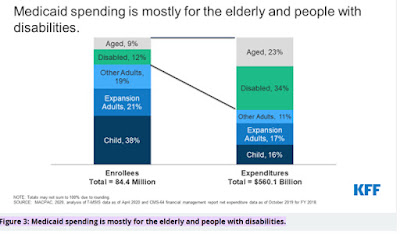
This lesson is a key one to keep in mind: everyone does not (and should not) use an equal share of health care, or account for an equal share of healthcare costs. Sick people cost more. Sicker people cost even more. Most people are not sick or costly in any one year. The aged, disabled, and those who have multiple chronic diseases are the sickest and among the costliest, and that is not most of us. The rest of us are not in that group until we are, either from gradually entering it as we age or suddenly falling into it from an accident or developing cancer. In general, not just nursing homes, about 3% of people account for 50% of health care costs and about 50% of the people account for 5% of costs. (see my post “Red, Blue, and Purple: The Math of Healthcare Spending”, Oct 20, 2009. It hasn’t changed much.)

Nursing homes are not the only healthcare institutions being turned over to “private equity”. Medicare, the most important health care funding advance of the last century, has been especially under attack. Traditional Medicare (TM) has two components; Part A, which pays for hospitalizations, is paid for by the Medicare Trust fund (your paycheck deductions), and Part B, which pays for outpatient care, by monthly premiums paid by recipients. Part C, now known as Medicare Advantage, is a privatized version of Medicare which, if you choose it, puts you essentially in an HMO, for good and bad. The good, the “advantage” is that it usually pays for all your hospitalization (TM only pays 80% of its approved charges, requiring most TM recipients to have a “Medicare supplement” insurance plan), and gives other services, including (sometimes) hearing and vision care, and even gym memberships! The bad is that, as in an HMO, you have a limited choice of doctors and hospitals, and except in an emergency they are usually in a limited geographic area. The worse is that these plans, mostly owned by insurance companies and increasingly by private equity, are only required to spend 80% of their premiums on actually delivering health care (and they pad even this with non-healthcare expenses, including executive salaries). The worst is that they don’t want you if you are sick (and thus will cost them money); those gym memberships cost little but hospitalizations cost a lot! They have many ways of encouraging healthy seniors to sign up (“cherry picking”) including lots of TV commercials, and even more inventive ways of discouraging sick people from staying in (“lemon dropping”). The money from this and other policies that funnel your taxpayer dollars to private companies is addressed in detail by former CIGNA executive Wendell Potter in his Substack where he documents how 72% of United Health’s income is from public funds!

The newest wrinkle, particularly good for private equity (and bad for Medicare recipients) is called Direct Contracting Entities (DCEs). These were created to address the problem investors had with Medicare Advantage identified above, that is, the ‘if you choose it’ part. Because with DCE you don’t have to! The DCE contracts with your primary care physician (or usually the company or health system that employs them; the physician often doesn’t even know about it!) and then all those physician’s patients are enrolled in the DCE even though they may not know it! This allows the private equity company to collect your Medicare $$ without your permission! And they have even addressed another ‘problem’: the DCE can keep 40% of your Medicare money as profit! What a deal! (BTW, this program will be renamed REACH in 2023, so don’t be confused. And Accountable Care Organizations, ACOs, have many of the same characteristics.)

So, look at how good this is! We get the government out of providing efficient cost-effective care by both starving the agencies for funds and encouraging (by $$) private investments. It works great! Well, for the investors. For you, probably not so much. But there is also a good chance it is working for your senators and representatives who may not only be getting campaign contributions, but even have stock in these companies.

We NEED a single-payer program that covers EVERYONE, such as an improved (covers every necessary service 100%, no 20% copay). We do NOT need scams such as Medicare Advantage and DCE/REACH that move us in the wrong direction!

Monday, February 7, 2022

Direct Contracting Entities: Scamming Medicare and you and bad for your health!

On October 25, 2021 I wrote about ‘Medicare Advantage, Direct Contracting Entities, and other scams to transfer your money to insurance companies’. In the interim, it has become clear that the impact, and even existence, of DCEs is not well known among Medicare recipients, physicians, members of Congress, and many policy analysts. Indeed, it involves a lot more than insurance companies, particularly “private equity” (a newish term for “venture capitalists” including hedge funds, that maybe sounds better). While DCEs are still an ‘experimental’ program by the Centers for Medicare and Medicaid Innovation (CMMI) it is significant that the Biden administration has continued this Trump-initiated policy. As, presumably, part of its experimental nature, it has not had much publicity; few Medicare recipients know about it and it is just getting known to Congress, particularly with Senate Finance Committee hearings on February 2, 2022. It is probably worth calling attention to again, even if this piece repeats some of what I wrote in October.

Medicare was established in 1965, and the first two cards were issued, by President Johnson, at the Truman Library in Independence, MO to Harry and Bess Truman, in recognition of Truman’s efforts to pass national health insurance during his presidency. It meant that for the first time in American history, older adults would not suffer and die just because they could not afford medical care. It remains, along with Social Security, the most popular program in the US, in every poll, by almost everyone (except of course the rich elites, who believe the best programs are the ones that funnel money directly into their pockets, but more on that later).

Medicare has been a rousing success, but there are two problems. The real and serious problem, as seen from the point of view of Medicare recipients, or for that matter anyone who claims to be a decent non-narcissistic human being, is that it does not comprehensively over health care costs. For starters, there are several important health conditions it does not cover, including vision, hearing, and long-term care. Also, even for the conditions (most hospitalizations and office visits) it does cover, it does not cover the entire cost. Generally, for hospitalization, it covers 80% of the Medicare-approved fee (which is always less than hospital charges, but which is in fact all the hospital can charge Medicare patients). This puts patients on the hook for the other 20%, which as anyone who has been hospitalized knows can be a lot of money.

The other problem, perceived as egregious by the small but powerful group of very wealthy investors (not regular people at all) is the same as with all effective government programs: it doesn’t put money in their pockets. Medicare is funded by different sources; Part A is for hospitalization and comes from the Medicare tax on your paycheck. Part B is for outpatient care and is funded from general revenue funds, plus a monthly charge to Medicare recipients (a minimum of about $135 now, which can go quite a bit higher for high-income people and be waived for low income). Part D is the drug plan that each recipient is required to buy. We’ll talk about Part C later.

Medicare, as a public (government) program that is in the business of paying for health care rather than generating shareholder profit operates very efficiently, with about a 2% overhead for administrative costs. As a taxpayer, I’d think this is good. But for the small number of powerful wealthy investors (for short, let’s call them GNPs, for Greedy Narcissistic Pukes) it represents an opportunity; if they could control it they could reap profit from it!

So, of course, while the fact that it is not making rich people even richer is not a problem for most of us, the problem we have is the solution that the government has come up with in service to the GNPs. It has been regularly altering Medicare to help them make money from it. First Congress created Medicare Part C, or Medicare Advantage (MA), which, if you choose it, basically enrolls you in an HMO. You get everything paid for plus other stuff that traditional Medicare (TM) doesn’t cover, like hearing and dental and maybe gym memberships. This is good for you provided you don’t get sick. If you do, you don’t have the choice of virtually all doctors and hospitals that you do with TM, just those “in network” (an even greater problem if you don’t spend all your time in the same area, since those networks are geographic). Also, since, if you are sick, those MA programs would just as soon you left went to TM so  they don’t have to pay your bills, and they have a variety of tricks to encourage you to do so. MA may be good for basically healthy seniors, unless they travel, until they’re not healthy. MA plans also don’t pay for long-term care – that’s expensive and would cost too much; gym memberships are cheap. And they can – and do -- pocket overhead and profits of up to 15%. (The insurance term is that their “medical loss ratio” -- the amount that they have to spend on actually providing medical care – has to be 85%, while in TM with its 2% overhead, it is effectively 98%.) Medicare Part D, the required drug coverage was another gift, this time to big pharmacies and pharmacy benefit managers (PBMs) who make big profit from them.

But wait! A lot of people were and are still choosing TM, and not all of them are the high-cost really sick people that the MA plans don’t want! While the insurance companies and GNPs are glad that they are in TM when they are sick and costly, there are still a lot of them who we could make money on. How can we do that? Well, let’s get the Center for Medicare and Medicaid Innovation (CMMI), which is supposed to come up with innovative programs that improve quality and save the government money, to implement an “innovation” that lets us pocket money from even those who chose TM! Cool! So they did, without even having to have Congress approved it. These are called Direct Contracting Entities (DCEs). If your primary care clinician is affiliated with a DCE, the DCE collects all your money from Medicare, and – this is a really good part – they only have a medical loss ratio requirement of 60%, so they can keep 40% if they can deny you enough care! A better deal (for them!) than even Medicare Advantage! And since most primary care physicians are now employees or part of large groups, the DCEs can just contract with the group, not with each physician. And even better, the DCEs, the majority of which are now owned by “private equity” (a particularly noxious form of GNP), can just buy the primary care groups! Voilà! The group is now owned by the DCE, your doctor is part of it, and you are part of it and being hosed. Your only recourse is to change your primary care doctor. Which you may not want to because you may like and trust your doctor…

Of course, the two problems I mentioned are mirror images of each other. Medicare does not pay for all your care because Congresspeople and Wise Policy Analysts say that would be bad because it would cost too much. They see it as much better to spend lots of money on further enriching the insurance companies, PBNs, DCEs, and other GNPs. Why? Because they contribute a lot of money to Congress, and because many congresspeople are heavily invested in these; often they are also GNPs, either before entering Congress or as a result of it (how they get so rich on a Congressional salary is another story).

By the way, in case I haven’t been clear in what I think, these are all both bad and evil programs, taking money that should be spent on your healthcare. They are healthcare examples of the impact of “gangster capitalism”, or in another term I’ve heard, Götterdämmerung capitalism, which describes our current situation where the GNPs would rather destroy the world that stop acquiring all its wealth. And if they are willing to destroy the world, how much weight do you think your health and life have? These programs are not developed by accident; they are purposely designed to take what you have (as in the cost of health insurance premiums) or have previously been recognized as social benefits (as Medicare) and transfer them to the richest people in society.

The only – maybe, hopefully -- good news is that Congress has recently started holding hearings on DCEs, recently by the Senate Finance Committee, with outstanding testimony by many experts including Dr. Susan Rogers, current president of Physicians for a National Health Program (PNHP), whose website has lots of good information on DCEs. At the end of the hearing, Sen. Elizabeth Warren (D, MA) urged the Biden administration in the strongest terms to have CMMI end this “innovative experiment” (or perhaps you prefer grift or scam). Maybe they will.

Let your Congresspeople know what you think. And everyone else.

Monday, October 25, 2021

Medicare Advantage, Direct Contracting Entities, and other scams to transfer your money to insurance companies

In my post DTC Advertising on TV illustrates the corruption and inequity of the US medical care system (March 6, 2021) I talked a little about advertisements for Medicare Advantage (MA), an alternative to traditional Medicare (TM, not ™) that involves an insurance company taking over your Medicare and you maybe paying additional money to, essentially, be enrolled in their HMO or PPO, with its concomitant advantages and disadvantages to you personally. Advantages include a variety of additional services that are not currently included in TM (they should be, but this is a different issue), such as vision care (or at least glasses), hearing aids, and sometimes dental care. This can save you money. The disadvantages are, essentially, the same as those for any HMO or PPO – a limited “network” of physicians and hospitals (and big charges for which you are liable if you go out of network) and, related to that, a limited geographic area in which your network applies. This is not generally a big issue for the occasional traveler (emergencies are usually covered) but can be a big problem for those who split their time between two or more areas. Plus, it doesn’t protect you from “surprise medical bills”, as they are called in Congress (which discusses them but has yet to enact anything to protect you from them). These occur when, while both your doctor and hospital are “in network”, someone else --  the ambulance company, some doctors caring for you (say, the group that staffs the Emergency Department, or the surgeon assisting your surgeon) are not. They can – and do – then send you big bills. This should be a caution.

Why I am bringing this up again now is that the pace and frequency of solicitations for people to abandon TM and enroll in MA have greatly accelerated because we have entered the “open enrollment” period, when people with Medicare can change their insurer or plan type, and the MA plans, mostly owned by insurance companies, really want you*. This is why in addition to adding more former NFL quarterbacks to their ads (Joe Theismann, who is only my age, joins the 78-year-old Joe Namath), you have (if you are of Medicare age) been getting dozens of information packets in your mail for the plans available in your area – almost all of which pick names and design their envelopes and otherwise do their best to make it look as if they are official and from Medicare (I was going to share the link to one with a name that prominently features “Medicare”, but I figured why advertise them?)  They’re not. And they’re being successful. As documented by the Kaiser Family Foundation, MA plans had an 8% increase from 2018 to 2019 and a 15% increase from 2019 to 2020. Advertising really pays off! And, boy, does it pay! Thanks to your generosity (well, Congress’ generosity, on your behalf, or at least using your money) MA plans (and, by the way, “Medicare Advantage” is the official term specified in the legislation, in case you had any doubts about the influence of insurance companies over Congress) get paid a lot more than the government pays on your behalf to TM. For starters, their administrative overhead – comparable to that of most private insurers – is about 13.2%. Is that a lot? Well, the overhead for TM is about 1.8%! Some sources have cited the overhead for “Medicare” as about 3% -- still a lot better – but that is because it is combining the two. And, of course, as MA increases as a share of Medicare that figure will continue to rise.


MEDPAC, the Medicare Payment Advisory Commission, an independent agency created by the federal government to monitor and recommend on issues related to Medicare, notes that MA plans receive more money from Medicare but spend less on providing patient care to their members, costing Medicare an additional $8B. So it is definitely worth pursuing your business! Unless, of course, and this was the reason for the asterisk (*) above following really want you, you are sick. Then you would cost them money, and they would rather that you switch to regular TM. Which would be better for you, of course, but it would have been better for you to have never been in MA. This is a core part of their business strategy: attracting healthy seniors who will not cost them much money with the lure of cheap glasses and hearing aids and such (“cherry picking”) and then getting rid of those beneficiaries who really get sick and would cost them a lot of money (“lemon dropping”). All this is an effort to improve their “Medical Loss Ratio”, which is to say decrease the % of the money that they collect which they have to spend on actually taking care of you. If it sounds weird or offensive (and it is both) that their spending money on what they are supposed to be in the business of doing is called “loss”, it is a term that comes from the overall insurance industry. The % of homeowner’s premiums that have to be paid out to clients because their homes burn down, or auto insurance premiums that have to be paid if you are in a car wreck, is called the loss ratio. Of course, you don’t expect (and certainly don’t hope) to be in a car wreck or have your house burn down, but you do (or should) expect to receive medical care. Indeed, a more apt comparison to your house burning down might be made to “major medical” – coverage for costly hospitalizations – but in fact most people will need those if they live long enough. Much more about the cost of MA and the reasons for it can be found in the Health Affairs Blog posts of September 29 (Medicare Advantage, Direct Contracting, And The Medicare ‘Money Machine,’ Part 1: The Risk-Score Game), and 30 (Medicare Advantage, Direct Contracting, And The Medicare ‘Money Machine,’ Part 2: Building On The ACO Model) by Rick Gilfilan and former CMS administrator Donald Berwick. Another article on MA can be found in Consumer Reports.

Since not everyone who would be a good health risk is forgoing TM for MA, a new scam (excuse me, option!) has been developed by CMMI, the Centers for Medicare and Medicaid Innovation, a branch of CMS, the Center for Medicare and Medicaid Services, which has been granted authority to implement such changes as they (or the insurance company lobbyists) can come up with without needing further Congressional approval. This one is Direct Contracting Entities (DCEs). A company, particularly a health system or medical group, may send people a complicated letter telling them that (for their benefit!) the group has enrolled them in a DCE. The client has the choice to opt out, but this is disguised in complex legal language, and the benefits(!) are so strongly sold, that many people do not.  Remember, this is not being sent to folks who are in MA, but those who have purposely and specifically chosen TM and NOT MA. Thus, they are not expecting that their providers will try to enroll them, backdoor, in a plan that, while it has benefits(!) – like those of MA – also lets insurance companies (wait, how di I get to an insurance company? I thought I was in TM!) collect a lot more money from CMS – like under MA! What a cool idea! If you resist MA because you are more concerned about your healthcare than insurance company profits, CMMI will find a way to allow you to help the insurance companies anyway! A lot more can be learned from a short (15 minute) youtube presentation by PNHP (Physician’s for a National Health  Plan) member Ana Malinow.

Medicare, along with its parent, Social Security, is the most popular government program in the nation, and for good reason. It actually provides important benefits to the taxpaying American people. Instead of paying out lots of extra money to Wall St. and insurance companies, Congress should expand the benefits available under TM to include all necessary health care, including dental care, vision care, and hearing care. Instead of forbidding Medicare to negotiate drug prices with BigPharma and the Pharmacy Benefits Mangers (PBMs) that control access to drugs, Congress should ENCOURAGE and REQUIRE it. Finally, it should extend all these Medicare benefits to EVERYONE in the country, not just the elderly and disabled.

This would be what the American people need.  But if you want to have this, you are going to need to shout it from the rooftops – and write letters to Congress -- to be heard over the sound of cash flowing from insurance companies into your Congresspeople’s pockets.

Then go to pnhp.org and sign the petition asking Sec. Becerra to close the DCE program!

Total Pageviews