Showing posts with label spending. Show all posts

Friday, September 16, 2022

"Private Equity": Profiteers in nursing homes, Medicare Advantage, DCEs, and all of healthcare

What happens “When private equity takes over a nursing home” is the subject of a recent New Yorker article. What happens is not pretty, at least not if you are concerned about the care of the people housed in it. Presumably it is good for the private equity investors, if all they care about is making money (probably). Compared to the days when the particular home examined in the article was run by the Catholic order of Little Sisters of the Poor, it is more crowded, more poorly staffed, dirtier, and the people living there are sicker, get less care, and are more likely to die. Good thing it is making money for the investors!

Private equity, a bland-sounding term for ‘rapacious profit-seeking capitalist investors’, is taking over a lot of things these days, in healthcare and in other areas formerly run by non-profits or government, as well as traditional businesses. Sometimes this is occasioned by circumstances largely outside “the market” or government policy, which is true (to a degree) in this case -- fewer women are becoming nuns, and the “10 sisters to a home” ratio that they aimed for became impossible to keep up. Sometimes it is “the market”, without outside interference (hard to come up with these examples). Sometimes it is a result of government policy, driven by people (largely but not only Republicans) who believe anything run by the government is bad and should be run privately, and probably anything run by a non-profit would be run better by a profit-seeking company. They are starry-eyed idealists who actually believe this despite all the evidence to the contrary. Much or most of the time it is a combination of the last two, that is market forces created by government policies that give tremendous advantage to profit-seekers, including direct subsidies of public funds and freedom from the restrictions placed on non-profits and government agencies themselves. The most common form of the latter in government, of course, is to starve the budgets, underfunding public agencies so that the public gets legitimately upset by the lack of service, and “private equity” rides in like a “white knight” to save the day.

Of course, it almost never works. That is, if “works” means “performs the ostensible functions of the company or agency better”. That they almost never do, and they also almost never save money, and almost always end up costing more – paid either the taxpayer or ratepayer or public that purchases their product. If by “works”, however, we mean “makes money for the investors”, it frequently does. This scenario plays out across many industries and formerly public functions, but it has a particularly bad smell when the “product” that is being invested in and turned over to profiteers is people, and people’s health.

People in nursing homes are very vulnerable. That is why they are in nursing homes. Even the best ones face problems with staffing, a big issue in any industry owned by profiteers since the best way to fix this is to hire more staff and pay them better and the prescription for “success” by investors is to have fewer staff and pay them less. Such problems, however, are generally even greater for those nursing homes that care for patients on Medicaid, who include the always-poor and the even larger number of “never-were-poor-before-but-are-now-after-trying-to-pay-for-long-term-care”. While the large majority of people on Medicaid are young women and their children (Medicaid, a federal/state partnership, makes it exceedingly difficult for single adults or men to receive benefits in most states), the large majority of its spending is on the aged and disabled requiring long-term care including in nursing homes. (Medicare, the federal program for aged and disabled people, does not generally pay for nursing home care, except a few days after some hospitalizations.) The Kaiser Family Foundation notes that although only 5.5% of Medicaid recipients are in nursing homes, they account for 34% of its spending.
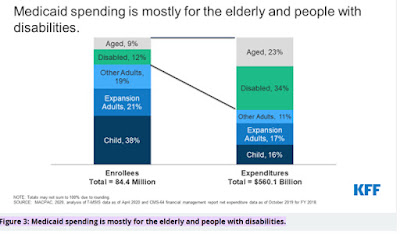
This lesson is a key one to keep in mind: everyone does not (and should not) use an equal share of health care, or account for an equal share of healthcare costs. Sick people cost more. Sicker people cost even more. Most people are not sick or costly in any one year. The aged, disabled, and those who have multiple chronic diseases are the sickest and among the costliest, and that is not most of us. The rest of us are not in that group until we are, either from gradually entering it as we age or suddenly falling into it from an accident or developing cancer. In general, not just nursing homes, about 3% of people account for 50% of health care costs and about 50% of the people account for 5% of costs. (see my post “Red, Blue, and Purple: The Math of Healthcare Spending”, Oct 20, 2009. It hasn’t changed much.)

Nursing homes are not the only healthcare institutions being turned over to “private equity”. Medicare, the most important health care funding advance of the last century, has been especially under attack. Traditional Medicare (TM) has two components; Part A, which pays for hospitalizations, is paid for by the Medicare Trust fund (your paycheck deductions), and Part B, which pays for outpatient care, by monthly premiums paid by recipients. Part C, now known as Medicare Advantage, is a privatized version of Medicare which, if you choose it, puts you essentially in an HMO, for good and bad. The good, the “advantage” is that it usually pays for all your hospitalization (TM only pays 80% of its approved charges, requiring most TM recipients to have a “Medicare supplement” insurance plan), and gives other services, including (sometimes) hearing and vision care, and even gym memberships! The bad is that, as in an HMO, you have a limited choice of doctors and hospitals, and except in an emergency they are usually in a limited geographic area. The worse is that these plans, mostly owned by insurance companies and increasingly by private equity, are only required to spend 80% of their premiums on actually delivering health care (and they pad even this with non-healthcare expenses, including executive salaries). The worst is that they don’t want you if you are sick (and thus will cost them money); those gym memberships cost little but hospitalizations cost a lot! They have many ways of encouraging healthy seniors to sign up (“cherry picking”) including lots of TV commercials, and even more inventive ways of discouraging sick people from staying in (“lemon dropping”). The money from this and other policies that funnel your taxpayer dollars to private companies is addressed in detail by former CIGNA executive Wendell Potter in his Substack where he documents how 72% of United Health’s income is from public funds!

The newest wrinkle, particularly good for private equity (and bad for Medicare recipients) is called Direct Contracting Entities (DCEs). These were created to address the problem investors had with Medicare Advantage identified above, that is, the ‘if you choose it’ part. Because with DCE you don’t have to! The DCE contracts with your primary care physician (or usually the company or health system that employs them; the physician often doesn’t even know about it!) and then all those physician’s patients are enrolled in the DCE even though they may not know it! This allows the private equity company to collect your Medicare $$ without your permission! And they have even addressed another ‘problem’: the DCE can keep 40% of your Medicare money as profit! What a deal! (BTW, this program will be renamed REACH in 2023, so don’t be confused. And Accountable Care Organizations, ACOs, have many of the same characteristics.)

So, look at how good this is! We get the government out of providing efficient cost-effective care by both starving the agencies for funds and encouraging (by $$) private investments. It works great! Well, for the investors. For you, probably not so much. But there is also a good chance it is working for your senators and representatives who may not only be getting campaign contributions, but even have stock in these companies.

We NEED a single-payer program that covers EVERYONE, such as an improved (covers every necessary service 100%, no 20% copay). We do NOT need scams such as Medicare Advantage and DCE/REACH that move us in the wrong direction!

Sunday, December 18, 2011

To improve health the US must spend more on social services


That the US spends far more, in total and per capita, on health care than any other country is a well-established fact which no one bothers to deny. That this expenditure has not brought us greater health is also established fact, although many still find this hard to believe, or don’t want to believe it. That we do not have the “best health care system in the world”, or even close, or even, actually, a health care system at all, is also demonstrably true. This does not stop a larger percent of the population, and particularly the very privileged sector represented by politicians, from maintaining that untruth.

However, in a provocative op-ed in the New York Times (“To fix health care, help the poor”), Elizabeth H. Bradley and Lauren Taylor argue that it is only when health care is viewed in its most narrow sense that the US spends more than other countries. Their study of 30 countries expenditures, “Health and social services expenditures: associations with health outcomes”[1], “…broadened the scope of traditional health care industry analyses to include spending on social services, like rent subsidies, employment-training programs, unemployment benefits, old-age pensions, family support and other services that can extend and improve life.”

Essentially, their data shows that having services available to people that improve the quality of their lives, or, more important, decrease the negative health impact of the adverse circumstances into which they are born, develop, and live, lessens disease burden and improves health. This then decreases the costs of providing medical care to them. For example, they note, “The Boston Health Care for the Homeless Program tracked the medical expenses of 119 chronically homeless people for several years. In one five-year period, the group accounted for 18,834 emergency room visits estimated to cost $12.7 million.”

Bradley and Taylor indicate that among industrialized countries, the US ranks #10 in total health + social service spending , and is one of only 3 that spend more on health care than on all other social services. This means that, in addition to not getting the preventive or early-intervention health care that they need, Americans are at higher risk of illness and more ill when they come to medical attention. They may not be homeless, although obviously this dramatically increases their risk. People may not have adequate food, not have adequate warmth (see the discussion of “excess winter deaths” in Michael Marmot, the British Medical Association, and the Social Determinants of Health, November 1, 2011), not had a safe environment. They likely had far too little income. Many of them are children, and many of those, and often their parents before them, have had an inadequate education. A large number of the determinants of health are antenatal, and many more are in the early years of life. The other group at high risk of both adverse health outcomes and the poverty-related social deficits that influence them, are the elderly. So what do we see in the US? Threats to cut Medicare, cut Social Security, cut education.


This wouldn’t affect everyone equally, of course. Only the most vulnerable. Or, at least, the more vulnerable. The wealthy, of course, are unlikely to be inadequately housed, inadequately nourished, inadequately educated, and, in a tautology, inadequately employed. Another recent study, from the Organization for Economic Cooperation and Development (OECD), called “Divided we stand: why economic inequality keeps rising”, demonstrates rising inequality in income as indicated by the difference between the income of the top 10% and bottom 10%. “The income gap has risen even in traditionally egalitarian countries, such as Germany, Denmark and Sweden, from 5 to 1 in the 1980s to 6 to 1 today. The gap is 10 to 1 in Italy, Japan, Korea and the United Kingdom, and higher still, at 14 to 1 in Israel, Turkey and the United States. In Chile and Mexico, the incomes of the richest are still more than 25 times those of the poorest, the highest in the OECD, but have finally started dropping. Income inequality is much higher in some major emerging economies outside the OECD area. At 50 to 1, Brazil's income gap remains much higher than in many other countries, although it has been falling significantly over the past decade.”


In the report’s “country note” on the US, it observes that “The United States has the fourth-highest inequality level in the OECD, after Chile, Mexico and Turkey. Inequality among working-age people has risen steadily since 1980, in total by 25%. In 2008, the average income of the top 10% of Americans was 114 000 USD, nearly 15 times higher than that of the bottom 10%, who had an average income of 7 800 USD. This is up from 12 to 1 in the mid 1990s, and 10 to 1 in the mid 1980s….Income taxes and cash benefits play a small role in redistributing income in the United States, reducing inequality by less than a fifth – in a typical OECD country, it is a quarter. Only in Korea, Chile and Switzerland is the effect still smaller.” Of course, comparing deciles is deceiving; as the Occupy Wall Street movement emphasizes, the concentration of wealth is in the top 1%, and economist and NY Times columnist Paul Krugman (“We are the 99.9%”, November 24, 2011) and others point out that most of that wealth in the US is in the top 0.1%! The wealthiest 400 families in the US own as much as the bottom 50% of the population.


One obvious result of the rising inequality in the US is the increase in the overt control that this wealthy class exerts over the political process, through direct lobbying, political contributions, employment after and between stints of government service, and control of media. The “corporate personhood” decision by the US Supreme Court in Citizens United simply codified and protected this inequality. But income inequality in itself is not sufficient to lead to the destruction of the social safety net that exposes increasing numbers and percents of people to ravages that adversely affect their health. It also requires extreme selfishness and disrespect, so that billionaire people and corporations pay little in tax, and governments are purposely squeezed so that they have neither the will nor the resources to provide services.


The findings of Bradley and Taylor are not news to the public health community, of course, which is very familiar with the social determinants of health and the positive impact that investment in basic social supports has on the health outcomes of both populations and individual people. Investment is required to see future benefit, and the investment that we need, and are not making, is in education, is in nutrition, is in housing. It is far more than a shame. It is shameful.  


[1 Bradley EH, Elkins BR, Herrin J, Elbel B.,Health and social services expenditures: associations with health outcomes, BMJ Qual Saf. 2011 Oct;20(10):826-31. Epub 2011 Mar 29

Total Pageviews