Friday, October 13, 2023

Self-centered Syllogism: Bad in public health, bad anywhere

I recently met someone who had seen a couple of my blog posts, was interested in public health, and asked a few interesting questions. My answers – or, really, comments – were things I have said and written about before, but his questions forced me to put them together, and in my opinion, the issues bear repeating.

The first question he asked was “why do we put so much emphasis on smoking but not on alcohol? After all, smoking never caused someone to beat their children or spouse, or to drive impaired and have an accident, or get into a bar fight and beat, shoot, or stab someone else.” That is true, and it raises the issue of the impact of substance abuse on the individual versus on the society (although second-hand smoke causes a lot of deaths). But the real answer is the incredible mortality caused by smoking. The CDC page identifies tobacco as the cause of nearly a half-million deaths in the US annually. While the data is from 15-20 years ago, and (hopefully) the mortality rate from tobacco has decreased as its usage has decreased, this is an astonishing statistic. Deaths from tobacco exceeded the total of deaths from alcohol, plus illegal drugs, plus accidents, plus homicides, plus suicides. It remains, even as smoking has decreased, a major health problem. The CDC says, “Tobacco is the leading cause of preventable mortality in the United States”. It was, therefore, the focus of public health efforts because of its tremendous impact on mortality.

However, of course, alcohol is also a major problem, causing both death and severe morbidity (bad outcomes besides death). It is, as my questioner noted, highly associated with violence against both family members and strangers, with automobile deaths, with homicide and not-homicide violence. It also, of course, kills people who use it, from diseases such as cirrhosis and heart disease as well as many cancers that are more common in heavy drinkers. We all have heard someone who did something very bad (commit violence against family members or strangers, have a car wreck, etc.) say “It was the alcohol. I wouldn’t have done it if I were sober”. But they were not sober, they had been drinking, and probably had often been.

The American Addiction Centers alcohol.org estimate that 88,000 people die from alcohol-related violence and abuse and accidents. The site also notes that “The American Society of Addiction Medicine notes that between 28% and 43% of violent injuries, and 47% of homicides, alcohol has been estimated to be involved.” That is a lot, and it could be an underestimate, but it is the closest I can get to quantifying the attributable risk for violence from alcohol. The concept of “attributable risk” in public health can be understood as the percentage of “bad outcome X” that would go away if “risky behavior Y” went away. This is different from the amount that it increases an individual’s risk; some behavior “Y” may increase your risk a lot but, because it is relatively uncommon, account for less attributable risk. Examples include asbestos and lung cancer (very high increase in risk but a lower percent of cases, compared to smoking). Or, looking at it inversely in terms of what disease a risk factor causes, smoking and lung cancer vs. heart disease. Smoking increases the risk of lung cancer more than it does heart disease, but because heart disease is so much more common, the attributable risk from smoking, the number of lives that would not be lost if people didn’t smoke, would be more from heart disease than lung cancer. An example of “smaller percentages of larger numbers can be greater than larger percentages of smaller numbers”.

So what did I say about alcohol? He identified the fact that there is a very large industry of alcohol manufacturers and sellers, which have great influence. I noted that there was (is) also a great industry of tobacco manufacturers and sellers. He said that in addition to the manufacturers, there were also many businesses, restaurants and bars whose existence depended on the sale and use of alcohol. The current emphasis we see in “alcohol reform” is “don’t drink too much”, a common “PSA” from alcohol manufacturers. The implicit message, however, is “do drink!”.

I think most of the members of our society, including many of those still smoking, recognize that any amount of smoking is bad for you, and more is worse, but I do not think that the same is true for alcohol use. The general attitude, even among medical and public health professionals, seems to be “a lot of drinking is obviously bad, for you and for others, but a little – like I do – is not.” What could be wrong with a couple of beers? A couple of glasses of wine? Especially if you’re not driving? Aren’t there studies that show a little red wine is good for you?

There are such studies but they are dated, poorly done, and wrong. Pretty much, while more is worse, there is no amount of alcohol consumption that is good for your health, and any amount is somewhat bad. We disparage those who use other drugs (heroin, cocaine, crack, meth, even still cannabis) for entertainment, but much of our society is actually built around alcohol as the “social lubricant”. Restaurants, bars, parties. Family events like weddings and funerals. Most of such entertainment revolves around alcohol. Perhaps the only place where alcohol is not the key component of “having fun” would be at an AA meeting! This issue is seriously joined by Holly Whitaker in her book “Quit Like a Woman: The radical choice not to drink in a culture obsessed by alcohol”.

The key here is that so many people drink (if “responsibly”, by which they usually mean “not too much” and “not when driving”) that they have to justify themselves by saying it is OK. I call this the “Dirk Gently Phenomenon” from Douglas Adams’ book “Dirk Gently’s Wholistic Detective Agency”. The lead character, who dies on the first page, was a millionaire who made his money by essentially developing syllogisms that took you from the data you had to the conclusion you had foreordained (his biggest client was the US Department of Defense). This is pretty much what we do in lots of areas, including alcohol use; we decide on what we want the answer to be and then look for evidence that supports it.

My new friend noted his son had been in a public health program a few years ago when the big emphasis was on obesity and its health effects. I nodded, but it not so much any more. Obesity has big health effects, yes, but it is also easy to disparage people who are overweight. This is a manifestation of another common tendency among people (including among health professionals): to be critical of people who do (or don’t do) things that come easily to you to do or not do, and conversely minimize the significance of the negative behaviors that you do (or don’t do). If you are naturally thin and have an no difficulty keeping weight off, it is easy to criticize those who are overweight. However, if you like your fancy wine or craft beer or expensive single-malt scotch, you don’t think drinking is such a bad thing. Or, for that matter, being self-righteous.

Public health is good and important. In the US, it is grossly underfunded compared to individual medical care (about 1% of health care dollars). But, like much of medicine it is also subspecialized. To a large degree, public health researchers go where the money is available for grants – in obesity, or smoking, or violence prevention, etc., and become specialists in that area. It is (or should be) different in primary care. As a family doctor, I can measure and counsel you on your blood pressure, but I cannot ignore your diabetes or lung disease and just refer you to another specialist. Similarly, while public health specialists “do obesity” or “do child seats”, this is not an option for the family physician. I need to help you to stop smoking, but cannot ignore that you need to use a seatbelt. Or get vaccinated. Or would have a greater probability of better health outcomes if you lost some weight. Or did not drink so much. Or at all.

Judging others for doing (or not doing) what we find it easy to not do (or do) and minimizing the damage caused by what we ourselves do is a big logical flaw, as is the “Dirk Gently” fallacy. They are not attractive, appropriate, or helpful or good for anyone, and are especially dangerous coming from medical or public health professionals.

Thursday, September 28, 2023

Primary Care, Private Equity, and Profit: How to ensure poor quality care for the American people

 I -- and many others -- have written (frequently and recently) about the abuses of for-profit companies, and especially private equity companies, and “non-profits” that act like for-profits in health care (Private equity, private profit, Medicare and your health: They are incompatible, May 11, 2023; Privatizing Medicare through "Medicare Advantage" and REACH: The Wrong Way to Go!, Jan 20, 2023; "Private Equity": Profiteers in nursing homes, Medicare Advantage, DCEs, and all of healthcare, Sept 16, 2022). But despite our efforts, it doesn’t get any better. Indeed it gets worse.

Drs. David Himmelstein, Steffie Woolhandler, Adam Gaffney, Don McCanne, and John Geyman, have been leaders in the campaign for a national health insurance plan (e.g., Medicare for All), published an article 18 months ago in ‘The Nation’ (March 31, 2022) titled ‘Medicare for All is Not Enough’. They go through the ways in which the ownership of our health system has changed, particularly over the last decade, to focus on profit for the private owners rather than “health care”. That is to say, while a single-payer Medicare for All program would be a great thing and would limit the negative impact that for-profit insurance companies wreak on our collective health – which is considerable – as long as for-profit companies continue to own, and to increase their share of, our actual health delivery systems (hospitals, nursing homes, pharmacies, and physician practices) there will be terrible consequences, with those single-payer dollars flooding into investors’ pockets rather than patient care.

Insurance companies like United Health and giant pharmacy firms like CVS own large portions of our practice and health delivery sector. And the role of private equity companies and investors, with their “buy ‘em and burn ‘em” approach to acquisition and profit, in taking over our delivery system is at least as terrifying. As the authors state:

At least UnitedHealth and CVS plan to stay in business for the foreseeable future, and may be constrained by the worry that substandard care will damage their reputation. Private equity companies face no such constraints. They promise investors quick profits, and often sell off the businesses they’ve bought within five years, often after stripping their assets and loading them with debts that hobble future operations.

On top of who will own our care provision, there also is the issue of who will provide the care. Most developed countries, with more rational health delivery systems, rely on primary care physicians and other clinicians far more than the US does. In those other countries primary care is at least 30-40% of the physician workforce, while here it is closer to 20% and dropping, an issue I have written about often (see, for example, What is the problem with Primary Care? The US health system!, March 22, 2022).  Primary care clinicians – family physicians, pediatricians, and general internists, and the NPs and PAs who work with them – can provide not only cost-effective care but care that is comprehensive, continuous, and reassuring to people and families because they know the person who is providing it and have a relationship with them. And the cost-effectiveness is not (only) about the fact that they earn less money (see below) but because they are in a position, as a result of taking care of the “whole person” and having a long term relationship, to more wisely utilize resources when necessary. Nonetheless, there is a definite shortage of primary care clinicians, as anyone who has tried to find one recently, because they moved, or their physicians retired or had their practice bought out by a large company like Optum (a subsidiary of United Health Care, which has become UHC’s major profit center as documented by former insurance executive Wendell Potter in his “Health Care Un-covered” substack) or, sometimes in response, went into a “concierge” or “boutique” practice, can testify. Elisabeth Rosenthal, editor of Kaiser Health News, documents this in a recent piece in the Washington Post, “The Shrinking Number of Primary Care Physicians is Reaching a Tipping Point”. She notes that “fewer medical students are choosing a field that once attracted some of the best and brightest because of its diagnostic challenges and the emotional gratification of deep relationships with patients.” And she makes the important point that

One explanation for the disappearing primary-care doctor is financial. The payment structure in the U.S. health system has long rewarded surgeries and procedures while shortchanging the diagnostic, prescriptive and preventive work that is the province of primary care.

Don’t forget that one. Rosenthal discusses the terrible experience of colleague Bob Morrow, MD, who, under financial pressure, finally had to sell his decades-old practice, and then, watching how the new owner ran it (suffice it to say, not in the best interests of the patients), leave medicine. Morrow is not a depressed person, but reading about what has happened to him and thousand of other primary care doctors is enough to make you depressed.

In a data-driven “Report Card” on primary care in the US, the Milbank Memorial Fund ranks it poorly on all front, although not on the quality of the physicians:

This first national primary care scorecard finds a chronic lack of adequate support for the implementation of high-quality primary care in the United States across all measures, although performance varies across states. The scorecard finds:

1.      Financing: The United States is systemically underinvesting in primary care.

2.      Workforce: The primary care physician workforce is shrinking and gaps in access to care appear to be growing.

3.      Access: The percentage of adults reporting they do not have a usual source of care is increasing.

4.      Training: Too few physicians are being trained in community settings, where most primary care takes place.

5.      Research: There is almost no federal funding available for primary care research.

The  report card, created for Milbank by the Robert Graham Center (the policy arm of the American Academy of Family Physicians, AAFP), not only identifies these deficits, but also the importance of solving them for the health of the American people. 100,000,000 people without a primary care doctor, only able to see a physician (if they can see any physician) who has a narrowly focused, disease-based practice is a real problem. We need those specialists for when we are diagnosed with a particular condition that requires their expertise, but they are often not knowledgeable about conditions outside it. Moreover, the primary care clinician does not only care for many conditions; much more important is that they care for the person who has those conditions.

The report also endorses the conclusions from the National Academy of Science, Engineering, and Medicine (NASEM) from 2021, recommending that the US:

  1. Pay for primary care teams to care for people, not doctors to deliver services.
  2. Ensure that high-quality primary care is available to every individual and family in every community.
  3. Train primary care teams where people live and work.
  4. Design information technology that serves the patient, family, and interprofessional care team.
  5. Ensure that high-quality primary care is implemented in the United States.

Finally, for the moment, an effort is actually being made in Congress to try to increase the number of primary care clinicians.  In an uncommon bipartisan effort, the bill is cosponsored by Bernie Sanders (I, VT), chair of the Senate HELP Committee and Roger Marshall, MD, an OB/GYN and conservative Republican from Kansas, as reported by Jake Johnson in Common Dreams, Sept 14, 2023. It’s a good thing to have bipartisan support, but it is, sadly, unlikely to have a major effect on increasing the primary care physician supply. Funding in the bill – about $6 billion -- goes mainly to Community Health Centers (CHCs), especially Federally-Qualified Health Centers (FQHCs). These centers can be, and usually are, good. They provide care to lower-income people and communities where access to other clinicians is difficult. Republicans like them because they are not actually “government” programs, but responsible only to their boards of directors. But, while they often rely heavily on primary care, and expanding them will increase the number of jobs for primary care clinicians, it does nothing to increase the supply of those clinicians, to convince medical students to enter family medicine, pediatrics, and general internal medicine instead of much higher-paying subspecialties.

I mention money, the Milbank report mentions money. It is a lot about money. It is increasingly difficult to convince students to enter fields where their income is likely to be a fraction of that of subspecialists (even if much better than that of most Americans), especially in the context of huge educational debt (frequently over $250K), and the lack of respect given by the medical profession and often the society at large to primary care. And, not at all to be minimized, the takeover of so many practices by for-profit corporations and private equity, with situations like Dr. Morrow’s becoming the norm rather than the exception. Some subspecialties make 2-3 or more times that of primary care doctors, which makes it increasingly difficult for students to decide to enter primary care. And while some of these subspecialties have grueling work hours (e.g., general surgery) others have much more circumscribed work hours, often shift work and little call.

There IS certainly something the federal government could do. The Center for Medicare and Medicaid Services (CMS) sets the relative reimbursement for physician services (office visits, procedures, etc.) and virtually all private insurance companies reimburse based on multiples of the Medicare rate (traditionally more, but now often less). So all CMS has to do is to revise its fee schedule, increasing the relative value of primary care visits relative to procedures. Of course, there will be great opposition from other specialists; indeed the “RUC”, a non-government committee that advises CMS on this ratio is completely dominated by subspecialists (Changes in the RUC: None.. How come we let a bunch of self-interested doctors decide what they get paid?, July 21, 2013). CMS is not required to follow the recommendations of the RUC although it usually does; CMS could ignore or adjust what the RUC recommends, or reconstitute the membership of the RUC to have more primary care doctors. Primary care physicians do not need to make as much as the highest-paid subspecialists (indeed neither do those subspecialists!) but the difference needs to be decreased. Studies have indicated that if primary care doctors earned 70% of what subspecialists do, income would no longer be a significant factor in specialty choice.

Addressing this income gap is critical for increasing the number of primary care clinicians. Then there is a lot else to do, like getting for-profit corporations and private equity out of healthcare altogether.


For a “humorous” depiction of the takeover of primary care by for-profit companies like Optum, check out this short piece by the brilliant Dr. Glaucomflecken: https://twitter.com/i/status/1706339952857149895

Sunday, September 3, 2023

The problems with our US 'Healthcare' system are well documented. We need to start with the solution!

Many sources of news have provided information that should be shocking on the abuses of the US “healthcare” industry. They include newspapers like the New York Times, Washington Post and the Guardian, non-profit policy organizations like the Commonwealth Fund and the Kaiser Family Foundation (KFF), and many smaller podcasts, substacks, and blogs (well, like this one). The rapacious profit-taking by corporations from dollars ostensibly allocated to provide our healthcare by the federal and state governments (through Medicare and Medicaid), our employers and, not least, ourselves, is regularly siphoned off for profits and administrative costs (like multi-million dollar C-suite salaries).

That this continues to happen and is built into the way our “system” (or better “non-system”) works seems to completely mystify our government and policy wonks. Their response is a hodge-podge of regulations that seek to try in some way to limit the negative health effects of our system, and to limit the number of people who are unable to access care because they have little money, no insurance, poor quality insurance, or have been excluded for reasons such as prior disease. The obvious solution – one single-payer health insurance system that automatically includes every single person of every age – has been anathema to them, despite the overwhelming evidence of it being pretty successful in every other developed country. And, even when far from perfect, always better than the US in terms of health access, health outcomes, and cost. We presume the reason is, essentially, corruption – that, as a result of getting fat and wealthy at the public (and our private) trough, these corporations give lots of money to politicians.

Just a few recent examples of what is wrong with not having single payer:

·        The NY Times reports on a “glitch” in many states incorrectly disenrolling children from Medicaid. Whoops.


·        The Healthcare Un-Covered substack takes a good long look a the practices of health insurance companies.

In the “good old days”–let’s call that period pre-2008–the majority of commercial insurance was full-risk: increases came out of payor profitability rather than employers’ and consumers’ pockets, and patients were protected from high out-of-network/out-of-pocket costs. In 15-20 years, everything has changed.  A lot.

Sure has. Its “poster child”, United Health Group, makes lots of money on its insurance business per se, denying people (whether on “regular” insurance or on Medicare-substitute plans like Medicare Advantage). Even more, it is making its most money on its owned physician practice subsidiary, Optum, as well as their pharmacy benefit mangers, using what is called “intercompany eliminations” to have one of its subsidiaries pay more to another of its subsidiaries than to competitors. Plus the Optum practice groups do not have the caps and regulations affecting the insurance group.

Practically, this means UnitedHealth Networks can pay its own physicians, UCCs, ASCs and the care delivery sites it owns above market rates–through something called intercompany elimination–then starve other providers with low rates. This accomplishes two things: it makes the starving providers more likely to sell their practices to Optum, and it allows UnitedHealth to post amazing profitability and stay under federal MLR caps. This is what we call “a good problem” in business.

Good problem for United Health. Big, bad problem for everyone else, including the providers in other groups and mostly the people (that is the English word for “patients”) who seek care.

·        The administration announces the first 10 incredibly-overpriced drugs that Medicare will negotiate the prices of.  Allowing Medicare to negotiate drug prices is one of the most popular issues in the US, across party lines; KFF found ‘in a survey late last year, 89 percent of Democrats and 77 percent of Republicans said they favored the plank of the Inflation Reduction Act that authorizes negotiations.’ Pharmaceutical companies of course push back, with completely bullshit claims that it will limit the number of new drugs. What it will, of course, threaten, is not whether they make a profit, but only the incredibly amount of money these companies are raking out of the economy in grossly excess profit. One good example of the vicious, avaricious abuses is found in The Lever, “Big Pharma’s American Con”, documenting how they rip us off while charging much less in the regulated environments in other countries.

·        The new administration regulations on nursing home staffing have angered both the operators (whose costs will go up, and also have trouble finding staff – at the salaries they pay) and the patient-advocacy groups who point out that they are far too little (patients have to be seen by someone 33 min a day??).

·        And on and on.

What do all these issues – and many more -- have in common? Well, of course, they are manifestations of insatiable and unregulated greed by corporations, and the willingness of our government to allow money that is supposed to be for our health go into corporate pockets. But they also have in common the fact that they can only exist in the absence of a single, rational, health insurance system for the American people. What can we do? We can – and I have, in this post and in many others – document and decry the absolute ripoff of the American people. For example, Medicare Advantage, which is great if you are pretty healthy and doing well, but not so much if you are sick and they deny you care, that are funded (even overfunded, paid more per recipient than is given to traditional Medicare) with the dollars that you have contributed over your working life to the Medicare trust fund. Of course, it is facilitated by the revolving door with government functionaries who are supposed to be regulating them but don’t, and facilitate their greed, and are rewarded by leaving the government and going to work for them for beaucoup bucks. One example is Billy Tauzin, the former Louisiana congressmen who chaired the committee that passed Medicare Part D and included a prohibition on Medicare negotiating drug prices, who became CEO of PhRMA. Or Tom Scully, the Center for Medicare and Medicaid Service director who oversaw  the development of privatized Medicare, who went on to join a major health private-equity firm and made out like the bandits he and they are, as detailed in American Prospect. The list of what is wrong seems endless.

So, I think, it is time to stop leading with all the skullduggery, rapacious, thievery, failure of public trust, and outright killing of people, and start with the solution. A single-payer health system. Everybody in, nobody out. Birth to death. No one is excluded, and no one can be “thrown out”. It covers the same things for everyone, regardless of income. If it is something people need for their health, it is covered; if it is unneeded, frivolous, or harmful it is not. Glasses, hearing aids, mental health, dental, long-term care. No out of pocket costs.

How can we pay for this? See above, all the money going to not-health-care. It would cost much less! Do not let your legislators off the hook. For example, Phoenix congressmen Ruben Gallego has co-sponsored Medicare for All legislation for years. Now he is running for Senate against wolf-in-sheep’s-clothing Democrat-turned-Independent Kysten Sinema and whatever yahoo the GOP drags up. But this year he has not signed on to the Medicare for All bill, HR 3421. I have made it clear in response to his daily solicitations that unless he does, no more money from me.

Demand a universal healthcare insurance system. Now.

Tuesday, August 22, 2023

Older adults cannot afford healthcare even if they are insured: Time for a new system!

Are health insurance companies the real enemy of Americans’ health? A strong argument can, and has been, made by myself and others that they are. More broadly, however, the enemy is all the companies that pursue making money as their primary goal, with providing healthcare a sideline (albeit a costly one). So many corporations are involved and responsible that it is hard to be sure that insurance companies are the main ones at fault. “Even” actual health care providers – mainly hospitals and “health systems” – try to squeeze out the poor and poorly insured and greatly prefer to deliver only the most high-profit-margin care. And, certainly, one cannot leave out the drug companies, making gigantic profits at the cost of our health (they remain #1 in profits, every year), or the less-well-known but also very dangerous “PBMs”, pharmacy benefit managers, who bundle our drug plans, and act as middlemen between the insurers and the drug companies and the providers. (You notice I didn’t say “consumer” or “patient”; they are no more than grist for the profit mill!)

But one can still make a strong case for insurance companies being at least a major cornerstone of the evil empire, sucking money out of government coffers, employer contributions, and, yes, your pockets, for the privilege of denying you care and padding their bottom lines. Long noted for their unwillingness to cover everyone, the insurance industry is moving the needle by providing poor coverage even to those it does insure. Two recent studies have looked at the financial burden on older adults provided by health care, one at those with private insurance and the other at those with Medicare.

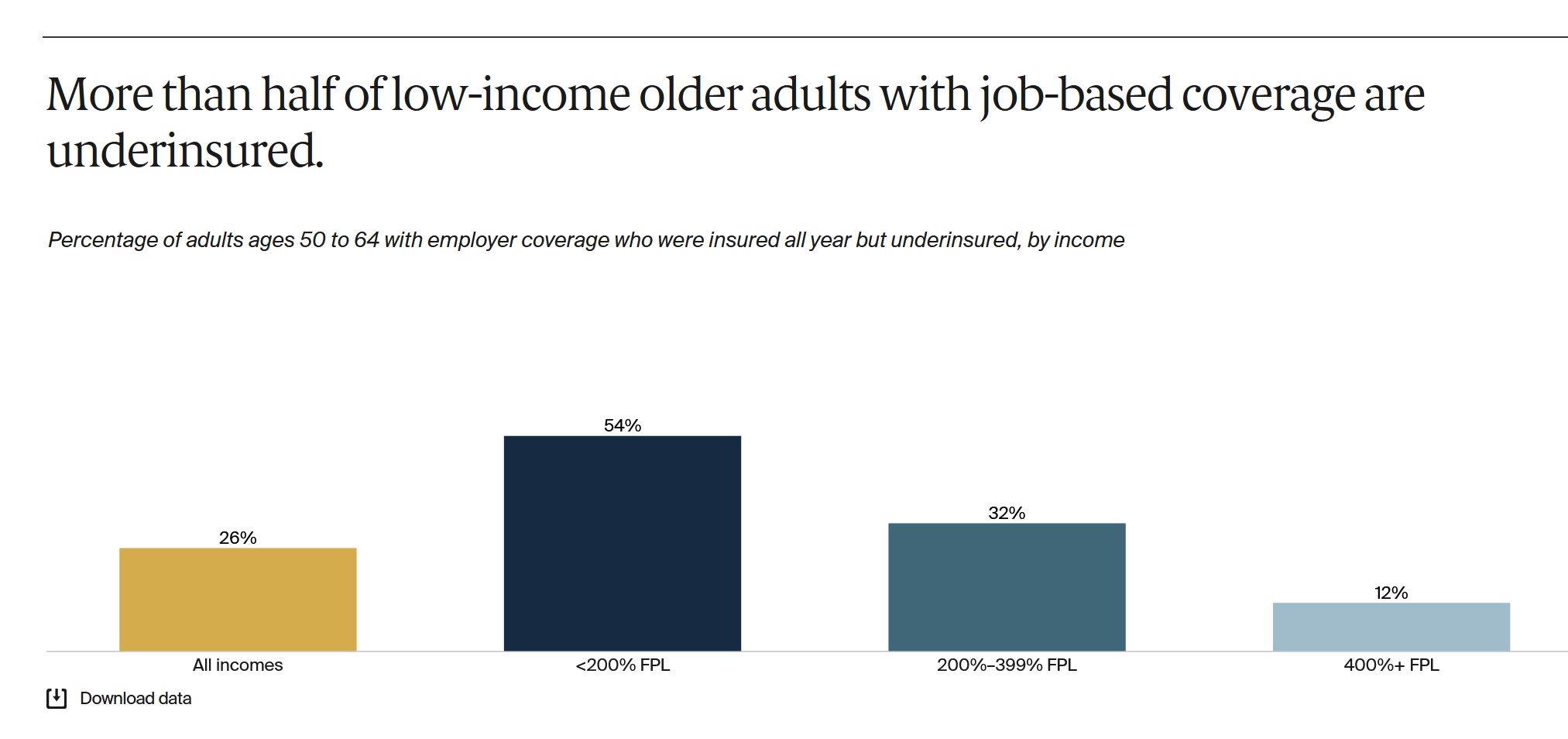
The Commonwealth Fund looked at the coverage and costs for older-but-not-yet-Medicare adults 50-64 in ‘Can Older Adults with Employer Coverage Afford Their Health Care?’ by Lauren A. Hayes and Sara R. Collins (August 10, 2023). A majority of these folks have private insurance through their employers (55%) with higher income (>400% of the Federal Poverty Level, FPL) at 82% and low income (<200% FPL) at 22%. It wasn’t enough. More than half of low-income and more than 1/3 of middle income (200-400% FPL) people had difficulty paying their premiums and didn’t get adequate medical care because of the cost. Unsurprisingly, those worst affected were not only low-income but sick; the issue of paying for health care is greatest when one has health problems.


The Kaiser Family Foundation study, ‘Medicare Households Spend More on Health Care Than Other Households’, by Nancy Ochieng, Juliette Cubanski, & Anthony Damico (July 19, 2023) examined adults over 65, those on Medicare. They found – well, what the title says. Again, not surprising; older people are sicker, and sicker people use more healthcare (duh!) and it costs them more. While Medicare is a federal government program, there are still out-of-pocket costs associated with it. For hospital care (Medicare Part A, funded by your paycheck deduction), traditional Medicare (TM) pays only 80% of approved charges, which means sick Medicare recipients have to come up with the other 20% (which can be a huge amount of money) or have a Medicare-supplement policy to cover it, which of course costs additional premiums. Medicare recipients also have to pay a monthly fee for Medicare “Part B” (the “outpatient” portion) which usually is deducted from their Social Security payments. At least this is tiered, so higher income people pay more and lower income less (or sometimes nothing). Also they have to pay for a drug plan (Part D). 


About half of Medicare recipients are now in “Medicare Advantage” (MA) plans, which are essentially HMOs. I have written about them previously, but because they are not actually Medicare (although paid for with Medicare dollars) but private insurance, they have the ability to deny coverage altogether. They have good perks if you don’t need expensive care (often no co-pays, no 20% coinsurance, drug coverage so no need for a separate Part D plan, coverage for some things TM doesn’t cover like glasses and hearing aids) which make them attractive to healthier seniors. But while TM covers (if only at 80%) the things it says it covers, and doesn’t deny individuals, MA can and does. So while Medicare Advantage can be advantageous for some seniors, its greatest advantage is to the insurance companies.

Indeed, that some people are better off with one type of plan and others with a different one is both understandable and OK. But that the difference is whether you are sick or not is dangerous, since the non-sick can quickly become sick, especially if they are elderly. That we try to segment public opinion by pitting the sick against the not-yet-sick (“I’m doing ok, and can afford my premiums and healthcare, for now”) is what is truly sick, and intolerable. It is a marker of a reprehensibly designed system.

The authors of the Commonwealth Fund report have a number of suggestions for addressing the problems that they identify, all of which are tweaks to our current system, and, in the unlikely event that they were implemented, would immediately be “gamed” by the power players – the insurance companies and the health systems – to ensure that there would still be lots of people left out, lots of people suffering. Their suggestions do not entail scrapping the entire for-profit insurance system that strangles the health of our people in favor of an adequately-funded single payer system, but rather the creation of new programs, and new rules to try to limit the damage caused to the health of older Americans by a system that simply should not exist

Seniors can be attracted to MA plans because of the costs TM doesn’t cover, especially the 20% of hospital bills. Those in MA plans, as well as those “younger” – still employed – older people in employer-based insurance plans can be financially screwed because those plans are operating with the goal of making money for the companies, not ensuring health care. The fact is that both problems could be addressed together – by getting rid of the profits and costs of insurance companies, enough money could be saved to cover 100% of all health care needs for Medicare recipients. One could say this is “ironic”, if it weren’t for the fact that irony implies lack of intentionality, and this criminally flawed and abusive system is clearly intentionally structured.

Dr. Don McCanne, who reported on this in his recent “Health Justice Monitor”, writes

Should that be the primary mission of our health care administrators? Of course not! Their primary mission should be to move health care to the people, the patients, all of the patients, and they need to use our health care dollars to do that. Our current system has demonstrated beyond any doubt whatsoever that private administrators have been and always will be on the wrong mission, and we need to replace them with public administrators who will always pursue a mission for the public good.”

Yes. Stop trying to make deals with the devil. Those companies, including insurance companies, taking money intended to provide healthcare as salaries and profit are evil, and it is hard to think of the legislators and executive-branch functionaries who facilitate and enable this as anything else.

Our government should use its (ie, our) money to fund our promises for healthcare to our seniors, not insurance companies who pay them back with graft.

Wednesday, August 2, 2023

US Maternal Mortality Rate Exemplifies Moral Bankruptcy of Our Health System

My friend, Dr. Don Frey, recently published America’s DWP Crisis: Dying While Pregnant (DWP) on his blog, “A Family Doctor Looks at the World”. It leads with shocking and distressing statistics about the US maternal mortality rate, which has long been the highest in the “developed world” and has been steadily increasing. Citing a recent article in JAMA, Trends in State-Level Maternal Mortality by Racial and Ethnic Group in the United States (LG Fleszar, AG Bryant, CO Johnson, July 3, 2023), he  points out that in the 20 years from 1999 to 2019 US maternal mortality more than doubled (it actually went up 2.5 times):

In every corner of the country, for every ethnic group, outcomes worsened.  By 2019, deaths per 100,000 pregnancies (the benchmark measure) had increased from 12.7 to 32.2.  For Black and American Indian women, the picture was much worse.  Their mortality skyrocketed to 55.4 and 49.2, respectively.

And this doesn’t even include deaths from accidents and homicide – the latter being the #1 cause of death for pregnant women in the US!

Let’s stop and think about that. In the rest of the OECD (Organization for Economic Cooperation and Development, = wealthy) countries maternal mortality is going down. For the most recent reported years, it ranges from about 1.6 to 8.8, with most below 5. When we were at 12.7 we were way out of the picture. Now we are at 32.2! And our rates for minority women are like poor countries! Even though the maternal mortality rate is high and rising for all races and ethnicities, it is made even higher by the ridiculously high rates for some populations. In what conceivable way could this be compatible with the US having “the best healthcare in the world”, or anything approaching it? Only if you accept the definition of “well, the best healthcare is available for some people, who can afford it, but not even for most Americans”.

Dr. Frey points to several reasons why our “DWP” (and our dying-while-recently-pregnant, ie, post-partum) rate is so high, and they are valid, and addressing them would certainly significantly lower it. The major one is what we often refer to as “the social determinants of health”. This is a fine term, except it has almost become routine to cite them while we, as a country, continue to do little or nothing to address them. People are much more likely to have poor health status if they are financially poor, poorly nourished, poorly housed, poorly educated and live with ongoing danger and the fear that comes from it. And when those bad things happen in childhood, their risk continues higher for the rest of their lives. We call this “ACEs”, Adverse Childhood Events, and the higher number and degree of ACEs, the worse the outcome for not only those children but for the adults that they will become. Thus a person who grew up poor is likely to have worse health status as an adult than a neighbor who did not grow up poor, even if they end up with similar incomes and lifestyles. In addition to the ACEs that have their origin in poverty, there are others, ranging from growing up in a family with adults who abuse alcohol and other drugs, to parents’ divorce, to death of a parent, to physical and sexual abuse, that can occur in any socioeconomic group.

Dr. Frey also cites the number of states that have passed – and implemented – “anti-woman” laws, usually under the guise of being “anti-abortion”. While the legislators who propose and vote for them, and the state governments implementing them, would deny that they are anti-woman, the facts speak otherwise. A good example that Dr. Frey discusses, is

Last year in Missouri, for example, the legislature debated whether to outlaw surgery for ectopic pregnancies (an embryo that implants in the fallopian tube instead of the uterus), even though such pregnancies are 100% non-viable.  Apparently, the near-certainty of a mother’s tubal rupture, internal bleeding, sepsis, and death, wasn’t particularly important.

That law has not passed (so far) but many others have so limited access to abortion that women have to travel very far, have waiting periods, get illegal abortions, and otherwise risk their lives. Despite the ostensible justification for anti-abortion laws is to protect the “unborn”, the result is to increase the risk to fetuses, newborns, and their mothers. Dramatically.


There are also medical and healthcare factors that contribute to the maternal mortality rate in this country. As much as the social determinants of health, and anti-abortion anti-woman laws, contribute to the problem, medical care can make a difference. But too many women are not able to access good medical care for their pregnancies and births, in the prenatal and especially in the post-partum period. Among the important factors are the number and type of providers, geographic distribution of those providers, preference of providers for the kind of care that they want to do (or not do), and the ownership of practices and hospital by corporations that are interested mainly in money-making.

Let’s look at providers. Usually we think of obstetricians (OB-GYNs) as the people who deliver babies. And they do. Or at least many of them do. Actually, a minority, decreasing in % as they age. Doing gynecologic surgery is much more lucrative, and doesn’t require getting up at all hours to do deliveries. Plus, like most specialists, they are concentrated in urban (but not poor or inner-city) and suburban areas. So access to them is limited, especially geographically and financially. Certified Nurse-Midwives (CNMs) and family physicians also deliver babies, but often have the same “lifestyle” disincentives. Nurse-midwives are by definition about delivering (or “catching”) babies but usually are subservient to the dictates of the OB-GYN community. OBs probably do not mind if CNMs -- or family physicians -- deliver babies where the OBs do not want to be (rural and inner-city areas) but training programs may not have enough deliveries to allow them to learn. While nurse-midwives are a separate profession, their training may not strongly encourage them to assert themselves in practice.

And there is huge gap is in post-partum care. It is not uncommon for OBs (and, perhaps, others) to believe their job is done when the baby emerges, or at least when the woman is discharged. But as Dr. Frey’s piece points out, a very large number of maternal deaths take place in the post-partum period, up to 6 weeks after delivery, from bleeding, infection, and other causes that could be identified with the kind of close follow-up that too frequently does not occur. Not to mention identifying the risks for homicide (and suicide) in the situation in which the women lives.

Finally, but far from least important, is the structure of the medical care system. I have written extensively in previous blog posts about how hospitals and medical practices are run as businesses, to make money, rather than as facilities dedicated to improving the health of communities and the people in them. Birth, and the accompanying circumstances including maternal mortality, make a particular case. The businesses, as well as the physicians who work for them, are interested mainly in providing care when and where it is relatively easy and most profitable. This is understandable, but it is unacceptable. It is, at bottom, the cause of all the other problems. Receiving care for childbirth –including the prenatal and postpartum periods, as with all necessary medical services, should not be treated as luxury goods.

It may be OK that some people have a Lexus or Tesla, others a Toyota or Chevy, and still others an old clunker, while many have to walk or ride the bus. But it is not ok for healthcare, and specifically not childbirth. Women need to have access to excellent care no matter how much money they have or where they live.

That they do not is yet another indictment of a system built on profit rather than health.

Sunday, July 23, 2023

Why are we paying wealthy corporations billions to limit our healthcare?

In an excellent “Guest Essay” in the New York Times (July 18, 2023) Linan Eirav and Amy Finkelstein ask a very important question: ‘We’re Already Paying for Universal Health Care. Why Don’t We Have It?’ It is a question that many people, including me, have asked many times over many years. This article answers several important concerns. One, as indicated in the title, is that the economic argument against it (“It will cost too much”) is nonsense, as we (the US) already pays more from public funds (per capita and overall) than other countries that have universal healthcare coverage. This has been documented for decades by authors such as Woolhandler and Himmelstein; when we consider Medicare, Medicaid, government employees and retirees at all levels, military retirees and families, and (least obvious) the lost revenue from the taxes not paid on employee health insurance contributions by employers (when it would be if it were salary) it is not only more than other countries pay for covering everyone, it is more than half US health expenditures.

The authors emphasize that while the emphasis is often on those Americans who are uninsured (and despite decreases as a result of the ACA, it is still far too many), there is also great suffering and uncertainty among those who have health insurance. This is because 1) their health insurance may be of poor quality, not covering all their health needs, and subject to the whims of insurance company denials, and 2) because there is uncertainty about whether they will continue to have it. The former is a real concern:

Many insured people still face the risk of enormous medical bills for their “covered” care. A team of researchers estimated that as of mid-2020, collections agencies held $140 billion in unpaid medical bills, reflecting care delivered before the Covid-19 pandemic. To put that number in perspective, that’s more than the amount held by collection agencies for all other consumer debt from nonmedical sources combined.

And the latter, losing health insurance, can be because temporary government programs end or because employer coverage (and amount of employee contribution) changes. Or because the requirements for qualifying for many programs can leave people out because they didn’t know they were eligible, because they weren’t aware of or able to fill out the paperwork, or for many other reasons. The most simple, profound, and perhaps important paragraph in the article is:

The risk of losing coverage is an inevitable consequence of a lack of universal coverage. Whenever there are varied pathways to eligibility, there will be many people who fail to find their path.

This is incredibly important. The risk of losing coverage is an inevitable consequence of a lack of universal coverage.  The cobbling together of different mechanisms for covering different groups of people (employer based insurance, various government funded insurance, self-pay, etc.) intrinsically leaves the opportunity for people to lose their insurance coverage. Only one solution prevents this, one so subtle and elusive that every other wealthy – and most middle income – country in the world has done it: cover everyone. Period. No qualification, no sign-up, no criteria, and preferably in one program. Just cover everybody. You are American, you are alive, you are covered.

That would take care of who is covered – everyone – but in itself is insufficient, as the coverage must be good coverage. It must pay for all needed healthcare and none that is unneeded. Thus, if we were to accomplish this by passing Medicare for ALL, that Medicare program would need to pay 100% (not 80%) of what is covered and cover all health needs include mental health, eyeglasses, hearing aids, and long-term care, without payments from users at the time of service. Unlike Eirav and Finkelstein, I do not think that the best answer is to provide basic coverage to everyone and allow wealthier people (or their employers) to purchase “upgrades”  as if it were an airline. Indeed, the best way to ensure that poor, uneducated, or unempowered people get the coverage and care that they need is to require the wealthy, educated, privileged and empowered to be in the same program. They will make sure that it works for them, and that will mean it works for everyone. The “upgrades” (if you like that term) should only be to allow people to purchase things they’d like but are not medically needed (most commonly cited is purely cosmetic surgery).

The money is there. It is currently going into the pockets and profits of insurance companies and pharmaceutical manufacturers (see, for example, How a Drug Maker Profited by Slow-Walking a Promising H.I.V. Therapy in the Jul 22, 2023 NY Times). Their greed is without limits. As I have discussed (Why do drugs cost so much? And what can we do about it?, Apr 18, 2023) Medicare is the only drug purchaser in the US with sufficient clout to negotiate down drug prices (other than the VA and TriCare, which already do). In response, the administration has carried through with its promise to the American people to let it do so, originally forbidden by the pharma-supported legislation creating the Medicare drug program, “Part D” (Fantastic (& fantastical) hospital charges: The industry + insurers + Pharma making money hand over fist!, Mar 26, 2023). This is  incredibly popular among Americans of all political persuasions, but not, of course, among the drug companies, who the NY Times reports are going all out to keep us paying the highest drug prices in the world (Drugmakers Are ‘Throwing the Kitchen Sink’ to Halt Medicare Price Negotiations, NY Times, Jul 23, 2023).

The money is also there and being pocketed by the owners of hospitals, health systems and practice groups, whether for-profit (often owned by private equity) or ostensibly non-profit but making and socking away money hand over fist. It is outrageous, but these companies are able to limit people’s access to healthcare and provide administrative or paperwork obstacles that discourage access, as shockingly demonstrated in another recent article by Chavi Karkowsky, (NY Times July 20, 2023), The Overlooked Reason Our Health Care System Crushes Patients. In discussing how her patient almost died because of the bureaucracy, Karkowsky says

This is the story of our medical system — quick, massive, powerful, able to assemble a team in under an hour and willing to spend thousands of dollars when a patient is sick.

This is also the story of a medical system that didn’t think my patient was worth a $12 medication to prevent any of this from happening.

This patient’s story is a result of the space between the care that providers want to give and the care that the patient actually receives. That space is full of barriers — tasks, paperwork, bureaucracy. Each is a point where someone can say no.

Why should we want to say no? In a rational system, everyone would be eligible and get the same benefit. No obstacles are necessary. Then the money we already spend would not only get us better healthcare, it would leave enough left over to begin to ensure that people have sufficient housing, food, and education.

All that would suffer would be the already bloated wealth of billionaires and huge corporations. And that should have zero weight.

Total Pageviews